
 Μake us preferred on Google
 The government has completed a new spatial planning framework that will determine where wind turbines and solar installations can be built for the foreseeable future, with the final version leaving the plan’s core restrictions largely untouched. Environment and Energy Minister Stavros Papastavrou has signed off on the new planning framework, which is expected to be published in the Government Gazette, within days. Officials familiar with the final text say most of the late changes were corrections and clarifications rather than a change in the plan’s underlying approach.
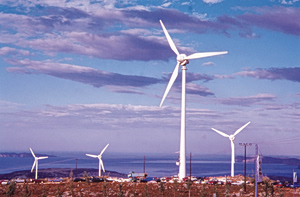
The core restrictions on wind power appear to have survived intact despite strong objections from the industry. A cap on turbines above 1,200 meters in elevation remains, as does a rule that closes off most of the Greek islands to new wind farm development. What still matters for the market is how the framework defines Suitability Areas, the specific zones where wind installations are permitted; how it treats Natura 2000 protected areas; and how its transitional provisions handle projects that are already well into the licensing process.
A narrower test for where wind farms can be placed
The plan reached its final form after review by the National Spatial Planning Council, which weighed in following public consultation, and approval from the Central Council for Spatial Planning Issues and Disputes (KESYCHOTHA), before the minister made the final decision.
Among the individual adjustments to the text, one concerns the definition of Suitability Areas, the zones where wind installations are allowed under specific conditions. The original draft measured wind potential at the level of the municipal unit, a broader administrative area, rather than at the specific site of a proposed project. A site could only qualify if the average wind speed across that entire municipal unit exceeded 4 meters per second.
That standard had drawn criticism from the industry, since a site with high wind potential could still be excluded if it sat within a municipal unit whose overall average fell short. The revised version, if it holds in the final published text, is expected to widen the land available for wind farm development, without altering any of the plan’s other spatial or environmental restrictions.
Wind Farms: just 13 islands remain open
For Greece’s islands, the restrictions remain unchanged. Sources at the Ministry of Environment and Energy say the plan still bars new wind installations on islands smaller than 300 square kilometers, one of the most consequential decisions in the entire framework.
Combined with a separate spatial plan covering tourism development, that rule sharply limits where new wind farms can be built on Greek islands. In practice, only 13 islands remain open to new wind farm development: Lesvos, Chios, Limnos, Samos, Thasos, Karpathos, Rhodes, Andros, Naxos, Kefalonia, Lefkada, Evia and Crete.
What will happen in Natura zones
It remains unclear whether the government adopted a recommendation from the National Spatial Planning Council concerning Special Protection Zones within the Natura 2000 network. The council had proposed dropping the current rule, which allows wind farms to be sited only where wind potential exceeds 7.5 meters per second, and judging each site instead through the required environmental studies.
If that change makes it into the final text, it will shift the basis for approval from a fixed technical threshold to case by case environmental review, a change likely to draw renewed objections from the wind power industry.
Power lines through protected land under review
The same emphasis on environmental protection extends to the infrastructure that supports renewable projects, particularly power lines that cross protected areas. It is not yet known whether the minister adopted the spatial council’s recommendation for stricter conditions, which would permit such lines through protected land only when specifically justified by required studies.
The issue has gained urgency after this year’s destructive wildfires in Attica and Boeotia, which reopened debate over the role of the electrical grid in causing fires. The spatial framework cannot override rights already granted under existing legislation, but it can set stricter conditions on how new infrastructure is sited going forward.
That question is tied to a separate proposal from Greece’s Regulatory Authority for Waste, Energy and Water. The authority is reviewing a five year investment plan submitted by HEDNO, the Hellenic Electricity Distribution Network Operator, and has proposed burying privately owned medium voltage lines that connect wind farms and currently run above ground through forested land. The plan would prioritize Evia, Boeotia, the eastern Peloponnese and Thrace, all areas identified as fire risks.
The provision that matters most to investors
The framework’s transitional provisions remain its most closely watched section, and individual adjustments there are still possible. The original draft exempted from the new restrictions any project that had already secured environmental approval by May 20, 2026. Industry groups had asked for that cutoff to be moved instead to the date the new framework takes effect. A later cutoff would protect more projects that are currently in advanced stages of licensing.
The final wording of that provision matters greatly for investors. It will decide how many projects keep operating under the existing rules and how many will have to adapt to the new restrictions, and it is the clearest sign of how the government is weighing tougher rules for future projects against protection for investments already well into the licensing process.
Solar faces the same restrictions
The picture is similar for solar power. Changes sought by the industry do not appear to have been adopted. According to the same sources, blanket bans on solar installations across all Natura 2000 areas and forest land remain in place, producing an equally strict siting framework for solar as for wind.
The complete picture will only be confirmed once the new framework is published in the Government Gazette, which will set out the exact final wording and the changes the renewable energy industry will need to work with.
Source: OT.gr