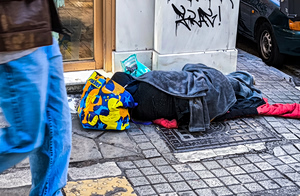
Behind every person living on the streets of Athens is a different story, highlighting the complexity of a homelessness crisis shaped by financial hardship, unemployment, rising housing costs and social challenges.
A new survey conducted by the City of Athens in cooperation with the Department of Social Policy at Panteion University has provided new insight into the characteristics of people experiencing homelessness in the Greek capital.
The survey was carried out in October 2025 as part of a wider European research initiative involving 35 European Union cities with populations of more than 200,000 residents. In Greece, the study was conducted by Panteion University’s Department of Social Policy with the support of social workers, civil society organizations and volunteers.
The aim was to identify the main challenges linked to homelessness and provide data that could support future policies addressing the issue.
Who are Athens’ homeless residents?
The survey recorded 681 people experiencing homelessness in the Municipality of Athens. Of those, 384 were identified on the streets and 297 through support organizations.
The figures do not include people living permanently in apartments or supported housing facilities.
Men account for the majority of those recorded, representing 71% of the total, while women make up 29%. Most respondents were Greek citizens, accounting for 69.9%.
The survey also shows that homelessness in Athens mainly affects middle-aged and older adults. Around 62% of those recorded were over the age of 50, while people under 30 represented less than 8% of the total.
At the same time, nearly two-thirds (65.8%) live alone, without the support of a partner or family network.
Homelessness often becomes long-term
The research highlights that homelessness in Athens has become a chronic social issue for many people.
More than half of those surveyed had been without independent housing for more than two years. Around 31.6% had experienced homelessness for more than five years, while 24.9% had been without stable housing for between two and five years.
The findings indicate that many people facing homelessness are not experiencing a temporary housing crisis but a prolonged situation requiring long-term support.
Financial problems are the main cause
Economic difficulties were identified as the leading reason people lost their homes.
Around 72.2% of participants said financial problems were the main factor behind their loss of housing. Other major contributing factors included health issues and addiction-related problems (37.9%), as well as family difficulties (30.2%).
The results show that homelessness is linked to multiple and interconnected challenges, rather than a single cause.