 Μake us preferred on Google
 One of the strangest objects ever spotted by the James Webb Space Telescope may point to a new stage in the evolution of supermassive black holes.
Astronomers have gathered strong evidence for the existence of a so called “black hole star,” a black hole surrounded by gas so dense and hot that, from far away, it looks like a giant star.
The case rests on two particularly important James Webb observations. The first is MoM-BH*-1, an extremely red object that already existed just about 660 million years after the Big Bang.
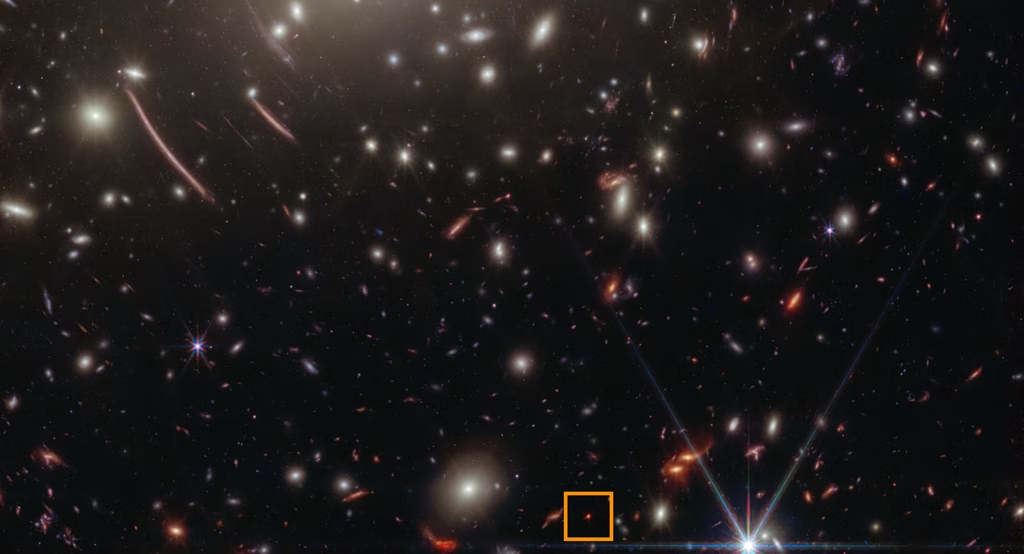
The second, GLIMPSE-17775, offers the most detailed spectrum of a “little red dot” obtained so far and strongly reinforces the same interpretation.
James Webb Deep Field showing GLIMPSE-17775 in the bottom right. Image Credit: NASA, ESA, CSA, Vasily Kokorev (UT Austin); Image Processing: Alyssa Pagan (STScI)
What Is a “Black Hole Star”?
The term sounds contradictory, but it describes a specific theoretical model.
At the center of the object sits a black hole growing rapidly as it absorbs matter. Around it lies an extremely dense shell of gas. The radiation produced near the black hole does not escape directly into space. Instead, it is absorbed and re-emitted by the gas, so the whole system looks from a distance like a giant star.
It is not, then, a star in the classic sense. Its energy does not come from nuclear fusion, as in the Sun, but from matter falling toward the black hole.
The Reddest Object Yet Seen by James Webb
MoM-BH*-1 was spotted as an extremely bright red spot in James Webb’s data and lies in the constellation Cetus. Its light has traveled to us from a time when the universe was still very young, about 660 million years after the Big Bang.
The object has a strikingly red appearance, and its emission shows a sharp change below a specific wavelength. These traits were among the reasons it caught researchers’ attention.
The team that studied the object, led by Rohan Naidu of the MIT Kavli Institute for Astrophysics and Space Research, argues that its spectrum does not fit easily into any of the known categories of early universe objects.
An Object That Looks Like a Star But Behaves Like a Black Hole
The observations show an object with features resembling a stellar atmosphere, but with energy behavior pointing to a black hole.
That is the central puzzle scientists are trying to solve.
Computer simulations show that a black hole surrounded by extremely dense layers of gas can produce a spectrum resembling that of a very large star. The gas essentially acts as a “shell” that transforms the light coming from the central black hole.
The idea isn’t limited to a single object. If the interpretation holds up, it could explain a significant share of the mysterious population of “little red dots” that James Webb has revealed.
The Second Object Provides The Strongest Evidence Yet
Especially significant is GLIMPSE-17775, studied by a team led by Vasily Kokorev of the University of Texas at Austin.
The object sits behind the galaxy cluster Abell S1063, and its image is amplified by gravitational lensing. The cluster’s gravity acts like a natural magnifying lens, letting James Webb pick up details that would otherwise be very hard to detect.
Webb captured a 30 hour spectrum which, thanks to gravitational lensing, is equivalent to roughly 80 hours of observation. Scientists identified more than 40 spectral lines, more than any other little red dot found so far.
A “Forest” of Iron Lines Reveals What’s Happening Inside
Among the most important findings are 16 iron lines, which the researchers describe as an “iron forest.”
The hydrogen, oxygen, and helium lines also don’t fit a simple model of a rotating gas cloud. The best explanation involves a dense shell in which light is scattered by electrons.
The picture that emerges is one of a powerful energy source at the center, most likely a black hole accumulating matter at a very fast rate, wrapped in a dense gas shell.
Why “Little Red Dots” Puzzled Astronomers
Little red dots have been one of the biggest surprises from James Webb since its scientific observations began in 2022.
They are small, extremely red objects found at very large cosmological distances. Their true nature remains a subject of intense scientific debate.
At first, their brightness posed a problem: if all their light came from stars, some of the earliest galaxies would have had to build up enormous mass in an extremely short time.
The presence of a black hole at the center changes the picture. A significant part of the energy doesn’t come from the fusion of billions of stars, but from matter falling toward the central black hole.
Could They Be the “Seeds” of Supermassive Black Holes?
This may be where the discovery matters most.
The supermassive black holes found today at the centers of galaxies are one of cosmology’s big puzzles: how did they manage to reach such enormous masses so early in the universe’s history?
The “black hole star” scenario offers a possible answer.
These objects could represent an early, gas shrouded growth phase, during which black holes rapidly gain mass before evolving into much larger objects.
Rohan Naidu has argued that such objects may be the original “seeds” from which the supermassive black holes of today’s galaxies grew.
The Mystery Isn’t Solved Yet
Despite the striking evidence, astronomers don’t consider the matter closed.
The model of a black hole wrapped in dense gas explains many features of little red dots, but other theoretical approaches exist too. Among them is the possibility that some of these objects are related to supermassive stars in the final stages before their collapse.
At the same time, newer studies have identified hundreds of candidate objects showing features consistent with the “black hole star” model, suggesting the phenomenon may not be limited to a handful of extremely rare sources.
The next crucial step is observing more such objects with James Webb and other telescopes. If the same spectral features keep showing up, “little red dots” could turn out to be far more than a strange feature of early universe images.
They may be the fingerprint of the process that gave rise to the giant black holes now sitting at the hearts of galaxies.