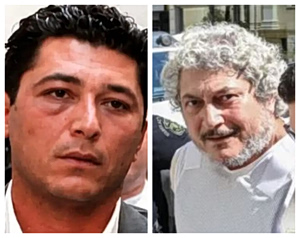
For nearly three decades, Demetrios “James” Dalamangas lived beyond the reach of Australian law – up until last week.
The 56-year-old Greek-Australian, who arrested at a remote residence near Aigio in southern Greece, is now in remand for the 1999 fatal shooting of Greek-Australian George Giannopoulos inside a Sydney nightclub.
Australian police have long listed him among the country’s most wanted fugitives after he allegedly fled before murder charges could be formally brought.
His arrest, carried out following cooperation between Greek and Australian authorities, has revived interest in a series of violent incidents that shook Sydney’s Greek-Australian community in the late 1990s. Australian investigators have also reportedly examined possible links between Dalamangas and the 1997 killing of another Greek-Australian, Tim Voukelatos, although no charges have been announced in that case.
Speaking to local television, Voukelatos’ son said he had heard speculation over the years that the Dalamangas brothers were connected to his father’s death but stressed that such claims remained unproven.
“I was three years old when it happened,” he said. “It was always a theory, a suspicion. Some people believed it was him, others thought it was someone else.”
The arrest marks a dramatic conclusion to a manhunt spanning 27 years. Greek authorities located Dalamangas roughly 15,000 kilometers from Sydney, ending one of Australia’s longest-running fugitive investigations.
The case is also intertwined with the controversial death of his younger brother, Peter Dalamangas, who died in January 1998 following an altercation at a Sydney casino. A coroner later concluded that the 23-year-old died after being subjected to unjustified force by casino security personnel. Surveillance footage reportedly showed security staff restraining him for several minutes before his death.
Before becoming a fugitive, James Dalamangas publicly campaigned for justice over his brother’s death, appearing outside Australian courts and calling for accountability. After his arrest in Greece, he again focused on that case, alleging police corruption and demanding renewed scrutiny of the circumstances surrounding his brother’s death.
He declined to comment on the murder charge for which Australian authorities are seeking his extradition.
According to accounts from former acquaintances cited in local media, Dalamangas worked as a nightclub security guard in Sydney and was known for a tough reputation. Reports have also linked him to past police investigations involving narcotics, though details remain unclear.
The arrest comes amid intensified cooperation between Greece and Australia on cross-border law enforcement matters. Greek courts are expected to examine Australia’s extradition request in the coming weeks, a process that could determine whether Dalamangas is returned to Sydney to face trial over a killing that has remained unresolved for more than a quarter of a century.