Greece is lagging behind national targets and other European countries on electricity self-consumption, with only about 37,500 such systems currently running in homes and businesses nationwide.
Aiming to change that, the Energy Ministry has finished public consultation (closed Monday, July 20) on a ministerial decision covering the rollout, installation, and grid connection of self-consumption stations and cheaper renewable energy use.
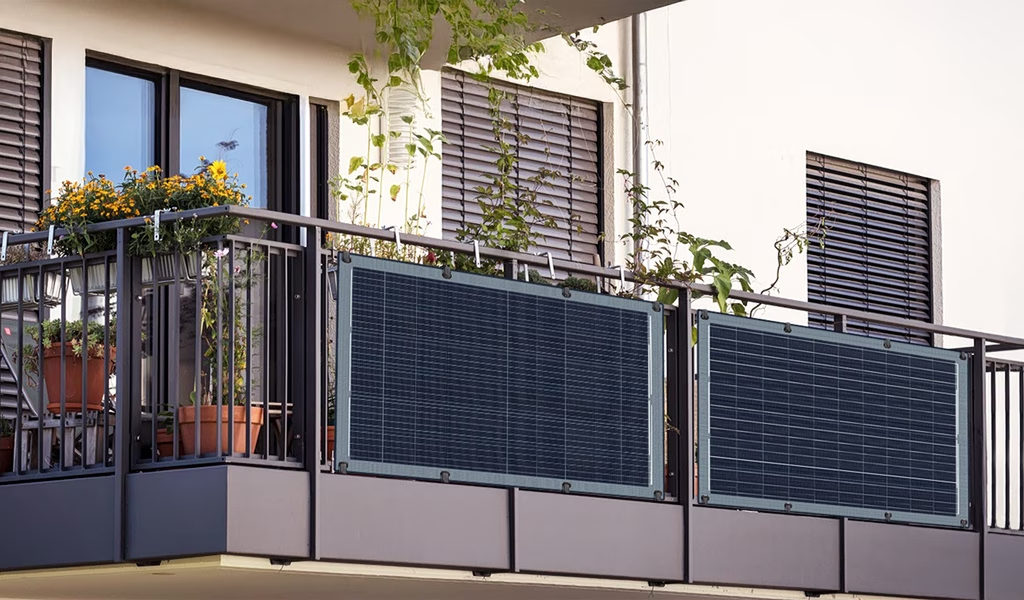
For the first time, the rule allows small “balcony solar” systems up to 800 watts, plus standalone battery storage, for personal use only, with zero feed-in to the grid. It also simplifies and clarifies the rules for all self-consumption schemes and sets conditions for adding storage systems.
What it offers: Estimates suggest savings of 20-30% on a typical annual electricity bill, with strict safeguards to prevent any energy from being pushed into the grid.
What it is: A plug-in micro-solar system with maximum feed-in power of 800 watts and installed capacity up to 900 watts, which can be combined with storage and is installed on or in buildings strictly for self-use, without grid injection.
Netting arrangement: Output is offset against the household’s own metered consumption; owners can’t sell power commercially through the system.
What consumers must do: When buying the system (in-store or online), declare your utility connection details to your supplier or installer. They must notify the grid operator through a dedicated digital portal up to five days before installation, using taxisnet credentials.
Requirements: A new Installer Declaration of Responsibility (renewed every two years), a directional sensor to guarantee zero feed-in, and a telemetry system to record production and consumption data for netting purposes. No connection agreement with DEDDIE, other permits, or connection fees are needed.
Power cap: Total installed and feed-in capacity per connection can’t exceed 800/900 watts.
Advantage over rooftop solar: Balcony units suit people who can’t install rooftop systems — especially renters, since no roof access is needed. They offer partial savings on steady loads (fridge, small appliances, daytime devices) rather than full energy independence, which rooftop solar plus storage can approach.
Cost: Roughly €700-1,000, though installers say DIY setups are impractical since the system must connect to the home’s electrical panel (not just an outlet) to enforce zero feed-in, requiring a special panel-mounted device.
Apartment buildings: The new framework allows collective self-consumption — at least two users in the same building can share output from one station across multiple connections.
Third-party installation: A third party can install, finance, or manage the station on the consumer’s behalf without being considered the self-consumer themselves; the benefit of the energy produced stays with the consumer it serves.