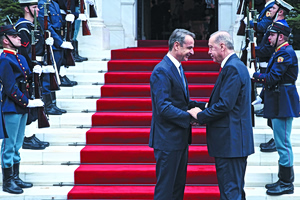
Greece’s Minister of the Interior, Theodoros Livanios, struck a firm tone toward the country’s mayors on Thursday as he opened the annual conference of the Central Union of Municipalities of Greece (KEDE), urging them to improve efficiency and accountability in local governance.
Speaking to a packed audience in Alexandroupolis, Livanios rebuked municipal leaders for demanding more funds and staff while failing, he said, to use the tools already at their disposal. “If municipalities do not collect even what they are owed, at some point even those who pay will stop doing so,” he warned.
New Birth and Housing Benefits
Livanios announced that municipalities will now have the option to offer a birth grant of up to €3,000 per child to residents and registered citizens, at their own discretion. He also revealed an expansion of housing allowances for newly appointed teachers working in remote mountain or island municipalities — an effort to make such posts more attractive.
A New Local Government Code and Voting Reform
The minister unveiled plans for a new Local Government Code, expected to be shared with municipal representatives next month before public consultation. The code, reportedly 95% complete, includes provisions for electronic voting and the abolition of the second round in local elections, meaning mayors and regional governors will be elected outright in the first round.
“The rules are being set three years before the next elections,” Livanios said. “We need clear, timely procedures — we have mayors and regional governors elected with only 30% turnout.”
Increased Funding and Stray Animal Support
Livanios also announced €105–110 million in new financial support for municipalities expected in November, along with an emergency grant of €28 million for school operations. In addition, funding for stray animal management will triple to €15 million starting January 1, 2026, up from €5 million today.
Criticism Over Hiring and Revenue
The minister rejected claims of municipal “financial suffocation,” stressing that the government had approved all hiring requests related to essential services such as sanitation, street lighting, and water management. Since 2019, he noted, 19,000 new municipal positions have been approved nationwide.
However, Livanios pointed out that in 2025, one in four municipalities collected less revenue than the previous year, while 101 municipalities failed to participate in programs aimed at improving debt collection. Doubling revenue collection rates, he argued, could add €150 million annually to local budgets.
Unused Funds and Delayed Projects
Turning to infrastructure, Livanios said many municipalities had failed to execute projects already funded through national and EU programs. “By the end of 2025, unimplemented maintenance projects will total €1.1 billion,” he said.
Only one in four roadworks projects budgeted at €521 million will be completed by year’s end, he added. Similarly, projects under the “Antonis Tritsis” development program, worth €3.78 billion, have only reached €1.8 billion in payments after five years.
“There is a €1 billion gap that prevents us from securing new financing tools,” Livanios warned, citing €270 million in contracted projects with no signed agreements and another €240 million where tenders have not yet begun.
Call for Greater Participation
The minister also noted low participation in an ongoing €15 million subsidy program for sterilizing stray animals, and poor absorption of digital transformation funds from the Recovery and Resilience Facility, where spending remains below 15%.