A decades-long insurance and pension inequality affecting certain healthcare workers in Greece is set to be resolved through a new provision included in a labor ministry bill.
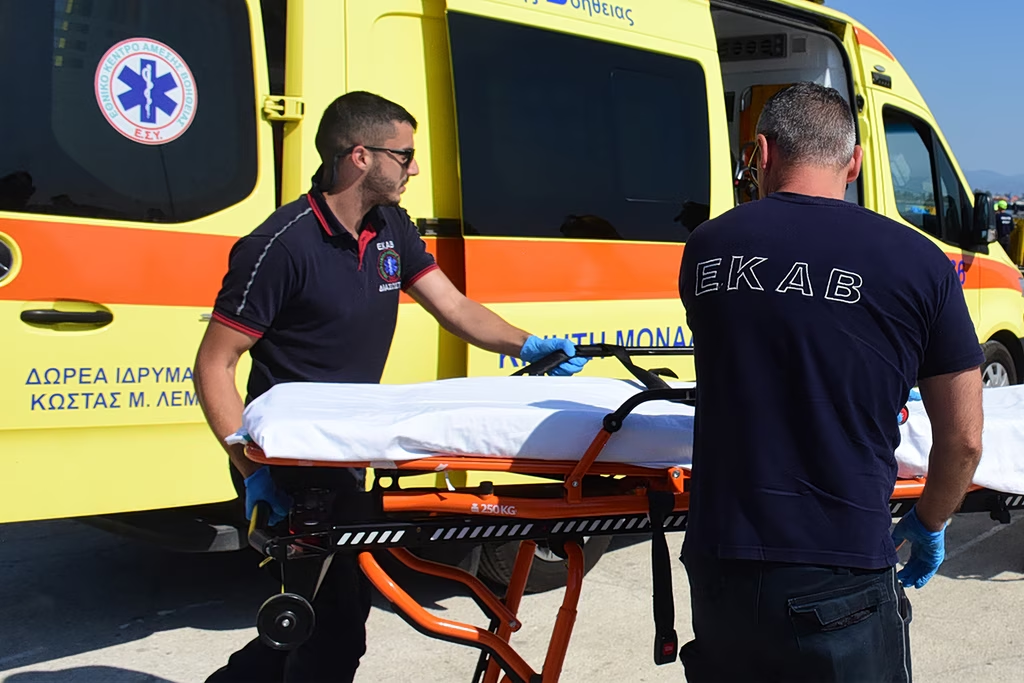
The measure applies to nurses, nursing assistants, drivers, paramedics and ambulance crews working in the public healthcare system and emergency medical services. For the first time, employees in these categories who were hired before 2011 and fall under the public-sector pension system will be classified as working in hazardous and arduous occupations.
The change grants them the same insurance and pension rights as colleagues performing identical duties under the same working conditions.
Correcting a Long-Standing Disparity
The new regulation addresses a long-standing inconsistency that created two different insurance regimes for employees with the same specialties and responsibilities.
Until now, workers hired more recently in these professions were covered under hazardous and arduous occupation provisions, while employees hired earlier and insured under the public-sector pension framework remained excluded. As a result, workers employed in the same hospitals or ambulance services often had different insurance and retirement rights despite carrying out the same duties.
Under the new framework, retirement conditions will be aligned with those already applicable to equivalent professions covered by the former private-sector insurance system.
Earlier Retirement Option
The reform introduces unified rules for both primary and supplementary insurance and provides eligible workers with the possibility of full retirement up to five years earlier, at the age of 62, provided certain insurance requirements and additional contributions are met.
Specifically, retirement eligibility will require 15 years of insurance coverage, including 12 years in the relevant professions and three years of service within the last 17 years before reaching retirement age or submitting a pension application.
Comprehensive Insurance Framework
The legislation also establishes, for the first time, a comprehensive framework covering:
- Inclusion in supplementary insurance schemes.
- Recognition and buyout of previous insurance periods.
- A unified process for both primary and supplementary insurance.
- The broader administrative and implementation framework of the reform.
Employees will also have the option to voluntarily join the new system by submitting an application. In addition, they will be able to recognize and purchase previous periods of employment in the eligible professions either through a lump-sum payment or in installments.
The recognized period will be treated as actual insurance time and will not count toward existing limits on recognized insurance periods.
According to the government, the measure aims to eliminate a long-standing injustice affecting a professional group that plays a critical role on the front lines of the public healthcare system.