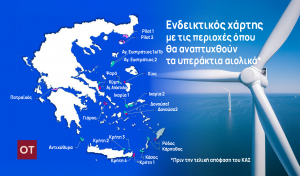
The Greek government is set to finalize long-delayed rules on where renewable energy projects can be built, with key decisions expected in early May. The new Special Spatial Framework for Renewable Energy Sources (RES) aims to settle one of the country’s most contentious issues: where wind farms will be allowed and where they will be banned.
Environment and Energy Minister Stavros Papastavrou has said that the updated plan is almost locked in, although last-minute changes remain possible. Officials are still weighing market reactions and considering both broader and more targeted regulations.
Renewable Energy as Greece’s “Domestic Fuel”
The timing is significant. Greece’s energy transition has accelerated, but public acceptance has lagged. At the same time, geopolitical tensions and in particular the war in Iran and the wider Middle East, have brought to the fore once more concerns about energy security.
Against this backdrop, renewable energy is emerging not just as essential to the green transition, but also as a cornerstone of Greece’s energy independence.
Tourism vs. Wind Farms on Greek Islands
A central flashpoint is the placement of wind farms on Greece’s islands, an issue that has sparked strong local opposition and raised concerns over competing land uses.
The new framework is expected to align with a separate spatial plan for tourism, aiming to avoid conflicting land uses and create a more cohesive development model.
For highly developed and developing tourist destinations — known as “Group I” islands — the direction appears clear. Government sources indicate a likely full ban on wind farm installations in these areas.
This group covers 46 islands including some of Greece’s most iconic destinations, such as Mykonos, Santorini, Paros, Naxos, Rhodes and Kos.
The move carries strong political weight. It aims to protect high-value tourism areas and ease local opposition, which has intensified in recent years.
A More Flexible Approach Elsewhere
For other inhabited islands — classified as “Group II” — the picture is less clear.
The prevailing approach would be to allow renewable energy projects only in areas with strong wind potential, based on mapping by Greece’s Center for Renewable Energy Sources. The goal is to avoid low-efficiency investments.
Meanwhile, uninhabited islands and rocky islets — “Group III” — are unlikely to face blanket bans. Instead, the government is considering targeted restrictions based on geographic, environmental and geopolitical criteria.
Mountain Zones and Local Opposition
Uncertainty also remains over mountainous regions. Authorities have yet to define the altitude above which wind turbines would be prohibited.
Last-minute interventions from the prime minister’s office are expected, as the government seeks to contain growing local resistance in several parts of the country.
What Happens to Projects Already in the Pipeline?
Another key issue is how the new rules will affect projects already underway.
The government plans to introduce transitional provisions based on a project’s level of maturity, though the exact threshold has not been finalized.
There is a clear intention to exempt renewable energy units that are already operating, under construction, or have secured environmental permits.
However, uncertainty surrounds projects that are close to final approval but are not yet fully licensed. Some of these investments could find themselves suddenly excluded if they fall into newly restricted zones.
A Framework Built to Withstand Legal Challenges
Officials are also focused on ensuring the new framework can withstand legal scrutiny. A stable regulatory environment is seen as essential to maintaining investor confidence.
The current spatial plan dates back to 2009 and is widely considered outdated. It does not account for newer technologies such as offshore wind farms or energy storage infrastructure, both critical to a renewable-based energy system.