Twenty years after the euro banknotes were first issued, they are being redesigned, with the new series set to gradually replace the ones currently in circulation. The European Central Bank officially began the process on December 6, 2021. In November 2023, two potential themes were selected: “European Culture” and “Rivers and Birds.”
The process has now reached its final stage. Ten designs, five for each theme, selected through a competition that drew 1,241 entries from designers across the European Union, are being put to the public in an open online survey that runs through September 21. Among the finalists is Greek visual artist Myrsini Vardopoulou.
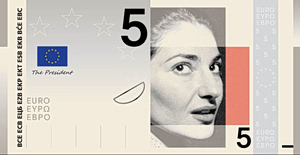
A final decision on which of the two themes will be chosen is expected toward the end of 2026, while the banknotes themselves will still take several more years to reach our wallets. Under the “European Culture” theme, among the figures proposed as motifs for the new banknotes is a woman deeply connected to both Greek and global cultural identity: Maria Callas. The Greek-American soprano has been selected as the face of the €5 banknote, with the series also featuring Beethoven on the €10 note, Marie Curie on the €20, Miguel de Cervantes on the €50, Leonardo da Vinci on the €100 and writer and Nobel Peace Prize winner Bertha von Suttner on the €200.
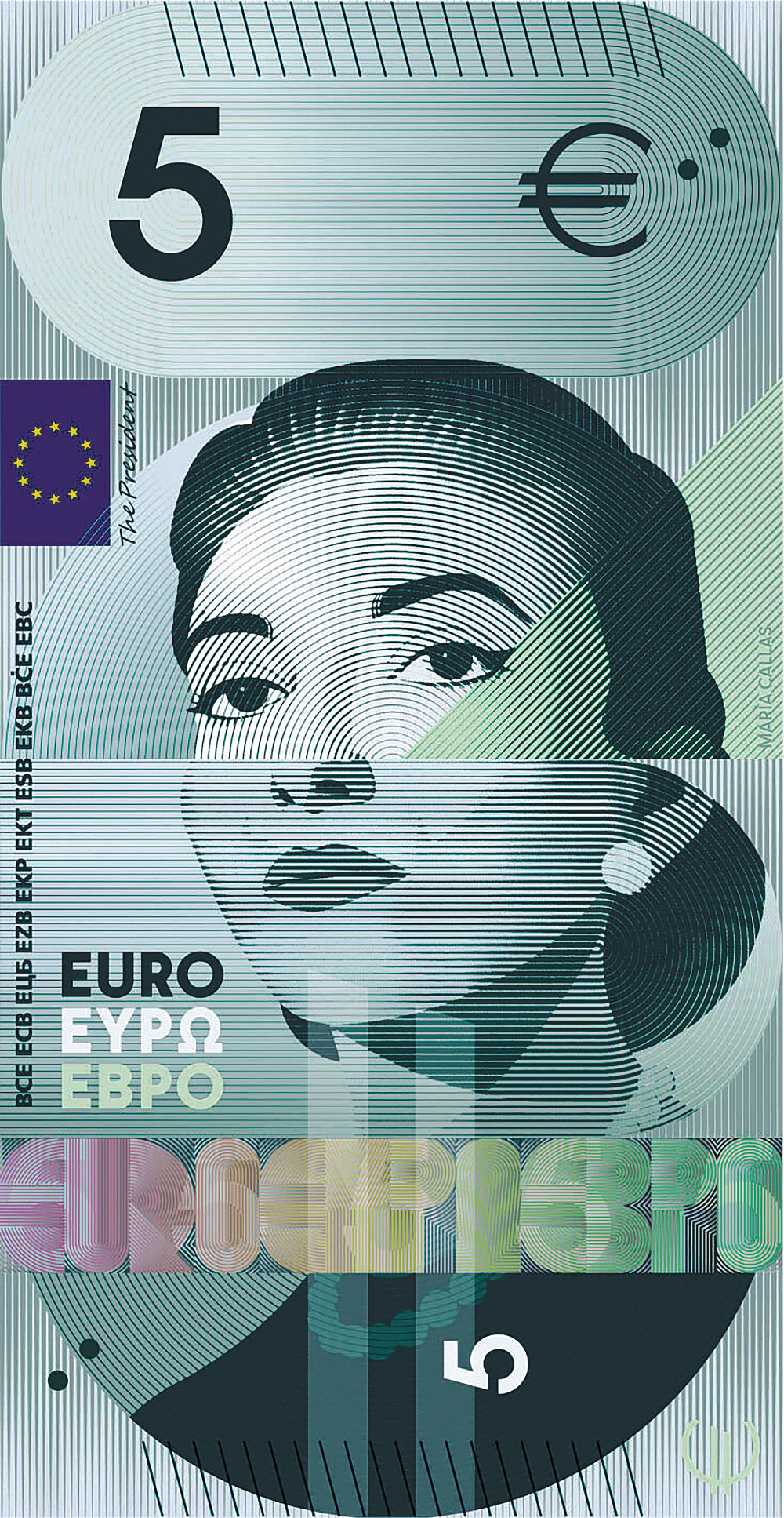
The striking gaze of opera legend Maria Callas dominates in the design realized by Rubio del Amo and Cruz mas Cruz.
Maria Callas was one of the most powerful and influential figures in the cultural history of humanity. A few seconds of her singing are enough to understand why. In reality, the great artist needs no honors, awards or official recognition to prove her stature; she shines above them all. Yet the prospect of seeing her face on a banknote circulating daily through the hands of millions of Europeans carries its own significance. It confirms that, nearly 50 years after her death, Callas’ voice is still regarded as part of the identity of an entire continent. In a way, it is also recognition that culture does not belong only in museums, theaters and books, but also in the everyday symbols we carry with us.
If she is ultimately selected, however, this will not be the first time Maria Callas’ image has appeared on currency as a tribute. In 2007, when the year was designated the “Year Dedicated to Maria Callas,” Greece issued a €10 silver commemorative coin. Then, in 2023, marking the 100th anniversary of the diva’s birth, the Bank of Greece issued both a €200 gold commemorative coin and a €2 commemorative circulation coin designed by George Stamatopoulos.
On a 1980 postage stamp
Callas has also appeared on Greek postage stamps, beginning with one issued in 1980, three years after her death, as part of the Hellenic Post (ELTA) series honoring figures from literature and the arts. The stamp depicts the soprano against the backdrop of the ancient theater of Epidaurus. In 2007, on the 30th anniversary of her death, ELTA returned with a commemorative issue. In 2023, it released a commemorative stamp series marking the 100th anniversary of her birth.
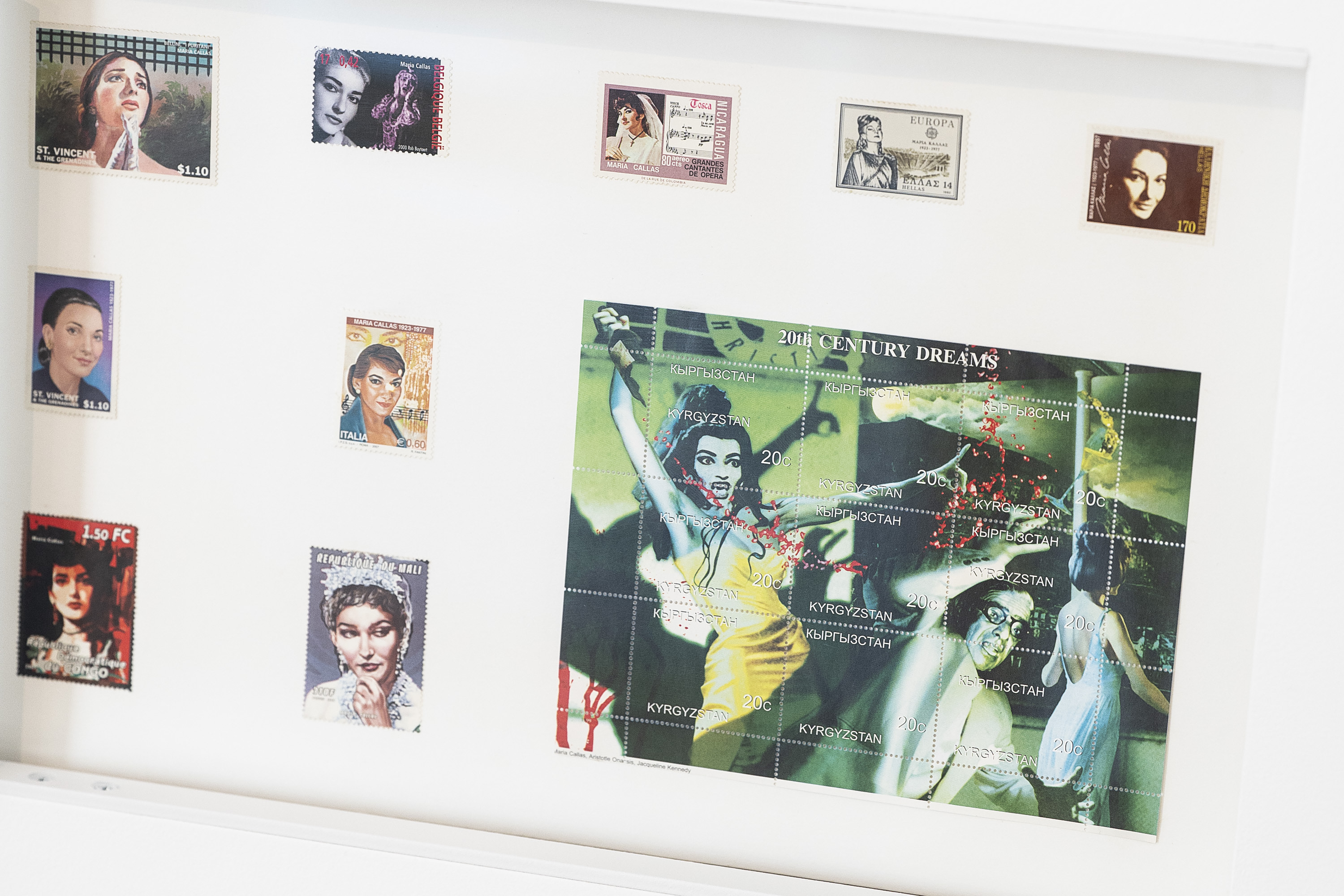
Collection of commemorative stamps of Maria Callas, donated by Maria Callas Greek Society. PHOTO BY VANGELIS PATSIALOS/THE MARIA CALLAS MUSEUM
Greece is not the only country to have honored her on a stamp. Italy issued a stamp featuring Callas in 2007 to mark the 30th anniversary of her death. It was a commemorative sheet of three stamps featuring, alongside the Greek soprano, tenor Beniamino Gigli and actor Amedeo Nazzari. France’s postal service issued a Callas stamp in 2023 to mark the 100th anniversary of her birth. That same year, the postal services of Monaco and Portugal issued their own editions.
There are also medals featuring Callas. One was issued by La Scala in Milan to mark the 25th anniversary of her death. The Festival Internazionale Maria Callas, meanwhile, created the “100 Petali per Maria Callas” medal, made of plated bronze and red enamel and designed by Christian Fez. The edition consisted of 100 numbered pieces intended to be awarded to major institutions, theaters and prominent figures.
If Maria Callas ultimately appears on the new €5 banknote, something strangely beautiful will happen: the voice that once filled the world’s greatest stages and moved the most demanding audiences with its musicality, allure and truth will fit onto a small piece of paper, destined to pass from hand to hand, travel from country to country, slip into wallets and pockets, and become part of the everyday lives of millions of people.
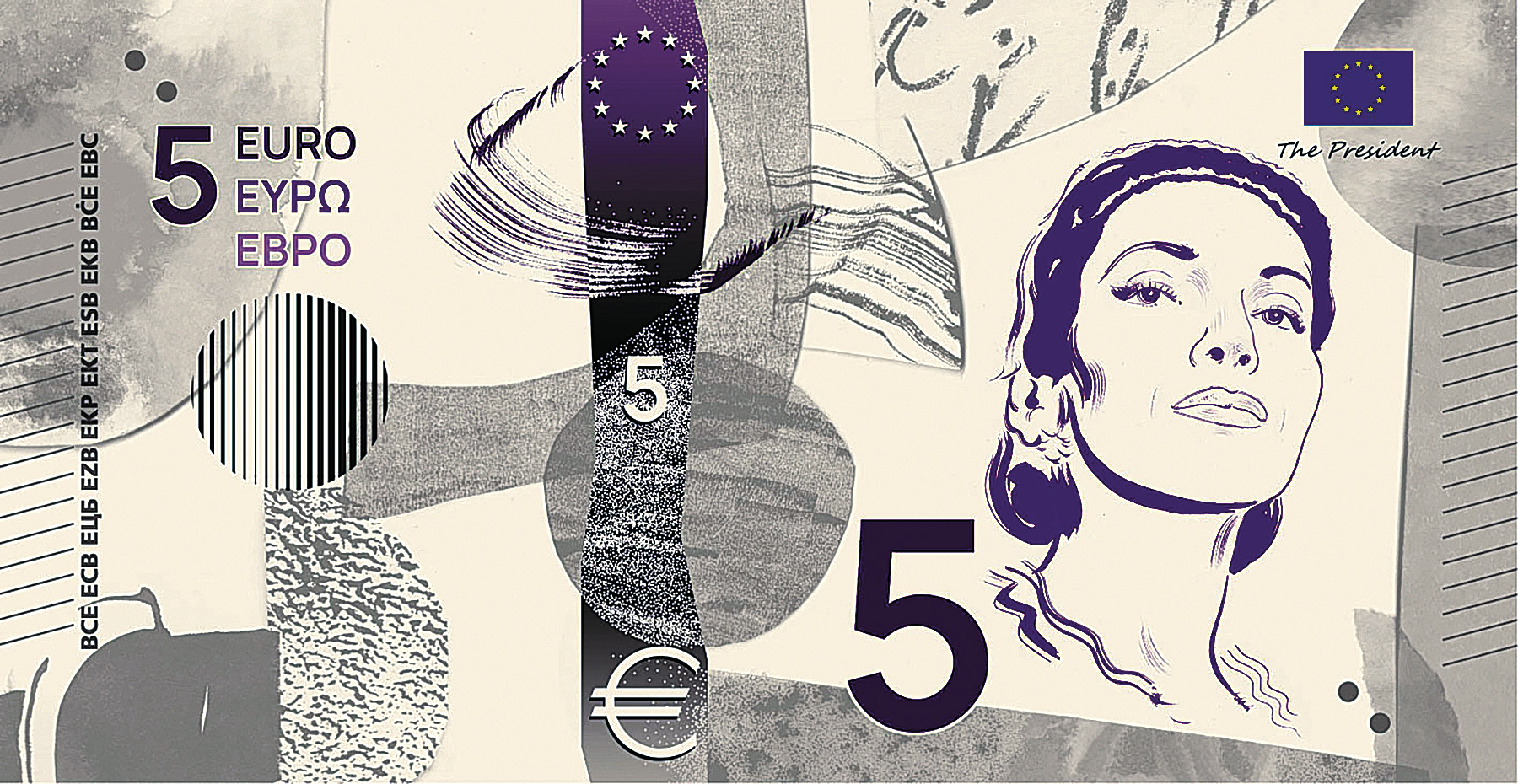
Jan Robert Dunnweller’s design utilizes the art of collage.
Perhaps that is the most unexpected form of immortality: to continue living, almost silently, within people’s everyday lives. Although, as we have already said, the great soprano needs no banknotes, coins or stamps to remain present. Callas has secured a place in the collective memory that needs no official seal to confirm it. If the €5 note ultimately comes, it will not make her any greater; it will simply be an honor she deserves.