 Μake us preferred on Google
 Hellenic Train has been fined 120,000 euros by the Greek Regulatory Authority for Railways (RAS), after an investigation found the company could not prove that materials used to repair passenger train seats met fire safety standards or were properly documented.
The authority’s full board reached its decision unanimously on August 3 and issued it on August 10. It broke the penalty into two parts: 100,000 euros for violations of EU rules governing vehicle maintenance, and a further 20,000 euros for breaches in four procedures within the company’s own maintenance system.
The decision concerns safety requirements for maintaining passenger car seats, the certification of the materials used in that work, the ability to trace after the fact which material went into which vehicle, and how Hellenic Train managed work it had outsourced to external suppliers. RAS said the violations are directly tied to the safety rules governing the rail system, and that the lack of traceability leaves its operation in what the authority called a precarious position.
A paper trail that did not hold up
RAS found that Hellenic Train violated Greek and EU rules in three areas: vehicle maintenance itself, the obligations of everyone involved in the maintenance process, and how the company outsources maintenance work to outside contractors. Within Hellenic Train’s own maintenance system, the authority identified breaches in four specific areas: how safety rules were issued, how suppliers were evaluated, how the technical maintenance file was managed, and the operating framework of the system itself.
It found that Hellenic Train could not demonstrate the required traceability for all the materials used. Nor could it show compliance with the seat and fire protection rules set out in Programmatic Agreements 41a and 41b, the contracts governing this maintenance work.
RAS’s review focused on four contracts Hellenic Train signed between 2021 and 2023 with two suppliers, Global Interior Systems (G.I.S.) and Tennis Craft Interkat, covering repairs and replacement parts for train seats.
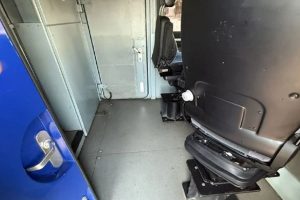
The original construction specifications for the passenger cars required seat upholstery made from flame retardant material certified to the UIC 564-2 standard, along with specific requirements for other nonmetallic materials on board. RAS found that later maintenance contracts were less precise. Some simply required replacement fabric to match the original in color and quality, with no explicit clause demanding the certificates to prove it.
The decision records that foam padding and internal fire blocking material were replaced in 5,200 full seat cushions, and matching material in 200 seat backs. Under other contracts, hundreds more first and second class seat cushions, backs and headrests were also replaced. RAS said it could not verify which train cars these materials were actually installed in. The decision states that Hellenic Train did not produce the certification and traceability documents required for this work, with one exception: a revised flammability test certificate.
Contracting out the work does not contract out the blame
One of the most significant parts of the decision concerns the outsourcing of maintenance work. Under Commission Implementing Regulation (EU) 2019/779, the entity responsible for a train’s maintenance stays responsible for the results even when it hires someone else to do the work, and must have a system in place to monitor how those contractors perform.
Handing a repair job to an outside supplier, in other words, does not transfer the final responsibility for safety. RAS said Hellenic Train should have had procedures to screen its suppliers and contractors, confirm they were qualified for the work, and check that they ran proper, documented maintenance systems of their own.
What Hellenic Train has to fix, and by when
Beyond the fine, the decision imposes a series of specific obligations on Hellenic Train. Hellenic Train must comply with Safety Recommendation 2025 RL01 018 from EODASAAM, Greece’s National Aviation and Railway Accident Investigation and Aviation Safety Authority, the body that investigated the 2023 Tempi rail disaster, and finish the current phase of the action plan it has already submitted to RAS within three months of being formally notified. It also owes RAS a progress report within one month.
More broadly, the company must guarantee traceability for all maintenance related information going forward and hand RAS an improved traceability procedure specifically covering seat maintenance and the materials involved.
Fire safety gets its own set of orders
RAS devoted a separate section of the decision to fire safety, ordering Hellenic Train to take immediate action to strengthen protection on its trains and build a stronger safety culture among both staff and passengers. The company has one month to submit an action plan covering short and medium term steps.
The immediate measures include stripping noncritical, flammable materials out of train cars, adding fire extinguishers, carrying out emergency maintenance on safety equipment, training staff and shortening how often trains are inspected and serviced.
The medium term plan is more sweeping: replacing seats and other interior fittings, and modernizing public address systems, air conditioning, ventilation and danger alert systems. For seating specifically, RAS wants full replacement with new seats certified to the EN 45545 fire safety standard, which it says lines up with the EODASAAM recommendation issued after the Tempi investigation.
Where the regulator drew the line
RAS was careful to note what its decision does not cover. It left out any assessment of claims from either side about the rolling stock of IC62, the train involved in the Tempi disaster, since that question falls squarely under EODASAAM’s jurisdiction. It also clarified that the fire safety standards it examined concern protection during a train’s normal operation, not fire following a collision.
Going forward, Hellenic Train must keep RAS informed whenever it outsources maintenance work and show how it is meeting the relevant requirements. The authority warned it could impose further fines or other measures if the violations continue or the company fails to comply with what the decision requires.
Source: in.gr