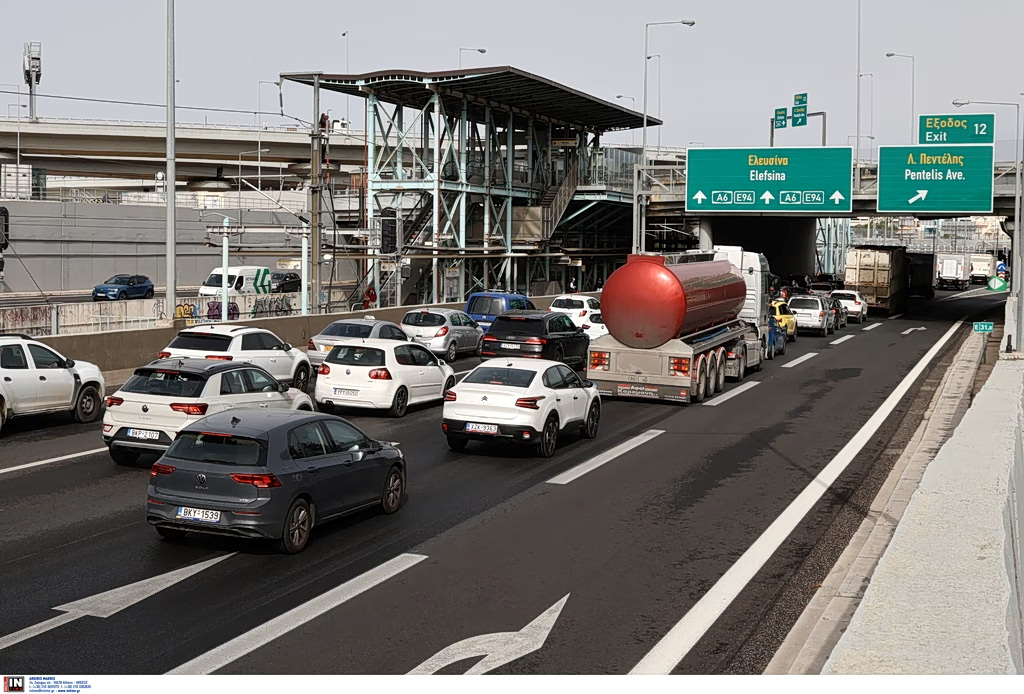
Greater Athens’ worsening traffic congestion is exacting an increasing toll on productivity, quality of life and the environment, while Greece continues to lag decades behind most European countries in deploying modern “smart” traffic light technology that could significantly ease gridlock, according to a report published in Thursday’s edition of the Athens daily Ta Nea.
The report says drivers in the Greek capital spent an estimated 100 to 111 hours stuck in traffic during 2025, with a typical 10-kilometer journey taking around 30 minutes on average and considerably longer during peak periods. As vehicle numbers continue to rise and road infrastructure approaches capacity, congestion has become one of the most pressing urban challenges facing the greater Athens-Piraeus agglomeration.
While the future completion of Metro Line 4 is expected to provide substantial relief, the project remains several years away, prompting transportation experts to argue that immediate technological upgrades are needed alongside long-term infrastructure investments.
According to the report, Greece currently has only eight fully adaptive traffic signal systems in operation nationwide — seven in Attica prefecture (which hosts greater Athens-Piraeus) and one in Thessaloniki. By comparison, adaptive traffic control systems have been widely adopted for years across European countries, including Germany, Spain and Cyprus.
Unlike conventional traffic lights operating on fixed schedules, adaptive systems use sensors, cameras and real-time software to monitor traffic volumes and automatically adjust signal timing. Green lights can be extended on congested approaches while reducing unnecessary delays on lightly traveled roads, improving traffic flow and lowering vehicle emissions.
Transportation engineers at Attica’s Traffic Management Center told Ta Nea that Greece trails many European countries by roughly 25 to 30 years in modernizing its traffic signal infrastructure. About half of the country’s traffic lights still operate exclusively on fixed timing cycles regardless of actual traffic conditions, while the remainder rely on preset schedules based on the time of day or day of the week rather than real-time demand.
The scale of the technological gap is underscored by the numbers. Attica prefecture alone has about 2,210 signalized intersections, each equipped with between six and 30 traffic lights, yet only seven intersections are fitted with fully adaptive control systems.
Experts cited in the report estimate that installing automated traffic management along Athens’ principal road corridors could reduce travel times by as much as 25%, while also cutting fuel consumption, carbon emissions, air pollution and lost working hours. The technology can also prioritize urban buses to improve public transport reliability, create “green waves” for ambulances, fire engines and police vehicles responding to emergencies, and to adjust pedestrian crossing times to improve accessibility.
According to the report, the principal obstacle is no longer technical expertise but funding. Installing a complete adaptive system along Alexandras Avenue, including its 14 signalized intersections, would cost about 1 million euro, largely because of the required central control infrastructure, communications networks, sensors and software. Once that backbone is in place, expanding the system is estimated to cost about 25,000 euros per additional intersection.
Transportation specialists told Ta Nea they believe such investments could pay for themselves within roughly 2½ to three years through lower fuel consumption, reduced travel delays and broader economic savings.