When they put on their beige uniforms, tighten their helmets, and pull on their masks to head into the front lines of a wildfire, Greece’s seasonal firefighters know one thing for certain: they’re walking into a “war” with no guarantee of when, or whether, they’ll make it home.
Sometimes fate deals an almost unbearable twist. On August 3, 2021, seasonal firefighter Kostas Tsamouras was battling the massive wildfire in northern Evia. While he fought to save other people’s lives and homes, his own house was already burning to the ground. He stood on the fire line while part of his own life burned behind him.
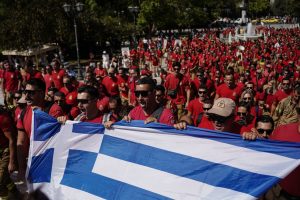
Wildfires in Greece are no longer just a tough operational job — they’ve become an increasingly violent, relentless, and unpredictable kind of warfare. Firefighters face extreme physical and psychological strain, a heightened risk of cardiovascular and neurological emergencies, and post-traumatic stress that can follow them long after a mission ends. “Our needs have changed because of climate change, and that’s exactly why I think we’re necessary year-round,” Tsamouras told Ta Nea. He spoke earlier in the day from Syntagma Square, where seasonal firefighters had gathered for a protest.
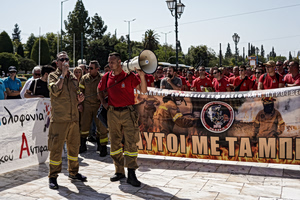
Protest by seasonal firefighters outside Hellenic Parliament, in Athens, Greece on August 31, 2026 / Credit: Nick Paleologos / SOOC
“My House Was Burning While I Was Fighting Fires In Northern Evia”
Seasonal firefighters cover permanent, ongoing staffing needs and fill the massive personnel gaps in the service — yet their pay comes to barely €1,000 a month. “We take that money without knowing if we’ll make it home. When I lost my own house while I was out on a mission, that was a devastating moment. They told me at dawn on August 6 that my home had burned down while I was in the next village over. I never once thought about walking away from what I do — saving lives and property — to go deal with it,” Tsamouras said.
He explained that he eventually rebuilt the house, where his parents now live, but the compensation the state gave him wasn’t even enough to redo the roof. “There was no real help, that’s the truth. And to the people who say we just sit around doing nothing half the time — I wish you could see us sitting around, not hearing any sirens. Because if you hear one, something bad is happening.”
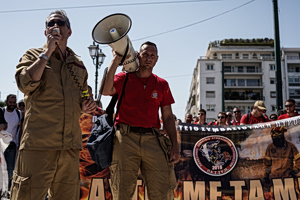
Protest by seasonal firefighters outside Hellenic Parliament, in Athens, Greece on August 31, 2026 / Credit: Nick Paleologos / SOOC
“Unemployment Benefits Alone Aren’t Enough”
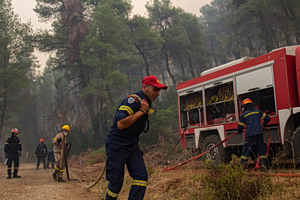
Seasonal firefighters and their colleagues operate in conditions that push the limits of human endurance. Surrounded by smoke, extreme heat, and strong winds, they stay on the front lines for endless hours, often without knowing when their shift will end or what emergency they’ll be called to next.
From one fire to the next, from a rescue to an extraction to a fresh emergency call, their bodies wear down — but they keep going. Even they might struggle to explain where they find the strength. “The conditions we deal with, from scorching heat to freezing cold and everything in between, plus incidents that can escalate from minor to extremely dangerous in an instant — it’s extreme, and the equipment just isn’t enough,” another seasonal firefighter told Ta Nea.
Alexandros Fasoulas pointed to the severe staffing shortages within the Fire Service. “According to Civil Protection’s own staffing chart, there are 3,500 vacant positions, and we’re only 2,500 seasonal firefighters asking to work on equal footing with our permanent colleagues.”
He said seasonal firefighters are demanding year-round, 12-month contracts instead of being pushed into unemployment every eight months with no idea how they’ll get by. “Unemployment benefits alone don’t cut it anymore — the cost of living has gotten too high, in the cities and in rural areas alike.”
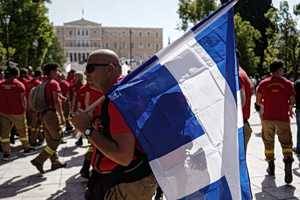
Protest by seasonal firefighters outside Hellenic Parliament, in Athens, Greece on August 31, 2026 / Credit: Nick Paleologos / SOOC
A Volatile Situation
This year, Fasoulas fought the major wildfire that broke out days before the mid-August holiday near Sivira, in Chalkidiki. “Our operational capacity could be so much better with proper training, better equipment, and more modern vehicles. But that’s not happening, even though we keep asking for it. Every seasonal firefighter gives everything on every front, in the middle of a volatile mix of traffic accidents, wildfires, and poorly maintained power grid infrastructure.”
The firefighters who spoke with Ta Nea also brought up their colleagues who lost their lives this year while fighting fires. “Those tragic incidents made us think twice, even three times, about how careful we need to be, about following protective measures and safety protocols — some of which we buy ourselves, since the Fire Service doesn’t provide them.”
Earlier that morning, at least 1,000 seasonal firefighters from across Greece marched in Syntagma Square and delivered a formal resolution listing their demands.
“If nothing changes after the Thessaloniki International Fair, you’ll find us back here again,” said Georgios Tselepis, president of the Panhellenic Union of Contract Firefighters.