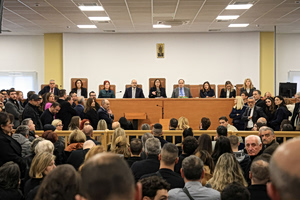
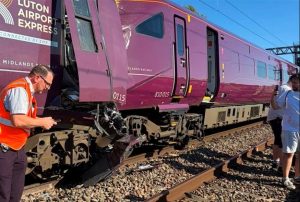
The trial over the Tempi railway disaster resumed Monday in Larissa, with a procedural development — the appointment of three court-assigned defense lawyers for one of the defendants — unfolding against the much larger question at the heart of the case: how far accountability should extend for Greece’s deadliest rail crash.
A total of 36 people are standing trial over the February 28, 2023 collision, including officials and executives from OSE, ERGOSE, the Ministry of Infrastructure and Transport, Hellenic Train and the Railway Regulatory Authority. The breadth of the defendant list reflects the complexity of the case, which reaches beyond the actions of individual stationmasters and into the functioning of the country’s railway system, its oversight mechanisms and the long-delayed safety upgrades that had been repeatedly flagged before the disaster.
At Monday’s hearing, the president of the Three-Member Felony Court of Appeals of Larissa appointed three defense lawyers for one of the defendants, who had informed the court during the previous session that financial difficulties prevented him from continuing with the lawyer who had represented him since the pre-trial stage.
The court said appointing three lawyers was necessary to help expedite the proceedings. After accepting the appointment, the newly assigned defense team said it would be ready to undertake the defendant’s representation once it had reviewed the case file.
The hearing was subsequently adjourned until Tuesday to allow the lawyers time to study the evidence. Addressing concerns raised in court about the pace of the proceedings and the growing number of interruptions, the presiding judge stressed that the court was determined to avoid both procedural irregularities and unnecessary delays.
Key Legal Questions Remain
Despite the procedural interruption, the focus of the trial remains on requests by lawyers representing the victims’ families to broaden the legal scope of the case.
Central to the latest courtroom debate are requests to upgrade charges and summon new witnesses. The prosecution has reserved judgment on whether the charge of negligent homicide could be changed to homicide with possible intent, as well as on possible prosecutions for the offenses of exposure to danger and explosion.
The prosecutor has also reserved judgment on whether the felony offense of disrupting transport safety should be attributed to two Hellenic Train executives who currently face only misdemeanor charges, with any decision to be considered after the evidentiary phase of the trial.
The prosecutor stressed, however, that new prosecutions cannot be brought for acts over which defendants were not questioned during the main investigative stage. She likewise reserved judgment on requests for additional witnesses and documentary evidence until the evidentiary process begins, while recommending that motions to supplement the investigation, annul the summons to trial and withdraw the case under Article 324 of the Code of Criminal Procedure be rejected.
A Broader Debate Over Responsibility
The legal arguments are technical, but their implications are not.
For the victims’ families, the central question is whether the trial will examine the disaster as a chain of individual mistakes or as the foreseeable consequence of systemic failures. For the state, the proceedings raise difficult questions about regulatory oversight, railway management and whether responsibility extended beyond operational staff to the administrative and political structures overseeing the network.
That broader accountability debate was underscored during an earlier hearing by the submission of a March 6, 2026 document from the Legal Council of State concerning the Greek state’s participation in the trial. The document, submitted by lawyer Zoe Konstantopoulou on behalf of victims’ relatives, was addressed to Finance Minister Kyriakos Pierrakakis, Infrastructure and Transport Minister Christos Dimas and Deputy Transport Minister Konstantinos Kyranakis.
In his March 20 response, submitted three days before the trial began, Kyranakis requested that the Greek state formally support the prosecution against the three stationmasters on duty during the afternoon and evening shift of February 28, 2023, as well as the then head of the Larissa Inspection Department of the Central and Southern Greece Traffic Support Service. The court accepted the state’s declaration.
The Charges
The charges vary depending on the defendant.
Thirty-three defendants face felony charges of dangerous interference with fixed-track transport with possible intent. According to the indictment, the alleged offenses resulted in numerous deaths, serious injuries and extensive damage to public infrastructure.
Thirty-five defendants are also charged with multiple counts of negligent homicide, grievous bodily harm through negligence and bodily harm through negligence, while three defendants additionally face charges of breach of duty.
With eleven hearings scheduled throughout July, the trial is entering a critical phase that could determine how broadly the court examines responsibility for the disaster. Monday’s appointment of new defense lawyers and the subsequent adjournment were procedural necessities, but the central issue remains unchanged: whether the proceedings will provide answers not only about what happened on the night of the crash, but also about why the conditions that made it possible were allowed to persist.