 Μake us preferred on Google
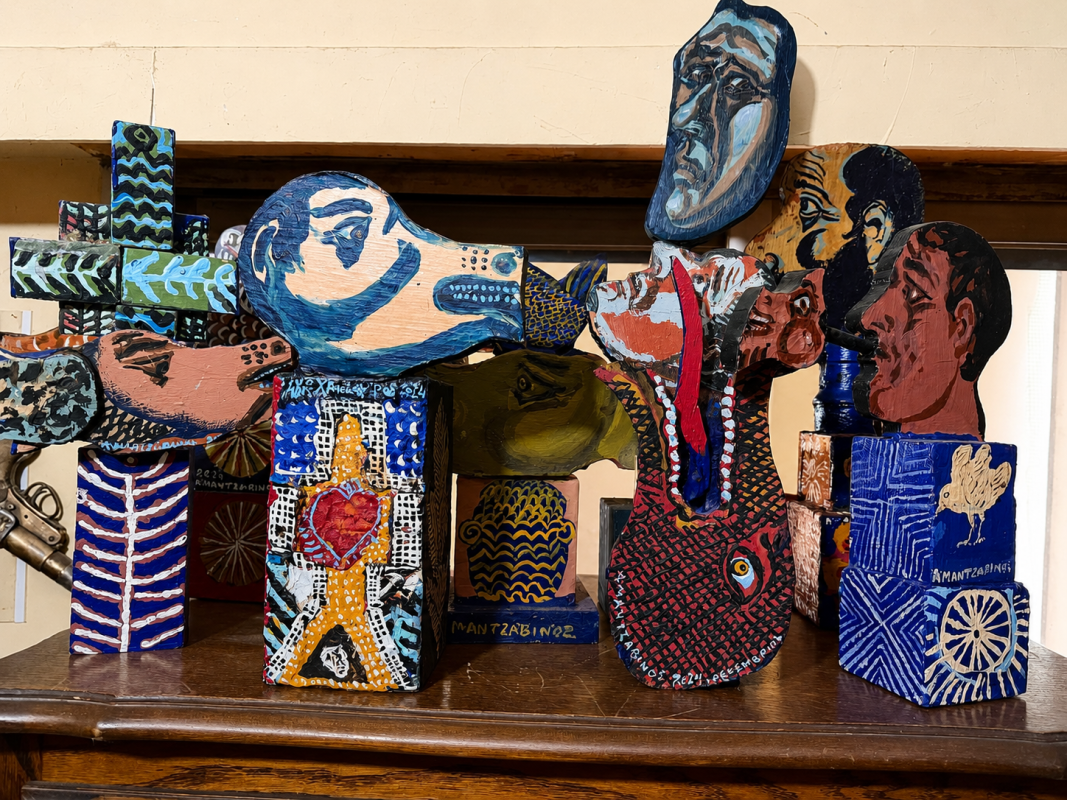
 Tassos Mantzavinos’s studio has little in common with those meticulously untidy spaces one often encounters in artists’ ateliers. There is nothing staged for the visitor’s gaze. Wood, paints, constructions, figures that are awaiting completion or have seemingly run their course—all coexist without vying for the spotlight. It is a space that seems inhabited more by memories than by objects.
He speaks the way he paints. There are no straight lines here. He starts with a memory, moves on to a painter he loved, returns to his childhood, pauses a while on Karagiozis, recalls his father, laughs, falls silent, then continues. His speech is associative but not chaotic. His meanderings circle a constant axis: the effort to understand where the images he paints come from. “You have to be a bit of a worldly monk,” he remarks at one point. And perhaps this phrase sums up not just his own journey, but an entire way of viewing art.
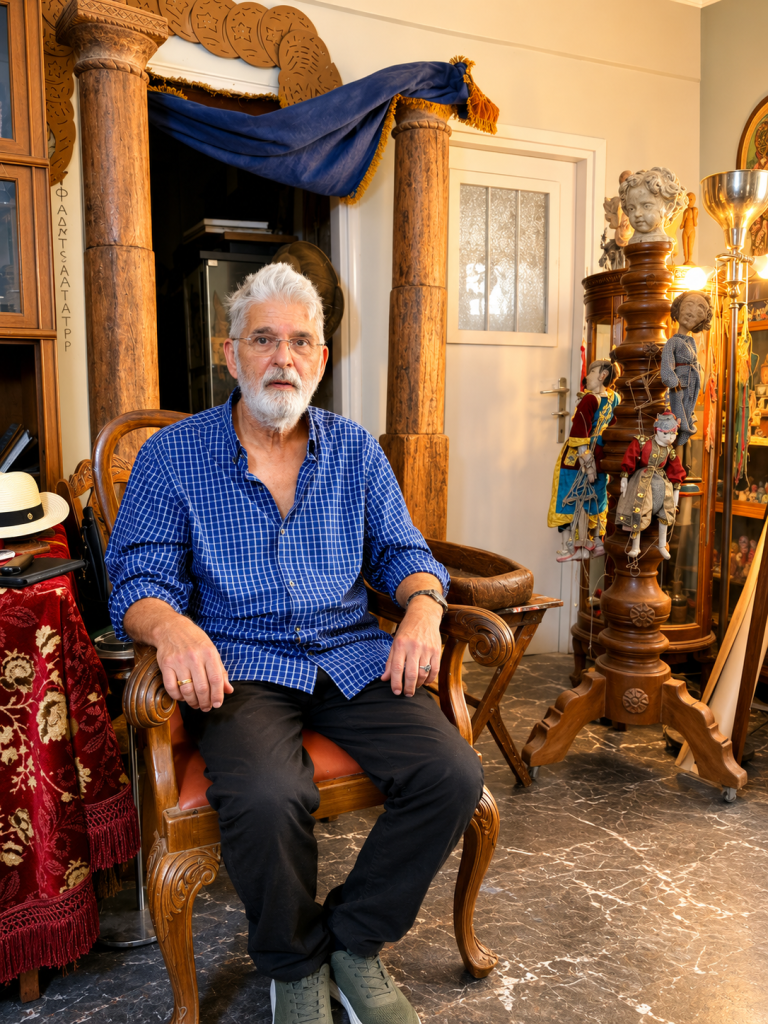
Painter Tassos Mantzavinos welcomed TO BHMA International Edition into his studio for a one-on-one interview. PANOS KOUGIAS/TO BHMA INTL EDITION
I get the feeling that painting was your way of coping with life. Was it?
Absolutely. If it weren’t for painting, I don’t know where I would have ended up. It helped me survive. And I don’t mean that metaphorically. When I lost my father, I was still very young. That event defined my entire life. Loss and loneliness became experiences I carried around without knowing it. Later, I realized that everything I painted was bound up with that trauma. Painting doesn’t heal in the sense of removing the pain. But it allows you to turn the pain into something else. To give it shape. To confront it head-on. That’s what it did for me. When I was painting, it was like I was putting the things within me in order—things that were in a state of total confusion. That is why I believe a painter cannot create with technique alone. They must have lived. They must have experienced rejection and sorrow, loss and love, joy. If they haven’t been through all that, what will they paint? Picasso used to say, “First I live, then I paint.” I agree completely. Lived experience comes first. Painting comes afterwards.
Still, you studied under two great masters: Yannis Moralis and Dimitris Mytaras. How can someone find their own voice after being exposed to such powerful influences?
With difficulty. And through a process that feels almost violent. I learned a tremendous amount at the Athens School of Fine Arts. Moralis and Mytaras were exceptional teachers. However, at some point I realized that if I continued to paint solely through what I’d learned, I would never find myself. I had to forget. To discard things. To walk away from the safety of “good painting.” The hard part is recognizing what you need and pursuing that, even if it leads you into a dead end. It’s something every painter has to endure. If they don’t, they’ll remain a good student—nothing more. They never grow into themselves.
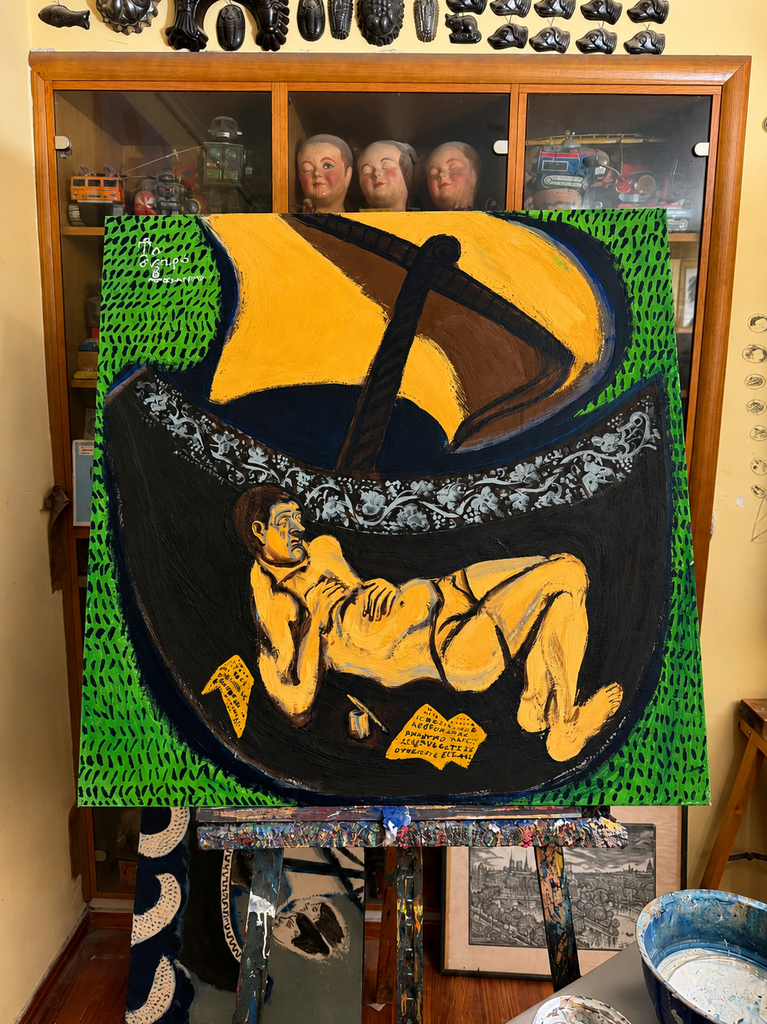
A painting sitting on an easel in the artist’s workshop. PANOS KOUGIAS/TO BHMA INTL EDITION
Karagiozis appears time and again in your work. What did you find in the shadow puppet theater that you couldn’t find elsewhere?
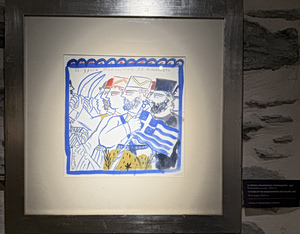
Karagiozis is one of the greatest visual experiences of my life. I never thought of him as folklore. I was deeply moved by Spatharis, who created an entire world out of almost nothing. With a single nail, a few tools, and his own hands. There is great art in that. I am very interested in this relationship between play and creation. Play is something incredibly serious. If a painter stops playing, if they take themselves too seriously, it’s over for them. They lose their freedom. I think art must retain this child-like spirit—not childishness, but the ability to rediscover the world as if seeing it for the first time. People who create without losing this innocence move me far more than those who rely solely on theory. No matter how much knowledge it requires, painting remains a deeply physical business. It’s in the hands, the body, the material.
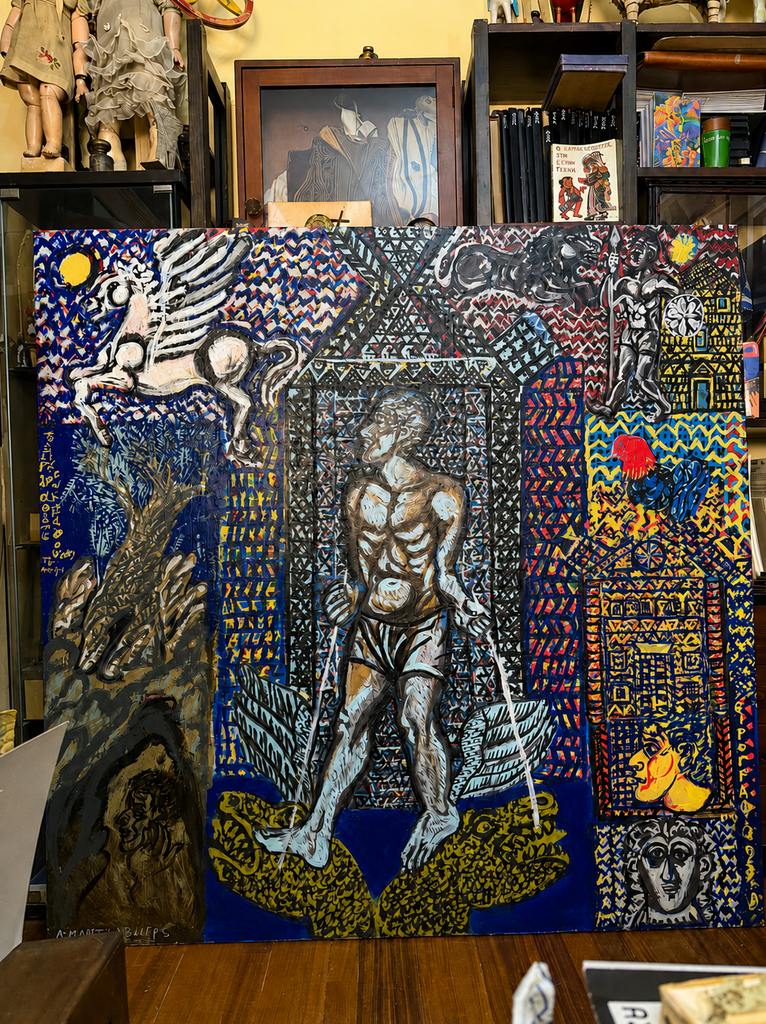
Karagiozis, as depicted by Mantzavinos in a painting in his workshop. PANOS KOUGIAS/TO BHMA INTL EDITION
The sea, ships, dark forests and large figures feature over and over again in your work. Are they memories or symbols?
They are everything all at once. I don’t sit down and say, “Now I’ll paint this, because it symbolizes that.” Most of it comes from deep within. The sea, for instance, is anything but an idyllic image for me. The house we lived in before my father died was right by the sea. We lost him in a port. So, within me, the sea became linked to death. That is why, even today, I struggle to view it the way most people do. For others, it’s about holidays, feeling carefree. For me, it comes with a different set of memories. You don’t think about these things when you paint. They occur to you later. You see that something keeps on reappearing. And then you realize that the images that live within you are far more powerful than your own decisions. That’s also why I don’t believe a painter is in complete control of their work. The work knows more than they do.
Alongside your paintings, you also create wooden constructions. What do you get out of the process?
I don’t think of them as sculptures. They are constructions. They stem from the same need that gives rise to painting, but the craftsman’s hand is more central here. I enjoy cutting, nailing, and assembling things. It is a different kind of joy. And, once again, it involves play. We say we “play a role” in the theater, and we “play music.” Well, the same is true here. If that aspect is lost, if everything is reduced to seriousness and theory, something is badly wrong. I don’t consider myself an art intellectual. I never was. I wasn’t good at school; I didn’t study much. I learned through the work itself. I try to remain humble before painting. The rest is for others to judge.
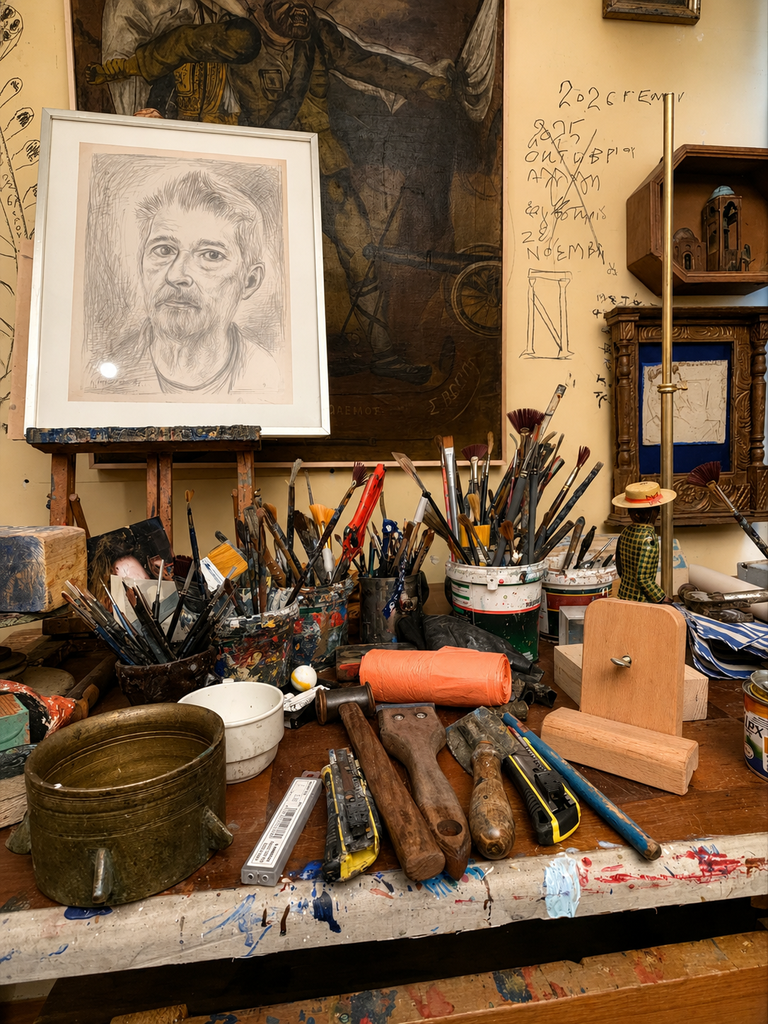
Mantzavinos’ work bench, full of paint brushes and wood carving tools. PANOS KOUGIAS/TO BHMA INTL EDITION
Today, art seems increasingly bound up with exposure and the market. What’s your take on that?
You cannot ignore reality. We all want to make a living from our work. There’s nothing bad about selling a painting. The point is that it shouldn’t become the reason you paint. Everyone’s in such a rush these days. Young people want to become famous overnight, to sell and gain recognition. But painting requires time. It requires solitude. You need to be able to take rejection. You have to be a bit of a “worldly monk”—to isolate yourself so you can get a feel for who you are. If you go into painting thinking everything’s going to come easily, you’re in for a disappointment. Art’s a journey that requires you to persevere and believe in yourself, even when others can’t see what you’re trying to achieve.
If a young person told you today that they wanted to be a painter, what would the first piece of advice you’d give them?
I would tell them to start by asking themselves if there really isn’t something else they could do. If there isn’t, and their need to paint is that deep-seated, I’d tell them to press on with it. Still, they should know that the road ahead will be full of difficulties, rejection, and doubts. Painting is not a job in the conventional sense. It is a way of life. It takes patience, endurance, and a lot of hard work. Above all, it needs you to remain receptive. To never tell yourself you’ve arrived. I’m still searching. I have obsessions that keep on circling back. Every time I think a cycle has come to an end, I realize a new one is beginning. That’s probably the most beautiful thing about painting: it never ends.