
London. One of the world’s biggest cosmopolitan hubs. Arguably, the financial capital of the world. But beyond the skyscrapers, banks, and regal architecture, London is one of the world’s most multicultural cities. Portuguese in Vauxhall, Punjabis in Southall, Bengalis in Tower Hamlets. I grew up in the rural county of Hertfordshire – just north of London itself – an area which shares much of its demographics with the northern London boroughs of Enfield, Barnet, and Haringey – the location of the largest Greek Cypriot community outside of Cyprus. As a Brit with no Greek heritage, these areas exposed me to a culture I would not have otherwise encountered, a language I would have otherwise not have heard, a people whom I would have otherwise likely not met. A community that gave the world George Michael (Georgios Kyriacos Panayiotou), Tulisa (Tula Contostavlos), and Yusuf Islam/Cat Stevens (born Steven Demetre Georgiou). Now, a few years on from growing up around “Mini Cyprus”, I am enrolled fulltime in Μodern Greek Studies at the University of Oxford. From Palmers Green to Palamas, from Enfield to Elytis, from Cockfosters to Cavafy. Now I am returning to the community to attempt to give a more holistic overview of the Cypriot community in the UK.
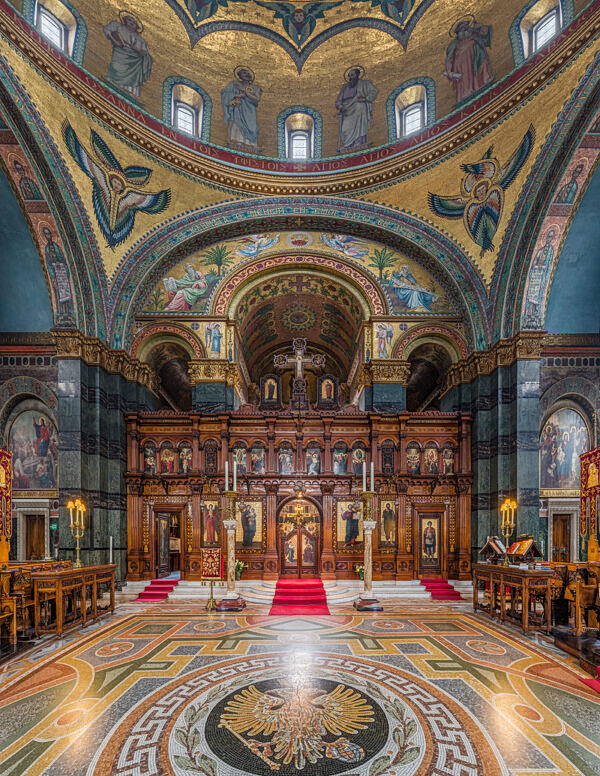
The Cathedral of the Divine Wisdom of God (Aghia Sophia) is Grade One Listed (highest legal protection) Greek Orthodox Cathedral in London, built in 1877. Many Greek Orthodox churches exist across the UK, from smaller converted churches to purpose built cathedrals. Credit: Diliff, Wikimedia Commons, CC BY-SA 3.0
To understand the community better, it would be wise to understand the history of Cypriots in the UK as it is hard to separate that from Cyprus’ British colonial status. Cyprus was leased to the UK to administer by the Ottomans in 1878, though remaining officially Ottoman. However, the Cypriot community remained small at this time with only 150 migrations from Cyprus to the UK before World War I and only a few marriages were registered to the Saint Sofia Cathedral in 1918. Cyprus was officially annexed by Britain in 1914 and after this migration became easier. The 1931 Census notes roughly 1,000 Cypriot-born people in the UK, but many were still British born to British servicemen based in Cyprus. By World War II, there were around 8,000 Cypriots in London. But it was only until after World War II that Cypriot immigration became regular. After the National Organization of Cypriot Fighters (EOKA) began its independence campaign in 1955, many Cypriots fled the violence at home and set sail for Britain. In the four-year struggle for independence (1955-1959), on average, roughly 4,000 Cypriots left Cyprus for the UK per year during this time – many of these being Turkish Cypriots in Greek-majority villages and Greek Cypriots in Turkish-majority villages, as they feared communal violence. Immediately following independence in 1960, immigration peaked at around 25,000. Whilst Greek Cypriots outnumbered Turkish Cypriots four-to-one in the sixties, this has largely levelled out now. Due to the Turkish invasion and subsequent occupation of the northern 38% of the island in 1974, there was another wave of immigration to the UK numbered around 10,000 – mostly refugees, though many of these returned to unoccupied Cyprus. The Cypriot community today (both Greek and Turkish) is centered around the North London boroughs of Enfield, Barnet, and Haringey – as well as significant populations in Hertfordshire, Essex, and Birmingham.
My personal introduction to the Cypriot community came from my childhood best friend, Marco, who is 3rd-generation Greek Cypriot. Marco took me to Cypriot shops, bakeries, and restaurants for the first time – so interviewing him was a great opportunity to revisit my introduction to the community. One of the areas of the diaspora which I am particularly interested in rediscovering is the status of the language there. The Greek language is something Marco is proud to be able to speak and I was keen to discuss it with him. Like many Greek Cypriots, he attended a Greek school when he was younger where the Greek language is taught. Marco, like me, grew up on the edge of the London diaspora, so he notes that the level of Greek was not as great among his classmates. Homeland Cypriots often call UK Cypriots “charlouthkia” – meaning ‘Charlies’ – due to their poor Greek or extensive use of ‘Greeklish’. Areas like Palmers Green and Southgate, suburbs about 13km (8mi) north of central London, where the diaspora is strongest have higher usage of Greek due to more exposure in local Greek-language shops and food establishments. Asking him if he thinks the language is in decline, he said that now that many Cypriots are now 3rd or 4th generation in the UK, it is becoming harder to preserve. However, he says he has begun to see an increase on social media of younger parents of Greek Cypriot heritage teaching their children the language, the culture, the food, and the history. Time will tell whether this rebound is a small movement or a larger change of community outlook to identity.
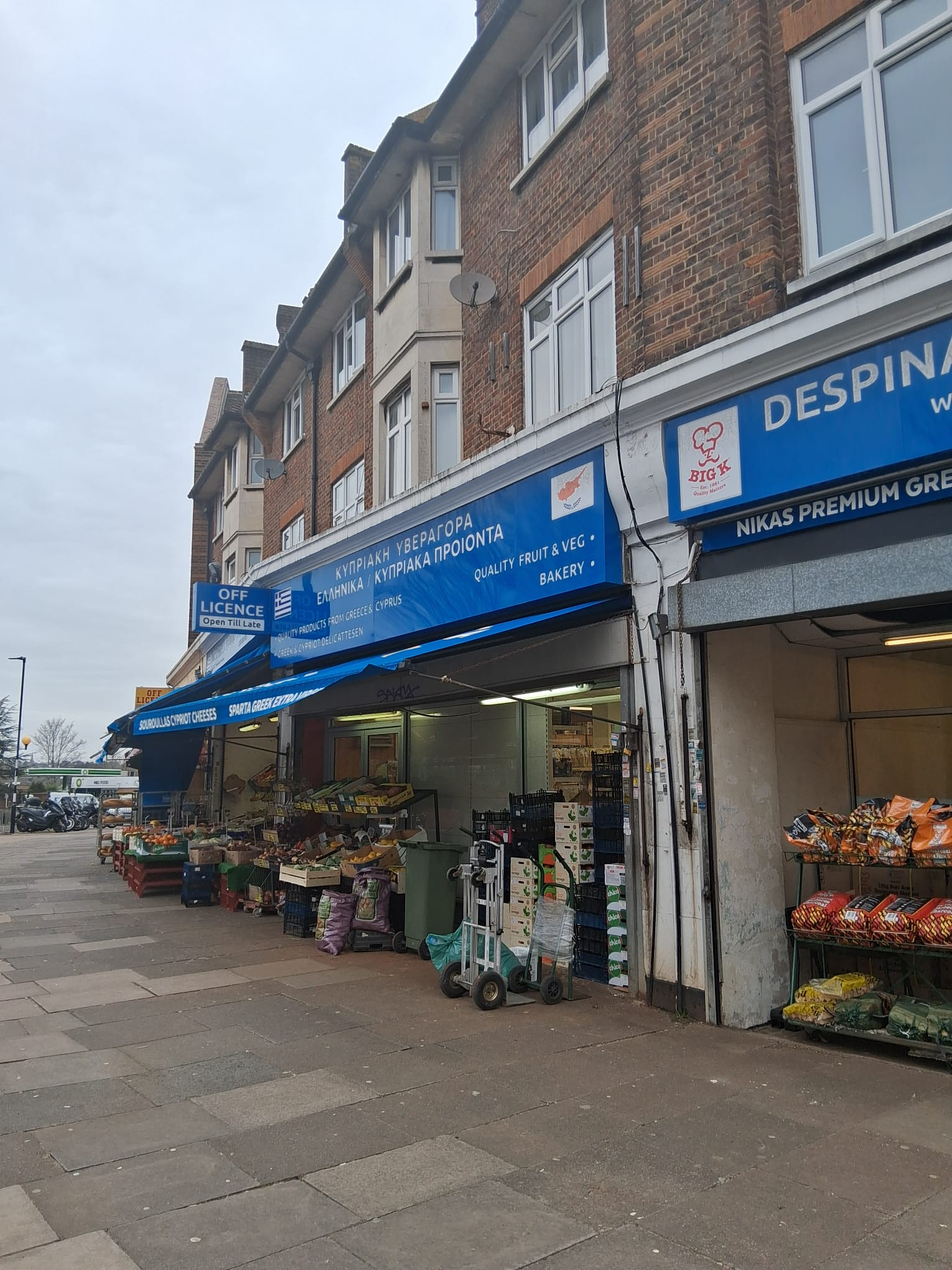
Despinas Greek and Cypriot shop, Southgate, London
Marco is a speaker of both Standard Modern Greek , which is taught at Greek school, and Cypriot Greek, which many Cypriots use at home and day-to-day. It is important to understand the linguistic situation in the Cypriot diaspora, as the varieties used by both Greek and Turkish Cypriots differ heavily from the respective standard forms of Greek and Turkish used in Greece and Turkey. Cypriot Greek and Cypriot Turkish are the main varieties used conversationally in the diaspora and what I heard most around the community. Standard Greek and Turkish are taught in community schools, as the official languages of Cyprus are still the standard varieties of both. Additionally, language teachers and media from Cyprus (but also Greece and Turkey) almost always use the standard form of the language. Anecdotally, I know of Cypriots whose first-generation relatives struggled to understand Standard Modern Greek when transmissions and media first started being broadcast. Now, many Cypriots can speak both the Cypriot variety and the standard variety, or often a mix of both.
Analyzing the statistics, The University of Manchester indicates a rise in Greek language usage in the UK with 50,205 declaring Greek as their main language in the 2011 Census compared to 76,675 in the 2021 Census. These numbers, I should add, are not just restricted to the Cypriot diaspora, as they also include first-generation Greek immigrants in the UK, a community which has grown in recent years. However, even this is a low estimate for diaspora Cypriots as it only concerns “main language”. As a heritage or second home language, the number is likely much higher. A report from 2000 reported there is likely between 280,600 and 300,000 Greek speakers in London alone (Multilingual Capital: The Languages of London’s Schoolchildren and their Relevance to Economic, Social and Educational Policy, Baker. P & Eversley, J., 2000). Most current estimates put it somewhere in the range of 150,000 to 300,000 as the Greek Cypriot diaspora as a whole is believed to be numbered in this range – with the Turkish Cypriot community also believed to be a similar size. It is harder, however, to know the level of language competency in these communities. Many speak Greek to grandparents or first-generation members of family, but with parents, siblings, and cousins English is often common. Many diaspora languages face a similar problem. This is not to say it is unheard of – I have heard younger people talking to their friends in Greek – but it is not the majority. Marco personally says that whilst encountering international students from Greece and Cyprus at university, they often remark on how good his Greek is for a diaspora Cypriot.
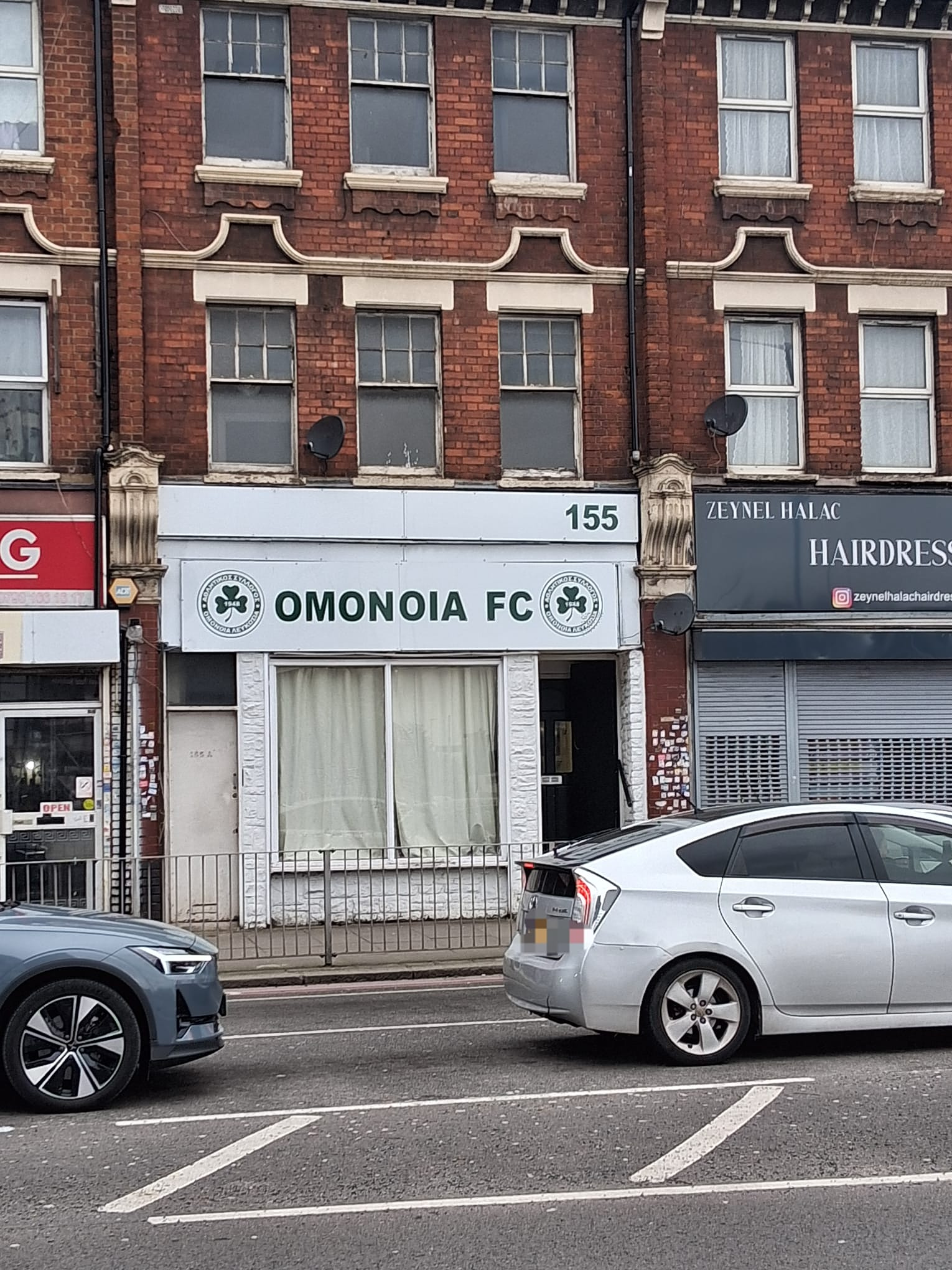
Offices of Cypriot football club Omonoia Nicosia, Green Lanes, London (particularly good i think as not just food)
So I found myself asking the question – what can be done to preserve the language amongst the diaspora? This question affects many other diaspora languages across the world – such as Polish, Punjabi, and Romanian in the UK. Another language challenge preservation in the Cypriot Greek diaspora is the lack of documentation on the Cypriot Greek variety itself. Standard Modern Greek is the focus in schools, with the Cypriot dialect of their first-generation relatives not receiving formal recognition. Anecdotally, Marco noted that, in his particular case, Cypriot Greek was stigmatized in his school where Standard Modern Greek was heavily pushed. It is not impossible for a non-standard variety to flourish in the diaspora – take Mirpuri (a language spoken by many British Pakistanis that is often considered a variety of Punjabi), is believed to be the second largest language in the UK by some sources, just lacking official data and recognition. So it is possible, but more difficult for sure.
Another aspect of the diaspora that I am also reminded of is the presence of Cypriot cultural elements – both Greek and Turkish. Marco was part of a Greek dance troupe based in North London when he was younger. This troupe was not alone, participating in competitions and exhibitions with other Greek (and Balkan) troupes. Dance is taught briefly at Greek school but the opportunity exists for people to get involved in more organized dance. Marco believes cultural practices like dance are important to maintain as they not only bring the diaspora together, but also add more depth to diasporic culture links to the homeland. There also exist many Cypriot businesses – from shops to restaurants – all around the area, especially in the areas around Southgate and Palmers Green – to which Marco and I have been several times to buy Greek, Cypriot, and Turkish products.
View this post on Instagram
My introduction to the diaspora was mainly informal – visits to shops and restaurants, hearing Cypriot Greek on the street, seeing Cypriot diaspora newspapers in the shop. One part of the diaspora, however, that I was not familiar with was organizational support of the Cypriot diaspora and its formal representation. To find out more, I spoke to the President of the National Federation of Cypriots in the UK, Christos Karaolis, about language, cultural preservation, and the work of his organization. The National Federation of Cypriots in the UK, set up in 1974 after the invasion, is the representative body for British Cypriots (Greek and Turkish) to both the British and Cypriot governments. Regarding the language, Christos also mentions the same issue of maintaining the language as generations go by, but work is being done by the NFCUK and its member organizations on the ground to try maintain it. As well as supporting the Greek schools, the NFCUK have also organized Greek language concerts and other such events to attempt to maintain it. They also lobbied the British government to reverse plans to scrap the Greek A Level qualification in the UK. They also have seven seats on their board reserved for younger Cypriots (28-38) so they can get involved with running the organization – aiming to engage the diaspora youth with community advocacy. They have 85 member organizations who receive support from them, which range from Greek language schools to community football leagues. The NFCUK also represent the Turkish Cypriot community. Many of the member organizations are bicommunal for both Greek and Turkish Cypriots, whereas others are specifically Greek or Turkish focused.
Take a look back at our highlights this year working for a #FreeUnitedCyprus and our #UKCypriot diaspora!
Thank you for all your support in 2025 🇨🇾 pic.twitter.com/Bkfy17ATkc
— National Federation of Cypriots in the UK (@UKCypriotFed) December 28, 2025
Much of the organization’s own work focuses on lobbying and awareness to resolve the Cyprus issue, which was the reason that the NFCUK was set up to start with. Recently, for example, they have started a project in which they are creating a database of all the dispossessed properties of British Greek Cypriots in the occupied territories – trying to raise awareness to the British government how seriously the occupation affects British citizens. Since at the time of writing in early February 2026, there is also talk of reopening talks regarding Cyprus, as the representative organization of the UK Cypriot diaspora, NCPUK have been talking to the British government and foreign office about the position they think they should take in these discussions.
Community schools were also a phenomenon that I knew of only at the surface level or through Marco’s experience. I wanted to understand more about how community schools work and how they are supported, so I spoke to Panayiota Serghi, the headteacher of the Greek School of Apostolos Andreas – a member organization of NFCUK and award-winning Greek community school in the city of Birmingham in central England. I spoke to her about her experience as a headteacher of a Greek Saturday school in the UK. Panayiota moved to the UK from Cyprus in 2013, coming to work at Greek schools in the UK through a program run by the Cypriot Ministry of Education – settling in Birmingham to teach at Apostolos Andreas. Panayiota had previously worked as a teacher in Athens and Cyprus, but applying to work in British Greek schools was a new challenge for her. She said whilst she was applying she was not really sure of what these schools were teaching and what they were like. I asked Panayiota more about the program which she applied through and how the Cypriot government supports these schools in the UK. She told me that the Cypriot government has been supporting British Greek schools for over 50 years. One of the ways they support them is through the Cyprus Educational Mission, a mission based in the Cypriot High Commission in London that connects UK diaspora education with the Cypriot Ministry of Education. They employ around twenty full-time teachers, like Panayiota, and a few hundred more part-time teachers around the UK. They give training to these teachers, supply Greek language books from Cyprus, and help organize the curriculum. Greek is taught as a foreign language in the curriculum at Greek language schools, but Panayiota says that these schools are not just language schools but community schools, so the curriculum is not only language. The curriculum is divided into two topics: Greek culture and Greek language. Greek culture is centered around national days, dance, music, history, geography, religious education, mythology, and other cultural aspects. The Greek language teaching at Apostolos Andreas covers levels from age 4 to GCSE (~15/16 years old) and A Level (~17/18 years old) qualifications. Many students choose to do the GCSE to get a qualification in Greek language, but A Level is rarer. Panayiota’s school also encourages students to take Ellinomatheia exams – the qualification recognized internationally by the Greek state. The schools also run Greek language classes for adults who are interested in learning the language.
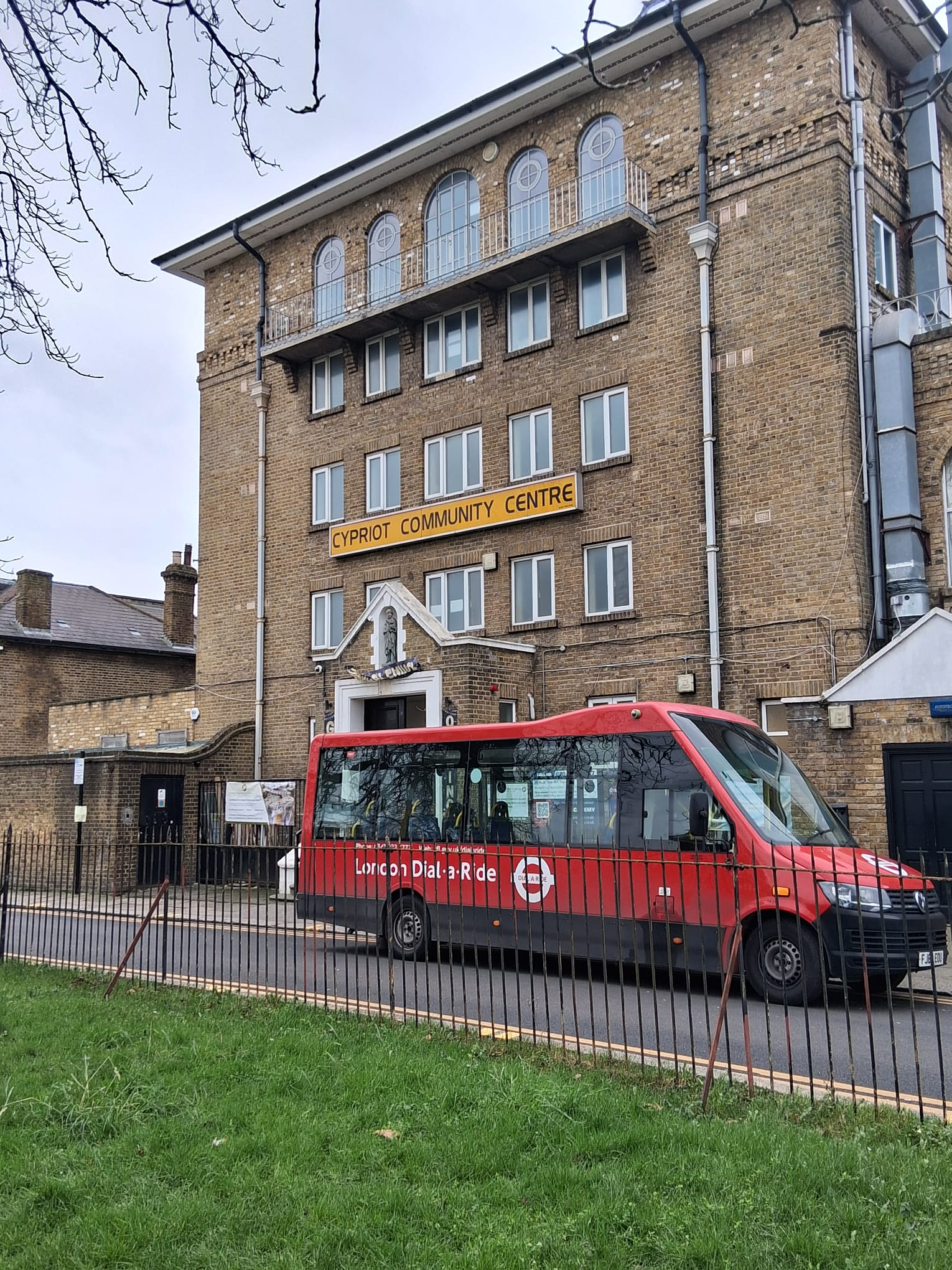
Cypriot Community Centre, Wood Green, London
From my understanding and from talking to Marco, I was aware that these community schools faced their own challenges – both administratively and teaching-wise. I asked Panayiota more about what challenges they face. One of the challenges of teaching the Greek language is the varying levels even in small classes. Some fourth/fifth generation students may have some basic Greek whereas some may have more advanced Greek, especially since more first-generation mainland Greeks have come to the UK since the financial crisis. Therefore, every student has different needs regarding their teaching. As a headteacher, one of her biggest concerns now is finding teachers after the British departure from the EU. Many schools are facing this issue as it is now harder for Greek and Cypriot teachers to stay in the UK long-term, with many of them going back or choosing other EU countries, like Germany, which is easier.
Despite these problems, Panayiota says that these schools are priceless, as they are not compulsory, children giving up time on their Saturdays to learn about Greek culture and language, as well as the fact they often receive support from parents and grandparents to stay running . She says it is an honor to work in a Greek community school – it may be challenging but she believes it is worth it to maintain the community language, culture, and traditions – to keep the sense of patrida alive. This sense of patrida, ‘homeland’ in Greek, is something that resonates with my perception of the community. There is a strong association, even amongst Cypriots who do not know the language or culture as well, with homeland and identity – whether that be culturally, linguistically, or politically.
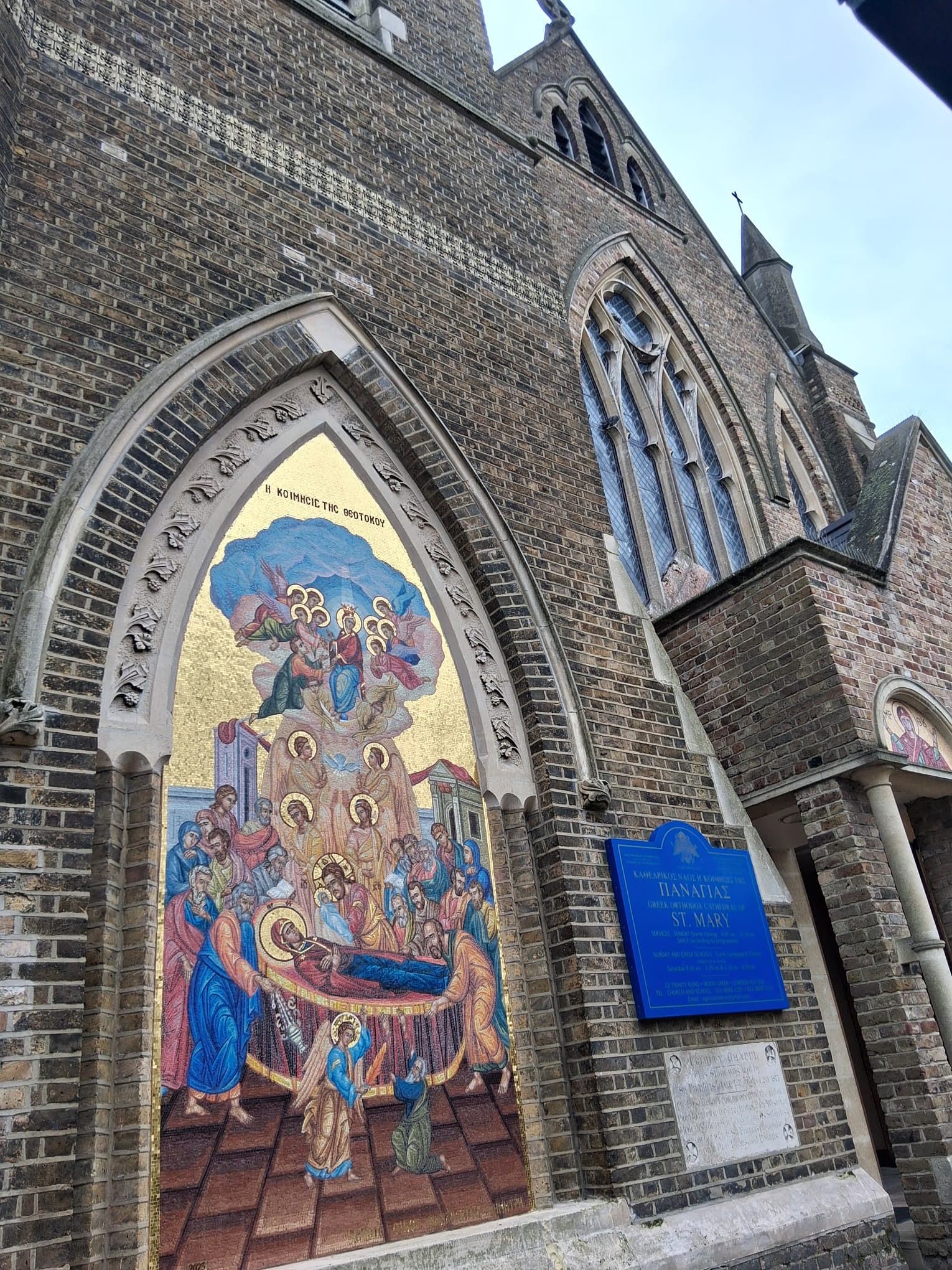
Cathedral of the Dormition of the Mother of God, Wood Green, London
Diving deeper into the Cypriot diaspora over these last few weeks has given me a more detailed overview of the community. My understanding of diaspora identity and organization more widely was basic, so understanding and discussing the specific situation of Cypriots in the UK allowed me to rediscover the community that introduced me to Greek, but this time in a deeper and more holistic way. My experience of years gone by was brief and surface-level, as not being part of the community limited me more to the surface manifestations of shops, restaurants and businesses. I had not encountered the nuanced identity differences that it has, the formal organizations and representatives that help maintain diaspora culture, the struggles of cultural and linguistic preservation and how this is dealt with.