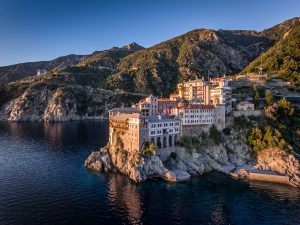
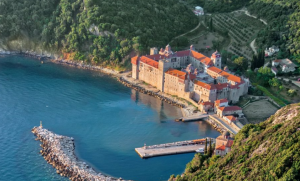
On the day of Pentecost, the first day of the current month, on the deck of the ship operating the return route from the port of Dafni on Mount Athos to Ouranoupoli, the scene causes discomfort. Some men sit on benches shirtless, enjoying the sun; others hold a can of beer in their hands, while just a little further a group of Serbs sings rhythmically, with an intensity that seems out of place for a location associated with silence and prayer. The scene resembles a weekend return from one of the Cycladic islands. Only the departure point was not a beach bar, but the Garden of the Virgin. The snapshot captures the growing flow of pilgrims, as well as of people who arrive on Athos more out of curiosity or a search for experience. But can spirituality coexist with a mass and at times commercialized approach to pilgrimage?
In his conversation with “To Vima,” Alkiviadis Stefanis, administrator of Mount Athos over the past two years, acknowledges the pressure and distortions sometimes created by the increased flow of pilgrims and visitors and, in cooperation with the Holy Community, has already proceeded with a series of interventions aimed at defining limits and safeguarding the character of the Athonite State.
The geopolitics of faith
Until 2021, the Russian element was dominant in organized pilgrimage flows to Mount Athos. However, Russia’s invasion of Ukraine and international sanctions reduced the presence of groups from Moscow and Saint Petersburg. The gap was filled by believers mainly from Balkan countries, with Romania at the forefront. At the same time, the inability to access the Holy Land due to the war in the Middle East also redirected additional Orthodox pilgrims toward Athos. For many societies of Eastern Europe, Athos remains one of the enduring pillars of Orthodox tradition. More than 170,000 people—Greeks and foreigners—now cross each year the borders of the autonomous monastic state, testing the limits of a system designed for a different scale.
This increase has also created a new market around pilgrimage. Travel agencies, mainly in Romania but also in other Orthodox countries, have created organized “religious packages” for Athos: from road trips of around €475 to so-called premium air travel packages reaching €750.
The paradox is evident: on Mount Athos, hospitality, accommodation, and food are traditionally provided free of charge by the monasteries. However, around this informal hospitality, a commercial ecosystem has begun to develop. Mr. Stefanis notes that the administration is closely monitoring the phenomenon and, in cooperation with the Ministry of Tourism, is already taking steps so that pilgrimage does not turn into a tourism product.
“I never put the word ‘tourism’ next to Mount Athos,” says the Athos administrator. “On Athos you do not go to enjoy the sunset, you do not go for a recreational experience. You go to find spiritual answers. Mount Athos cannot be considered an alternative holiday destination. It is a global beacon of Orthodoxy, where monks dedicate themselves to a harsh life of obedience and prayer,” he stresses.
For him, the issue is not only the number of visitors but also their awareness of the place they are in. In fact, he describes incidents that reveal a lack of understanding of the character of the site. “One evening I was in the Administration building in Karyes. I go outside and I see that in a kiosk there were about eight foreign visitors. They had taken a dessert, put candles on it, were drinking beers and singing ‘Happy Birthday.’ I sent the police for recommendations. Laypeople cannot go to a place of such high spiritual value and demand that monks incorporate our habits into their ascetic life.”
Monks and infrastructure under strain
The pressure is also reflected in the daily life of the monasteries. The fathers are often called upon to assume a role that goes beyond traditional hospitality. “Many try to bring all their dilemmas to the elders. They ask them: ‘Should I get vaccinated?’, ‘Which party should I vote for?’ The other day an elder told me laughing: ‘A blessed man called me and asked me which car he should buy.’” At the same time, infrastructure is being tested. Monasteries created for smaller communities are now expected to host hundreds of people. “There is no hotel in Greece with 300 overnight stays per day, yet there are monasteries that receive this number. The Xenophontos Monastery, during a feast day, had to set the refectory table for 280 people three times,” he notes.
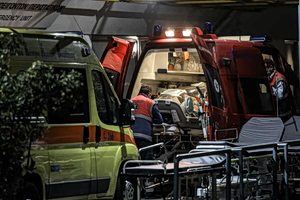
Increased visitation also creates safety issues. Visitors get lost on trails or attempt difficult climbs without proper equipment. “You see visitors trying to climb Mount Athos peak, at 2,000 meters, in flip-flops. They reach 800 meters, get injured, and wait for a helicopter to bring them down. But Mount Athos is not a place for mountaineering, hiking, or sports.”
To address the pressure, new measures were implemented in 2025: a monthly cap of approximately 300 overnight stays per monastery, 50 per skete, and 6 per cell, as well as stricter control over special invitations. The goal, according to Mr. Stefanis, is to limit organized mass flows that could alter the character of the pilgrimage.
Is Athos becoming secularized?
Despite recent pressures, the Athos administrator rejects the view that the Holy Mountain is in an identity crisis or under siege. “Mount Athos resists, and we must support it,” he says. “The toxicity and uncertainty of the modern world drive citizens toward Orthodoxy. Even people without religious faith, when they stand before a monastery and attend a service in the same space where it has been held for centuries, can feel the weight of history,” he concludes.
The stakes are clear: Mount Athos may remain open to pilgrims—after all, the need for spiritual search cannot be measured or evaluated—but it cannot be turned into a “theme park” of Orthodoxy, with monks acting as receptionists, guides, and life coaches. The great struggle of Athos is not against its visitors, but against the idea that everything, even prayer, can be transformed into an experience or, worse, into a product.