
 Μake us preferred on Google
 There is no doubt that during his first term, Donald Trump reshaped—some would say hijacked—the traditional Republican Party, abandoning the more moderate legacy of Ronald Reagan and the two Bush presidents in favor of the much more right-wing populism of Trumpism.
In the even sharper rightward turn of his second term, marked by the intense nationalism and isolationism of the MAGA ideology—which claims it will restore the bygone greatness and power of America, a country Trump claims he inherited in ruins—the ultra-conservative Heritage Foundation played a pivotal role through a 920-page treatise known as Project 2025.
During his 2024 presidential campaign, seeing that this hard-right agenda faced fierce criticism and was hurting him in the polls, Trump feigned ignorance and distanced himself from it, calling it “extreme”. Yet its core ideological lines are plainly visible in his current administration.
Paul Dans, the “architect” and driving force behind the ambitious program, formally entitled “Mandate for Leadership: The Conservative Promise”, says in an exclusive interview with TO BHMA that he takes pride in the adoption of many of the treatise’s central points—written by 35 co-authors—though he believes much more still needs to be done.
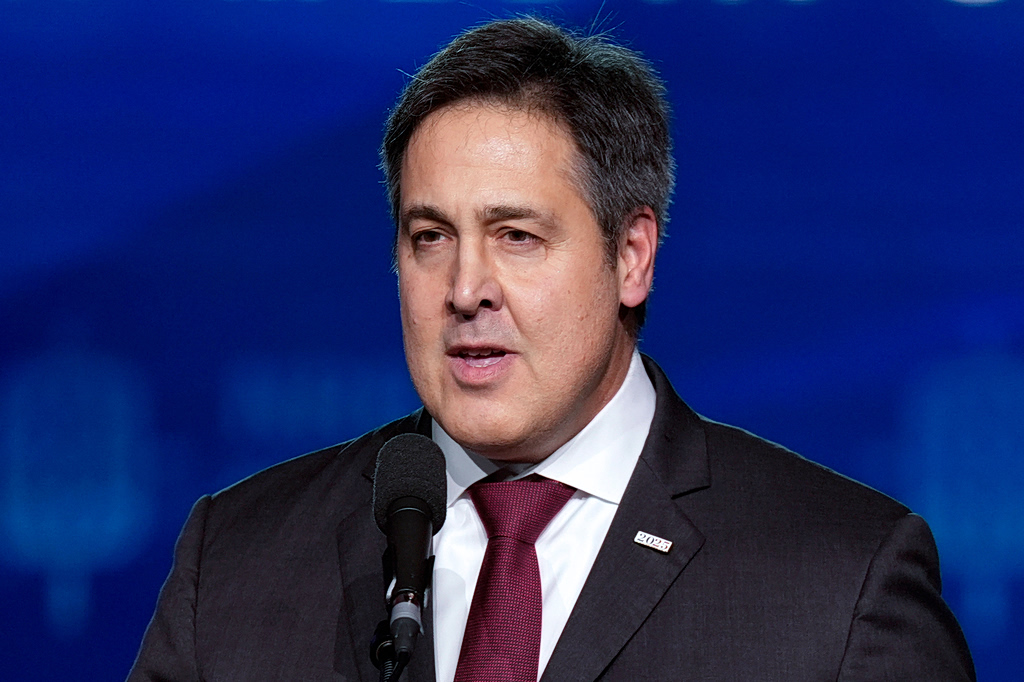
FILE – Paul Dans, director of Project 2025 at the Heritage Foundation, speaks at the National Religious Broadcasters convention, Feb. 22, 2024, in Nashville, Tenn. (AP Photo/George Walker IV, File)
In his first term and now in his second, President Trump totally transformed the Republican Party. If one looks at the party of Ronald Reagan and the two Bush presidents, how would you say he changed the party ideologically and policy-wise?
I think it was putting people back in their government, the fundamental assertion is that we are a government of, by, and for the people. Over time, we’ve been ruled by a privileged elite, a political class. That’s really the notion of putting the people first again, as well as directing the policy towards making their lives better in America, as opposed to always looking abroad or for others’ commercial interests. It is, to be sure, an ongoing process, though, and right now there is a fair amount of turmoil even within the party, so the struggle continues.
Who is in that political class and how are they reacting?
I think the top thing that shows the primacy of the political class was the deindustrialization that happened in America, from about 1990 to the present, and that become manifest all over life on the ground in the U.S. – the joblessness, the kind of despair, the drug culture that grew up, the lawlessness, and now the mass importation of illegals that have brought here.
So, Trump is now pushing towards reestablishing that American post-war industrial base, and the privileged elite, I think, have lashed out. You kind of saw that during the Biden years with a crackdown on personal liberties and constitutional protections.
How did President Biden crack down on personal liberties?
A great example would be the response to COVID and the forced inoculations of people for permission to participate in civic life. It’s the privilege of those who run our life now. You can say it’s big banks, it’s Wall Street, it’s Big Pharma, and it is big media and big law.
I was recently in a place called Hudson Yards in Manhattan, which was a former rail yard, but now it’s dominated by 50-floor skyscrapers, and each one is kind of emblematic. There’s a Pfizer skyscraper, there’s one for CNN, there’s one for a major law firm. It’s also BlackRock [investments giant]. This is kind of who is running the world. This is our privileged elite.
Critics of the president on the left argue that under the Trump administration billionaires are running the country with people like Elon Musk and others. That is, for example, Bernie Sanders’ argument.
I’ll concede that is a fair take. As someone who came into this movement really in order to champion the working class, I’m a little bit dismayed to see people like Howard Lutnick, a guy who profited immensely from Wall Street, now basically running data centers and plunking them down in the middle of the heartland. So yes, I think the reality with modern politics, though, is money. Until we devise a different system, if ever, that’s kind of what goes at the end of the day.
Trump has been transcended as far as the billionaire class, at least in his first term, of being able to resonate with and champion the cause of the common man. Yet, I do believe that in the second term there’s been a crowding out of common people who were more along the lines of restoring the working class and have been helping themselves, shall we say, to the government’s largesse. That’s kind of human nature, unfortunately.
There would have to be a really big revolution for money and PACs not to be the king in politics. To get elected, anybody needs that.
As someone who ran against Lindsey Graham for the United States Senate, as a true believer, and as someone who wanted world stability and to be representative of the man and woman on the soil in South Carolina, I know it can’t be done without money, and right now that’s what is ruling the day. So, I’m for tearing down the system. We have to get money out of politics in some manner. To date, I don’t think the approaches to divorcing money and politics have been effective.
In mid-2024, before the elections, after a backlash President Trump claimed that he knew nothing about Project 2025, that he had no idea who’s behind it, and that it is “extreme”, even though a lot of his people were involved in drafting it. Now he has embraced a good chunk of the Project 2025 agenda. Which are the main pillars of the plan that he has now adopted?
Well, as the architect of Project 2025, it was never about credit or even the glory to go to the project itself. We have a $7 trillion US federal government spending Behemoth that is unmanageable because no one is in charge of it. The seminal part is you have to take control of the bureaucracy and deconstruct it. That’s what overall has taken route. It’s the president reasserting his executive authority under Article II, Section 1, Clause 1 of the Constitution, that all that executive power is vested in the president by the people.
That is one of the criticisms of the administration – that the executive, and in particular the president, is accruing a massive amount of power that it didn’t have before and that the US now has an imperial presidency. Trump has even been depicted as a king with a crown. How do you respond to that?
Well, that’s kind of the new political humor. It’s kind of the latter-day Argonauts kind of stuff. We need executive power to rebuild America. This is a reversal of the last 100 years of the Progressive Era, which was kind of usurping that power and investing it in unaccountable bureaucratic elites. The point is the buck has to stop somewhere, and the framers of the Constitution put it at the president’s desk, to make someone accountable. We are kind of restoring that. Like it or not, you can cheer on Trump or blame him, but at least you can point the finger at somebody. That’ s the promise of the bureaucratic reform.
President Trump promised to pare down a bloated federal bureaucracy, but few expected the magnitude of that, with about a quarter million employees leaving in 2025. If one accepts that an excellent bureaucracy is a necessary component of a strong, effective state, was it possible in such a short time to make meritocratic calls on who stays and who goes, or was it just across the board, in a sense throwing out the baby with the bathwater?
There hadn’t been an attic cleaning in the federal government for 40 or 50 years, to be sure. It is not just the full-time federal workforce. It’s really this huge penumbra which we call the contracting class. What happened in the last 40 years has been kind of an expansion of government through contract. There’s about 15 to 20 million people we call [Washington] “Beltway Bandits”, but are just an entire group of businesses that feed off the federal government. This is really the size of it when we’re talking about the breadth and scope of this $7 trillion monster. That is really where a lot of the reform needs to be targeted.
If you take the long view, when we first set up the civil service in 1883 under the Pendleton Act, 10% of the jobs were consecrated to career protections. Now, fast forward to 2020, 99.7% of the jobs are protected. Only 1/10 of 1% is ever on an annual basis judged to be not performing.
Therein lies the problem, that this pendulum has not just swung all the way to the other side, it’s totally stuck and we had to re-swing it. That’s what happens when you allow a system to organize itself without any sort of accountability. They put the inmates in charge of the asylum, if you will. It was basically reestablishing performance metrics. The seminal proposition is that we have an election every four years to direct the way policy should be administered. It would be an attack on democracy if a president can get in there and not affect the policy that people just voted for. That’s what had been happening, that there was kind of a gilded elite that was being obstreperous and saying “No”, that they knew better. The policy people have to be responsive to the president, or if they aren’t they have to step aside.
Regarding the federal workforce, I want ask about the abolition of the executive branch’s USAID [The United States Agency for International Development]. It was created by JFK and had 65 years of experience. Only 10,000 people were employed there. The 5th biggest recipients of aid in 2024 were the West Bank and Gaza ($918mn). Is it possible that the decision to close USAID was more ideological than financial, as has been said? Also, is it possible that this administration doesn’t really understand the importance of American soft power in projecting US influence and power around the world?
I think the reason is different. We need USAID to the USA. The problem is that we have spent trillions of dollars on foreign wars and building abroad. Meanwhile, infrastructure is literally crumbling in the United States.
Beyond the humanitarian side, didn’t that money enhance US influence internationally?
Well, the influence to do what – to go break up countries and kill brown people? What are we doing making a privileged elite able to put their factories there and subjugate child labor?
Are you saying that this is what USAID did, subjugating child labor?
I’m saying that the very fact of purposing our attention abroad necessarily diminishes life at home, and the new focus has to be on building back our own property, our own people. That is why there is a complete, reflexive “No” when it comes to foreign aid. It’s preposterous that we’re giving foreign aid to countries that run a surplus! I mean, who would ever have thought of such a thing?
Which countries are those?
We’re borrowing money from the Chinese to pay the civil servants of Ukraine! It’s absurd. Meanwhile, our people can’t even afford meat. Why are we propping up Israel when they have tens of billions of dollars and run a surplus?
What does President Trump have to say about that?
Well, I think that President Trump right now is in a position where he is addressing all these fires that have been going on and have been started by prior administrations. The reality is that the system of USAID ran counter to Trump in the first term. To be sure, it was actually flouting a lot of his foreign policy. That was the problem, that we were literally undercutting the Secretary of State through the USAID mechanism. He has brought that to heel again.
You asked why are we giving tens of billions to Israel. Would you agree with critics who attribute this in part to the powerful influence wielded by the Israeli lobby AIPAC (American Israel Public Affairs Committee) in Washington?
Look, we have a problem with foreign influence in the United States, and AIPAC is one, but certainly the Chinese [Chinese-Americans’ and foreign proxies’ campaign contributions] is the other. Therein lies the problem – that we have Americans who are not operating in America’s interest. I think that genre of organization needs to be outlawed. This needs to be at least fully exposed and we need to say, “Look, you can’t have foreign influence with that sort of money.” This is what I ran into in my Senate run against Lindsay Graham [a Chinese-born biotech executive in South Carolina allegedly made a donation to his campaign]. I am not from some elite wealthy background, so I have to rely on donors, but I would never be able to match the amount of money they put behind my opponent. That is true across the board for many other candidates who are “America First”.
It is said by people like Bernie Sanders that if you go against a powerful lobby, they will run a candidate against you and you will lose the election. Is that how it works?
That is how it seems to be working right now. I am hoping that there are candidates who are going to transcend this. Now it is like swimming upstream. I think it has to be outlawed. AIPAC should be outlawed.
Looking abroad, the US in Iran has been forced to sit at the table with the hardline IRGC [Islamic Revolutionary Guard Corps]. If the US makes various concessions to them, wouldn’t this be a very significant strategic defeat and blow to America’s prestige that will take time to recover from?
I would end our whole intervention in the Middle East tomorrow if we could. We need to be focusing on Asia. Right now, we are just draining our armaments and having war fatigue. Basically we are allowing China to grow stronger by the day. I find some of the rationale for going into Iran absurd. As a devout Christian, what is happening in Lebanon right now really bothers me. Ιt is hard to say that some of this stuff was not, as my friends on the left might say, genocide. There is no rational reason to go after the unarmed populace like that in Gaza.
Why is it, do you think, that the president just turned the other way while tens of thousands were being killed in Gaza and the whole place was levelled to the ground? What does that say about America’s moral standing?
Again, I think that there is unnatural foreign influence being peddled all the way to the Oval Office. This is where the proposition to outlaw AIPAC comes in. Yes, it is beyond regrettable. This is the sort of thing we are going to have to answer for when we go before the Almighty. On the human level, I cannot explain this away.
I am a believer in President Trump, but when you get to that level, everyone is coming at you. There are very powerful forces, dark forces that can win the day unless you have the moral compass to basically say “No”. To be fair to President Trump, this started under Joe Biden. That is why they call him “genocide Joe” [an estimated 50,000 had been killed when Trump took office on 20 January, 2025]. This is a bipartisan foreign influence peddling operation, and you cannot say that the Democrat Party is immune from it. The Democrat Party has been fueled by the whole thing. That is the one issue people can agree on, on both sides. They are happy to take money from AIPAC.
President Trump has been highly critical of America’s crucial post-World War II multilateral alliances with the Europeans and with NATO, but most observers think they were critical for global security and projecting American power. What is your take?
I would say as a conservative that I stand with the EU. The organization and the purpose have changed. Europeans now have to take fundamental responsibility for defending themselves and the continent. They do that by building their own weapons now and letting us have healthcare. We have allowed you [the EU] to have healthcare, and we build your weapons, but the battle of the 21st century is in the East, so we are going to need one another.