

 Μake us preferred on Google
 The scientific community’s reaction was immediate and condemnatory: He was sentenced to three years in prison and fined three million yuan. His case sparked an intense ethical debate that continues to this day.
The tools of modern genetics
Today, science has methods that allow for the prevention of certain hereditary diseases even before a child is born. The most common is in vitro fertilization combined with preimplantation genetic diagnosis, which allows for the selection of embryos without specific serious mutations. In specific cases, mitochondrial replacement, also known as the “three-parent” technique, is used to prevent mitochondrial diseases.
CRISPR is a tool that functions like “molecular scissors” and allows scientists to locate a specific site in DNA and alter it. It originates from a natural defense mechanism in bacteria, which helps them recognize and cut viral DNA. In the lab, scientists use it to correct, remove, or deactivate genes. Its great significance lies in the fact that it has opened new avenues in gene therapy and biotechnology.
However, its use in human embryos remains strictly limited. The reason is that such changes may be permanent and passed on to future generations. Thus, the big question today is not only what science can do, but also what it should be allowed to do.
From Plato to gene editing
The desire to control our genetic heritage is not new — it is as old as civilization itself. In the Republic, Plato suggested that reproduction in the ideal city should not be left to chance: the finest guardians should mate more frequently with the finest women so that the best children would be born, while the offspring of the “inferior” would be secretly removed. Reproduction, for Plato, was a matter for the state, not the individual.
This practice was not merely theoretical in ancient Greece. In Sparta, newborns were examined by the city-state’s elders immediately after birth: those deemed weak or deformed were, according to later tradition, thrown into the Keadas — a deep chasm in Mount Taygetus. Survival was not a right but a privilege granted only to those deemed fit to serve the military city-state. Ancient Sparta, in essence, practiced a brutal form of eugenics millennia before the term was coined.
Worldwide, this logic — that certain people are more “suitable” to reproduce — was not always limited to philosophical theory. In India, the caste system enforced strict endogamy for millennia: marriages took place exclusively within the same caste, maintaining the “genetic purity” of each social group. Genetic studies show that this practice, which became established about 2,000 years ago, created population groups so genetically distinct that the genetic divergence between some neighboring communities can exceed that between Northern and Southern Europe. In Europe, in turn, aristocratic marriages served as a mechanism for preserving both wealth and “blood” within a closed circle of the privileged — the royal houses of Europe married among themselves for centuries, consolidating power but also increasing the risk of serious genetic problems.
The modern version of this desire took on a scientific guise in the early 20th century. The eugenics movement, inspired by the theories of Francis Galton, advocated selective breeding as a means of social progress. The consequences were tragic: forced sterilization programs in many countries and, ultimately, the horrific implementation of eugenics by the Nazi regime. After World War II, eugenics was condemned as scientifically unfounded and morally reprehensible.
However, technology continued to advance. The discovery of the structure of DNA in 1953 by Watson and Crick, the development of in vitro fertilization (IVF) in the 1970s, the mapping of the human genome in 2003, and the invention of CRISPR‑Cas9 have opened up avenues that once belonged to the realm of science fiction. Preimplantation genetic diagnosis (PGD) now allows parents to select embryos based on genetic characteristics, while CRISPR offers the potential for direct DNA editing. The question is no longer whether we can, but whether we should.
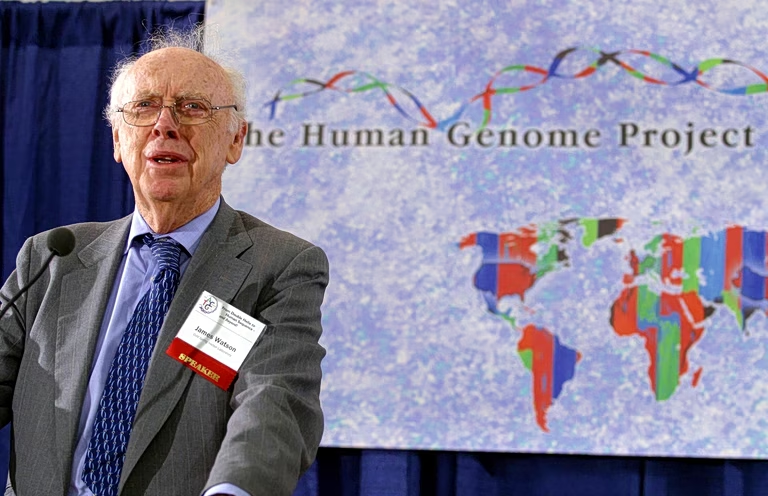
James Watson
The Principle of Procreative Beneficence
The philosopher Julian Savulescu formulated the principle of “procreative beneficence”: every prospective parent has a duty to choose, from among the potential children they could have, the one expected to have the best life. This principle does not concern only the avoidance of diseases — it extends to the selection of traits related to intelligence or a predisposition for well-being. For Savulescu, parents have not merely the right, but the moral obligation to choose the “best” child.
But what does “a better life” mean? And who defines it?

Francis Crick

Julian Savulescu
Deafness: disability or a different way of being?
One of the most provocative examples discussed in bioethics regarding “designer babies” concerns the hypothetical case of a deaf couple who would use preimplantation genetic diagnosis (PGD) to ensure that their child is born deaf. The reasoning of such a couple would be that, as deaf parents, they can offer better guidance to a child who shares their lived experience and grows up within Deaf culture.
This scenario raises a fundamental philosophical question: is disability inherently negative, or simply a different form of human experience? Philosopher Elizabeth Barnes distinguishes two perspectives. The first, the “bad-difference view,” argues that disability inherently makes someone worse off — regardless of social circumstances. The second, the “mere-difference view,” argues that disability is not in itself something bad — like gender, ethnicity, or sexual orientation, it is an aspect of human diversity.
This distinction has enormous implications for the argument regarding genetic selection. If deafness is a “bad difference,” then selecting for it is morally problematic. But if it is a “mere difference” — a different way of experiencing the world, such as how a deaf person experiences music as vibration rather than sound — then the selection of deafness is not necessarily morally reprehensible. Our society, however, is designed for the hearing majority, and this makes deafness a “disability,” not because it is an inherently inferior condition, but because auditory perception is the norm.
Parents, culture, and the child’s rights
The philosopher Robert Sparrow offers a different perspective. He argues that parents may be better suited to raise children who share their culture. A deaf child with deaf parents grows up in an environment of complete understanding, belongs to a community that recognizes them, and feels like a member of their family without the sense of being “different.” If the principle of procreative beneficence takes into account the quality of the parent-child relationship and cultural integration, then the principle itself argues that deaf parents should choose a deaf child.
On the other hand, deaf parents are not in a position to fully prepare a child to navigate the hearing world, a world where prejudices against difference are real and tangible. Does this mean that the lives of people with disabilities are worth less?
CRISPR and the new frontier
It is worth noting, however, that the above scenario remains primarily a theoretical example in the bioethical debate. In most countries, the use of preimplantation genetic diagnosis is regulated so that it is permitted only to prevent serious hereditary diseases, and not for the selection of non-medical characteristics or for the deliberate selection of disabilities such as deafness. The deliberate selection of a disability is widely considered ethically problematic and is generally not approved by the relevant committees and clinics, although the legal framework is not entirely uniform internationally.
With CRISPR‑Cas9 technology, the possibilities are dramatically expanded. We are no longer talking merely about embryo selection, but about the prospect of directly editing the human genome in germ cells and embryos, with changes that are passed down to future generations. Following the He case, international scientific societies and organizations called in 2019 for a moratorium (for example, ten years) on heritable gene editing for reproductive purposes, that is, on its use to create genetically modified children. Yet despite these calls, new entities and companies continue to emerge with ambitious visions for future “genetically enhanced” children, intensifying fears of the gradual commodification of human reproduction.

He Jiankui
The problem is not only ethical but also scientific. Analysis of He’s experiment showed that Lulu and Nana did not precisely acquire the intended mutation in the CCR5 gene, but instead developed new variants with uncertain consequences for their health. The risks of “off-target” mutations and mosaicism remain significant, and most scientific publications highlight serious safety concerns and potential harm associated with editing the inherited genetic lineage.
Eugenics 2.0?
Critics warn of a new form of eugenics, not state-sponsored this time, but market-driven. A “high-tech market eugenics,” where those with the financial means will be able to “design” their children, exacerbating existing inequalities. Bioethicist Françoise Baylis describes it as a continuation of the eugenics program that has at times dominated our culture.
The difference is that today the choice appears to lie with the individual, not the state, which makes it more palatable but no less dangerous. Who defines what constitutes a “desirable” trait? Who decides which life is worth living? And who will have access to these technologies?
Genetics and reincarnation
A question that is rarely asked, but is worth considering, concerns cultures that believe in reincarnation, hundreds of millions of people in Hindu, Buddhist, and other traditions. If the soul chooses or is destined for a specific body and a specific biological fate, what does genetic modification mean? Who ultimately reincarnates, and in what form, when the body’s biology has been artificially altered?
This idea is not exclusively “Eastern.” In the Greek philosophical tradition, the Neoplatonic philosophers accepted reincarnation as a fundamental principle. Plotinus taught that the soul, after death, is reincarnated in a form corresponding to the life it lived. His student Porphyry, as well as Iamblichus and Proclus, followed the same Platonic tradition: the soul is punished or rewarded according to its choices, it may descend into lower beings if it lived wickedly, or ascend toward divinity if it practiced virtue. So, if genetic intervention alters a person’s biological “fate,” a profound metaphysical question arises: are we interfering with the cosmic plan that determines the soul’s evolution?
Control or acceptance?
There is another perspective: perhaps genetic intervention itself is fundamentally the wrong path. Perhaps leaving things to chance is not a weakness, but an exercise in acceptance rather than control.
The Christian Church, both Catholic and Orthodox, shares a common fundamental framework: acceptance of life as a “gift” from God and strong reservations regarding technologies that treat the human embryo as an object of experimentation or enhancement.
Nature, after all, harbors balances that we are only beginning to understand and many that we may never understand. We observe, for example, that the ratio of males to females at birth remains remarkably stable globally, approximately 105 boys for every 100 girls, although individual births are influenced by biological and social factors. But when we massively interfere with these balances, the consequences can be dramatic: in China, the one-child policy, combined with a preference for boys and practices such as selective abortions and the lethal abandonment of newborn girls, has led to a severe gender imbalance, with millions more men than women. In some regions, this “shortage of women” has been linked to an increase in human trafficking and the abduction of women for forced marriages. There are many such phenomena, subtle interdependencies in biology, ecology, and genetic diversity, that act as invisible regulators of life. If we tamper with something we do not fully understand, the consequences can be unpredictable, not only for individuals but for entire societies and the planet.
And there is something deeper: the relativity of reality itself. What we consider “normal” and “desirable” is always culturally and historically charged. When we attempt to genetically “correct” humans, we imply that we know what a “proper” human is, and this is an assumption that history has taught us to question.
Parents’ desire to protect their children from pain is deeply human. But the line between treatment and “enhancement” is blurred. When gene editing is used on somatic cells to treat serious hereditary diseases in living patients, such as the recently approved CRISPR therapies for sickle cell anemia and beta-thalassemia, most agree that this is an ethically acceptable use. But when we talk about selecting traits such as gender, intelligence, height, or eye colour, we enter dangerous territory.
The debate over genetically engineered babies is not just about biology or technology. It is about who we are and who we want to become. And perhaps the truest answer is not control, but acceptance of the uncertainty that accompanies every human life. Leaving things to chance is not always resignation; it is a recognition that nature holds wisdom we have not yet deciphered and that humility in the face of the unknown may be the wisest stance toward our species’ future.