Migration and refugee flows have emerged as one of the most critical, complex and increasingly global phenomena of our era. Democratic societies are being called upon to tackle the profound challenges and critical questions these issues pose—issues which touch upon their fundamental principles, values, and very social cohesion.
Understanding this complexity demands holistic, empathetic analysis that delves deep both into the painful experiences of people forced to flee their homelands and the migrants’ potential impact on the fragile equilibria of the democratic states they flee to.
Our research and the interviews we conducted with refugees, asylum seekers and asylum officers at the Pournara First Reception Center in Kokkinotrimithia, Cyprus, as well as with academics produced some important findings.
Specifically, we spoke with the following academics from Frederick University: Andreas Panagiotou, Associate Professor of Sociology; Professor Loukia Demetriou, who teaches Intercultural Developmental Psychology in the Department of Education and Social Sciences; and Assistant Professor Ivy Lambrou. We also interviewed officials from within the asylum system: Andreas Agrotis, administrative officer and head of the Pournara First Reception Center, Dimitra Themistokleous, Christina Pantelidou and Stéphanie Violari.
Anxiety, fear and a desire for safety
At the heart of the migration phenomenon, we find human stories full of anguish, fear and an unquenchable desire for safety and dignity. The reasons people quit their homes are multiple and interrelated. Wars, civil strife, the threat of terrorism and more generalized insecurity are uprooting entire communities and forcing them to embark on an uncertain and dangerous journey to survival.
At the same time, poverty, a lack of educational and employment opportunities coupled with systematic human rights abuses are pushing many others to seek a better life for themselves and their families.
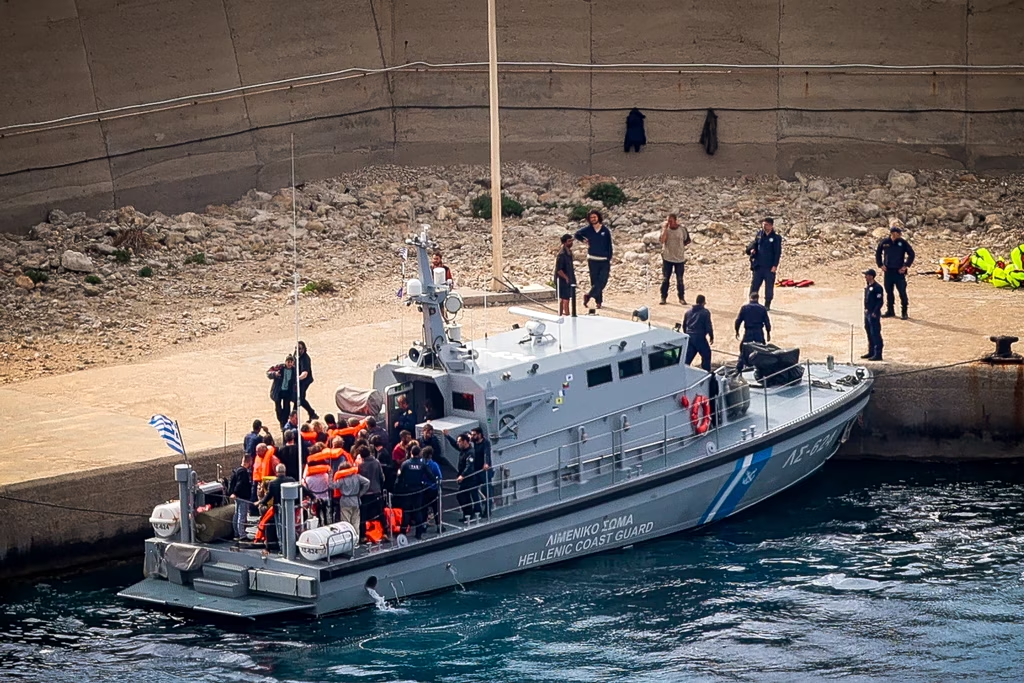
The journey to safety is often a nightmare. Refugees face the suffering of sea crossings, the darkness of abandonment, exploitation by trafficking rings, and the unbearable anxiety of not knowing what the future will bring.
In addition, the financial cost of the flight to safety can be devastating, forcing families to sacrifice everything they own. Arriving in a new and unfamiliar country brings with it a jumble of emotions. But relief and a sense of basic security often predominate, as hope for a more humane future is born. Nonetheless, adapting to a new society with an unfamiliar language and culture and a different set of rules is a huge challenge that requires time, resilience and meaningful support.
The influx of refugees poses profound questions for democratic societies, too, as it touches the very core of their values and practices. Migration can impact democratic processes and social cohesion in a number of often contradictory ways.
On the one hand, the arrival of new cultures and ideas can act as a catalyst for the enrichment of society. Pluralism, tolerance and respect for the minority rights—all fundamental components of a healthy democracy—can be enhanced through interaction with different perspectives and experiences.
Migration brings with it diversity, which can promote democratic ideals and challenge stereotypes and prejudices. And over time, migrants and their descendants can integrate into political and civic life. By claiming their rights to inclusion, to the vote and to equal representation, they will enhance democratic participation and representation.
The instrumentalization of refugee flows
On the other hand, the increase in refugee flows may also give rise to concerns and fears about national identity, established cultural values and social cohesion.
When these concerns are not addressed in a calm and clear-headed manner through dialogue, they can lead to social tensions and division. In some cases, refugee flows can be instrumentalized by populist and far-right movements intent on stoking public fears and promoting xenophobic and racist rhetoric. This can lead to discrimination, racist attacks, and restrictions on refugees’ rights, undermining the fundamental principles of equality and human dignity that constitute the very core of democracy.
It is vital that refugees are successfully integrated into their host society; by promoting social cohesion, the social tensions that can stem from the parallel societies that would otherwise form can be avoided. Policies aimed at providing migrants and refugees with quality education, helping them learn the language of the host country, giving them access to the labor market and to decent housing, as well as effectively combating discrimination in all its forms, are essential if this crucial goal is to be achieved.
Moreover, as our interviewees stressed, increased migration can pose questions about a society’s national identity and cultural values. Some citizens may feel that increased cultural diversity poses a threat to traditional values and a sense of national unity. However, it is important to recognize that migration can also lead to a dynamic enrichment and renewal of the host culture, enhancing creativity, innovation and a society’s ability to adapt to changing global conditions.
Risks and opportunities
Refugee flows undoubtedly come with both risks and significant opportunities attached for democratic societies. Uncontrolled or poorly managed migration can lead to social tensions, political polarization, the rise of populism, and the gradual erosion of democratic values. Failure to effectively integrate refugees can create social exclusion and marginalization, undermining social cohesion more broadly.
However, when managed wisely and humanely, migration can shore up democracy in a powerful and meaningful way. By promoting diversity, tolerance and social justice, the successful integration of refugees can lead to a more resilient and inclusive society. In addition, refugees’ active participation in the social and political life of their host country can enrich the public discourse with new perspectives and help make democratic institutions more representativeness of the people they are there to serve.
Suggestions and best practices
To ensure that refugee flows represent an opportunity to strengthen society rather a threat to it, certain fundamental principles and practices need to be adopted.
First and foremost, the protection of refugees’ rights, including the inalienable right to asylum, is a fundamental principle that cannot and must not be called into question in any democratic society. A democratic government must respect and protect the rights of all the people on its territory, regardless of their origin or legal status. Social peace and prosperity are inextricably linked to the universal protection of rights.
Second, the policies implemented must seek to integrate refugees into the host society smoothly and effectively. Providing access to quality education, employment opportunities, decent housing and other basic services is essential if refugees are to be empowered and contribute to society in their turn. Policies that strengthen social cohesion and mitigate stereotypes and prejudices are effective, as well as those that ensure transparency and mutual respect between different groups.
Thirdly, as our academic interlocutors explained to us, promoting meaningful dialogue and mutual understanding between different social groups is essential for easing tensions and building a more tolerant and inclusive society. Social cohesion is directly affected by a state’s policies in relation to, among other things, the implementation of equality and equal opportunities for all. The challenge posed by migration highlights the crucial importance of democratic values and the need for them to be applied universally.
Finally, governments, the media and civil society must work closely together to effectively combat xenophobia, racism and discrimination in all its forms. Managing refugee flows is not a national issue; it requires international cooperation and solidarity, as well as a fair distribution of responsibilities among states.
Ongoing evaluations over time
It is important to stress that no policy can deliver immediate results. Successful integration requires time, the ongoing evaluation of the policies in place, flexibility in adapting them to changing needs, and above all consistency in their implementation.
Policies that have shown positive results—such as access to a transparent and fair asylum system, comprehensive integration programs combining language tuition, intercultural education and vocational guidance, as well as ensuring effective access to the labor market—are crucial steps in the right direction.
Ultimately, refugee flows are a complex and ongoing challenge for democratic societies. Responding to this challenge requires a balanced and multi-dimensional approach that combines the unconditional protection of refugees’ rights with the active promotion of social cohesion and the effective strengthening of fundamental democratic values. Failing to effectively address this challenge could have serious and long-term consequences for the future of democracy and of the human race. Success, on the other hand, can lead to a more resilient, inclusive and humane society in which diversity, far from posing a threat, is a source of strength and progress.
This article was originally published in the insert “The European BHMA” published with “TO BHMA on Sunday” on 11 May 2025.