On September 27, Aleksandar Vučić, who has dominated Serbian politics as either prime minister or president since 2014, resigned seven months before the end of his second and final presidential term. Barred from seeking a third term, he is now attempting to extend his hold on power through the October 25 parliamentary election, running on the Serbian Progressive Party (SNS) ballot with the expectation that, if the party secures a governing majority, parliament would return him to the premiership — an office he previously held before becoming president in 2017.
The manoeuvre has created an unusual political moment: Vučić is relinquishing one office while seeking to re-enter government through another, more directly executive one. The election will therefore test not only the durability of Serbia’s dominant political figure, but the resilience of a system built around more than a decade of his rule.
For the first time in years, that system also faces a challenger largely born outside Serbia’s established opposition parties.
“It is the first time that there appears to be a strong electoral force capable of challenging Vučić’s primacy,” says Ioannis Armakolas, Associate Professor of Comparative Politics of South-East Europe at the University of Macedonia and Senior Research Fellow at the Hellenic Foundation for European & Foreign Policy (ELIAMEP). Speaking to TO VIMA International Edition he cautions against interpreting that challenge as an inevitable transfer of power. “Political change remains very difficult even now,” he says, “despite the fact that we recognise that this is the first time in many years that we are seeing a strong contender”.
From Novi Sad to the ballot box
On November 1, 2024, a concrete canopy at Novi Sad railway station collapsed, eventually killing 16 people. The station had recently been renovated as part of Serbia’s flagship rail modernisation programme. The disaster quickly became a symbol of wider concerns about how major public projects were awarded and supervised. Protesters and opposition figures argued that opaque contracting and political patronage had weakened accountability and contributed to poor oversight. The government rejected claims that corruption caused the collapse, however, the investigation, which later reached senior officials and project supervisors, has turned a structural failure into a broader challenge to the way the Serbian state manages public works and political responsibility.
Students led a movement that expanded from vigils and blockades into nationwide demonstrations. Mass demonstrations steadily grew and became a much broader expression of public frustration, drawing in professional groups, workers, rural communities and ordinary citizens who saw the Novi Sad disaster as evidence of deeper failures in the way the country was governed. The movement consequently grew into the most sustained challenge to Vučić’s political dominance in years.
Nearly two years later, that mobilisation has moved from the universities and streets to electoral politics. A student-backed electoral list, Studentska lista (Student List), will contest the October election, drawing candidates from academia, education and professional life, many without previous party affiliation and spanning a broad range of political views. Student activists have continued to frame the campaign around constitutionalism, institutional accountability and the rule of law.
What began as a demand for accountability over the deaths in Novi Sad has since developed into a broader bid for political power and is now polling in a range that makes it a genuine national challenger. Yet the movement’s strength- its ability to draw support from across Serbia’s ideological spectrum- also makes it difficult to define in conventional political terms. “It is not, for example, a pro-European movement against a Vučić who openly converses with Russia and China,” says Armakolas, “it is a broad movement that includes liberals, pro-Europeans, anti-nationalists and nationalists.”
That breadth complicates any simple reading of the election as a contest between an eastward-looking government and a uniformly pro-European opposition. The movement is held together more by opposition to the political order built around Vučić than by consensus over Serbia’s place in the world.
That ambiguity will become harder to preserve if electoral success forces the movement to define itself on the issues that have long shaped Serbian foreign policy. Russia has already provided an early test. On September 30, the Student List on their official X account stated that Serbia should continue to refrain from imposing sanctions on Moscow, invoking the country’s own experience of sanctions and questioning their value as a political instrument.
The statement points to a broader constraint on any post-Vučić order: political opposition to the president does not automatically translate into a rejection of Serbia’s established strategic instincts.
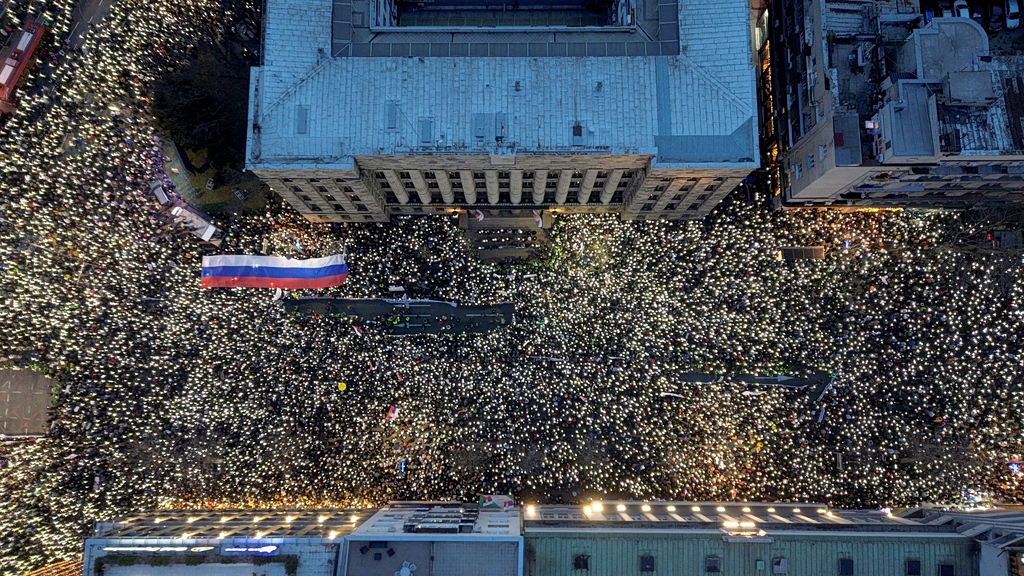
People gather in front of the constitutional court as students protest against government policies, corruption, and negligence, which they blame for the deaths of the victims in the November 2024 Novi Sad railway station disaster, in Belgrade, Serbia, January 12, 2025. REUTERS/Djordje Kojadinovic TPX IMAGES OF THE DAY
Europe — without fully choosing Europe
Serbia applied for EU membership in 2009, became a candidate in 2012 and opened accession talks in 2014. The EU remains by far Serbia’s most important economic partner, accounting for 58.3 per cent of its total trade in 2024 with EU companies having supplied about 56 per cent of foreign direct investment between 2010 and 2024, worth roughly €24bn, while Brussels remains the country’s largest source of financial assistance. Yet Belgrade has preserved close ties with both Russia and China, refusing to join EU sanctions on Moscow and maintaining positions at odds with Brussels on several foreign-policy issues.
Vučić has presented that approach as strategic autonomy rather than geopolitical indecision. In his resignation remarks, he again defended the balancing act that has defined his rule: resisting pressure over Russia while maintaining ties with Beijing, Washington and Europe’s major capitals.
Armakolas argues that the strategy has endured partly because EU membership itself has remained remote. “One could say that the political model Vučić has pursued has been successful, primarily because the European perspective has not moved forward,” he says.
For years, European governments relied on Belgrade as an interlocutor on Kosovo, Bosnia and wider regional security. Vučić remained central to that diplomacy even as criticism mounted over Serbia’s democratic trajectory.
Russia’s full-scale invasion of Ukraine altered that calculation. Eastern and northern European member states now view Serbia’s ties with Moscow through a much more explicitly strategic lens, while enlargement itself has been reframed as part of European security policy.
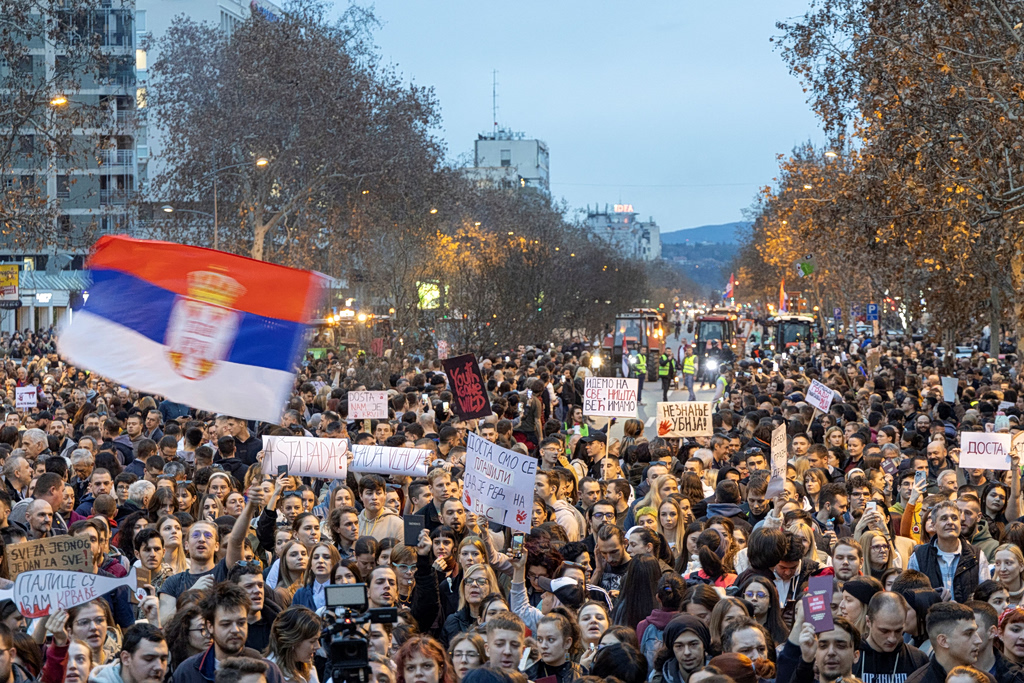
Serbian students protest in front of the ruling Serbian Progressive Party (SNS) headquarters following the overnight beating of their colleagues by what they say were SNS activists, in Novi Sad, Serbia, January 28, 2025. REUTERS/Mitar Mitrovic NO RESALES. NO ARCHIVES
Between Moscow and Beijing
Serbia’s relationship with Russia is rooted in history, culture and Moscow’s backing over Kosovo. Belgrade has nevertheless supported Ukraine’s territorial integrity while refusing to join EU sanctions, a hallmark of Vučić’s balancing strategy.
China’s role on the other hand, is more economic. Beijing has become a major investor in Serbian infrastructure, mining and industry, while the two countries deepened ties during Xi Jinping’s 2024 visit and through a bilateral free-trade agreement. A future government would therefore inherit not just a diplomatic relationship with China, but one embedded in Serbia’s economic model.
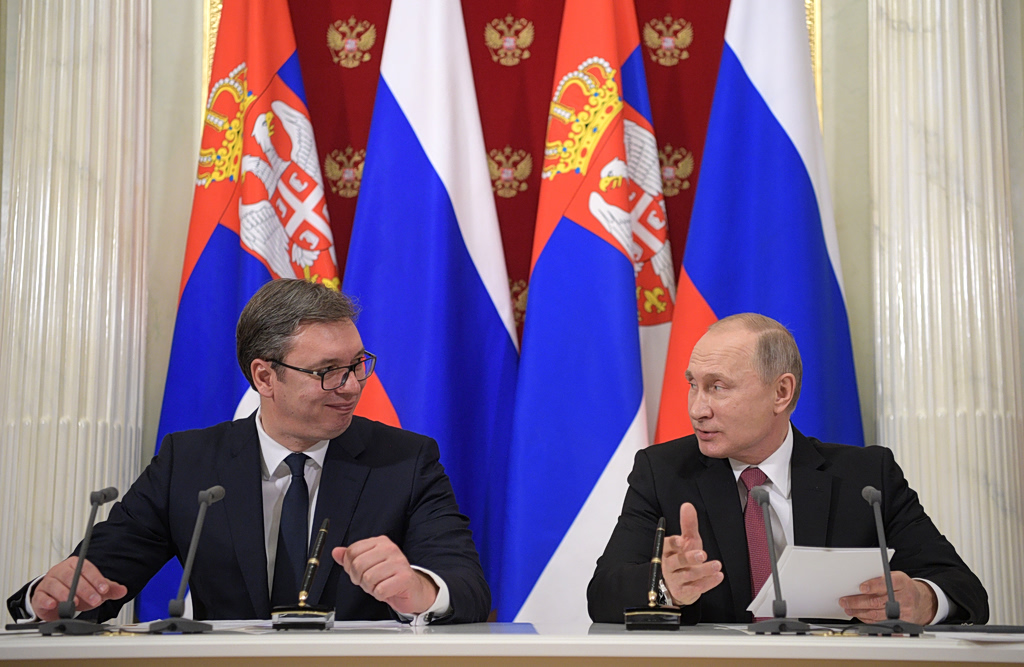
epa06398854 Russian President Vladimir Putin (R) and Serbian President Aleksandar Vucic (L)during a joint press statement following Russian-Serbian talks in the Kremlin in Moscow, Russia, 19 December 2017. Aleksandar Vucic is on a working visit to Moscow. EPA/ALEXEI DRUZHININ / SPUTNIK / KREMLIN POOL MANDATORY CREDIT
Yet for all the attention paid to Moscow and Beijing, Armakolas argues that neither represents the most difficult obstacle to Serbia’s European future.
“The great problem for Serbia is Kosovo,” he says.
Kosovo remains the most difficult obstacle on Serbia’s European path. It declared independence in 2008, a status Belgrade continues to reject, while most EU member states recognise it; Greece, Cyprus, Spain, Romania and Slovakia do not. Since 2011, the EU has tried to bridge that divide through talks between Belgrade and Pristina. The 2023 normalisation agreement sought to move the relationship on to a more pragmatic footing and linked implementation directly to Serbia’s accession process, reinforcing Brussels’ position that lasting normalisation is essential to the European future of both sides.
“There is no possibility of Serbia moving forward towards EU membership unless the Kosovo issue is resolved,” says Armakolas. For him, the deeper obstacle is domestic. “Serbian society is not being prepared,” he says. “To resolve a problem like this, you prepare public opinion. Here, the opposite is happening.”
Armakolas argues that nationalist narratives have hardened over the past decade, leaving little political space for the kind of compromise a final settlement would require. That helps explain why a change of government would not necessarily produce a change in foreign policy. Even a more reformist administration would still confront the same limits over Kosovo. The student movement reflects that tension: alongside liberals and pro-Europeans, it also includes nationalists who may favour an even harder line on what Serbia considers its core national questions.
Greece and Serbia: a strategic relationship
For Greece, the outcome matters well beyond the two countries’ traditionally close historical, cultural and religious ties.
Greece and Serbia formalised their traditionally close relationship as a strategic partnership in 2019, creating a framework for deeper co-operation on EU integration, infrastructure, energy and regional security. Foreign Minister George Gerapetritis, visiting Belgrade in June, described Serbia’s accession to the EU as a “geopolitical necessity” and said Greece regarded the country’s European future as central to regional peace and prosperity.
In an interview with Serbia’s Politika during the same visit, he put the strategic argument still more explicitly: “The Western Balkans lie at the heart of Europe, and Serbia at the center of the Western Balkans.” Serbia was Greece’s third-largest trading partner in the region, with bilateral trade of around €830mn, while the stock of Greek direct investment in Serbia stood at approximately €330mn in 2024 — making Serbia one of the two largest destinations for Greek investment in the Western Balkans.
Athens and Belgrade are also linked by a broader effort to create north-south infrastructure corridors through southeastern Europe.
The proposed Thessaloniki–Skopje–Belgrade railway axis remains, according to Gerapetritis, a Greek strategic priority capable of strengthening connections between the Aegean and Central Europe. Energy ties are developing in parallel. Serbia has secured gas quantities through the Alexandroupolis floating LNG terminal, while Greece is promoting the Vertical Corridor and pipeline connections through North Macedonia and Bulgaria as part of a wider attempt to diversify Balkan energy supplies and reduce dependence on individual suppliers. Gerapetritis has described Greece as the southern energy gateway for the Western Balkans and Serbia as pivotal to extending those networks toward Central and Northern Europe.
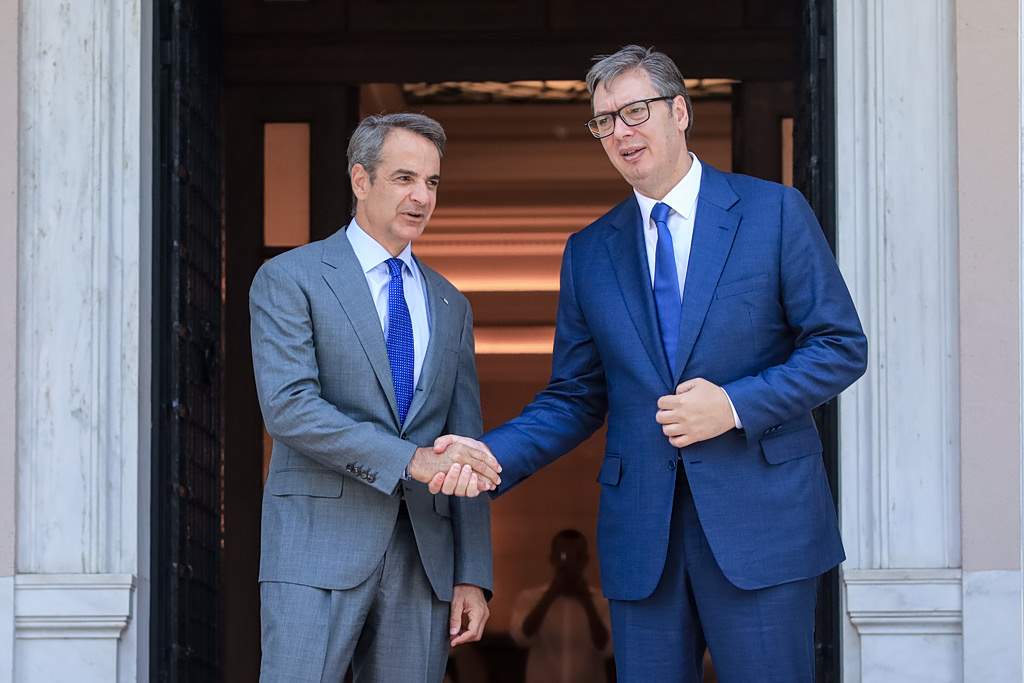
Διμερής συνάντηση του Πρωθυπουργού Κυριάκου Μητσοτάκη με τον πρόεδρο της Σερβίας Αλεξάνταρ Βούτσιτς. Τρίτη 22 Αυγούστου 2023 (ΓΙΑΝΝΗΣ ΠΑΝΑΓΟΠΟΥΛΟΣ / EUROKINISSI)
Greece’s 2027 European presidency
This gives Serbia particular significance ahead of Greece’s presidency of the Council of the European Union in the second half of 2027. Gerapetritis has said that his ambition for the 2027 presidency is to see “one or more” Western Balkan partners join the European family. Greece and Serbia also signed a memorandum in September 2025 under which Athens provides expertise on the EU acquis to support Serbia’s accession process.
Serbia’s political trajectory therefore matters directly to a foreign-policy objective Athens has chosen for itself. Armakolas nonetheless expects continuity in the Greek position regardless of who governs in Belgrade. “Whether it is a Vučić government or an opposition government, I do not think Greece’s position will change,” he says. “Greece has a stable policy in favour of European Union enlargement, especially towards the Western Balkans, provided that the criteria are fulfilled and bilateral disputes are resolved.”
The limits of political change
The October election is nevertheless a consequential moment. The student movement has transformed an infrastructure disaster into a national argument about institutions, corruption and political accountability, producing the strongest challenge to Vučić’s political dominance in years. Yet even a substantial change in domestic politics would leave the next Serbian government facing an EU demanding deeper political and foreign-policy alignment, Russia retaining historical and diplomatic significance, China embedded economically, and Kosovo unresolved at the heart of Serbia’s European aspirations.
For Greece, whose government regards Serbia’s European integration as a geopolitical imperative and hopes to revive Western Balkan enlargement during its 2027 EU presidency, the outcome will certainly matter, but so will what comes after it.