Μake us preferred on Google
When Miša Stojiljković and Aleksandra Mladenović returned to Radio Belgrade 1’s morning programme on October 30, it marked more than the return of two familiar voices. It came as Serbia began to confront the conduct of its public media during 14 years of dominance by Aleksandar Vučić and his Serbian Progressive Party.
Both veterans of Radio Television of Serbia (RTS), the public broadcaster, had been reassigned in April 2026 after a long dispute over editorial independence. Stojiljković, who had given airtime to student protesters, was moved to children’s educational programming. Mladenović, a 32-year RTS veteran who had risen to edit the evening news and the morning programme, was sent back to reading the news, the job with which she began her career.
Speaking to To Vima International Edition, they describe a system in which those who resisted were penalised and those loyal to the ruling party’s line were rewarded. Censorship rarely came as written orders. Instead, journalists gradually learnt which subjects, guests and perspectives were unwelcome, and adjusted accordingly.

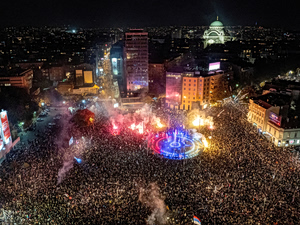
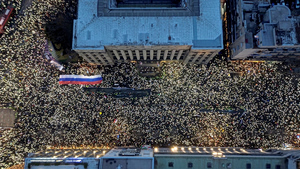
FILE PHOTO: A drone view shows people celebrating the victory of the Student List at parliamentary election after Aleksandar Vucic conceded defeat, at Slavija Square in Belgrade, Serbia, October 26, 2026. REUTERS/Djordje Kojadinovic/File Photo
How the silence was manufactured
They recount restrictions on coverage of the student movement and pressure to omit certain headlines from the morning press review. In the second half of 2025, Stojiljković defied an instruction not to interview the Secretary-General of the Journalists’ Association of Serbia about a presidential statement he regarded as false. He broadcast the interview live and was placed on six months’ disciplinary probation, during which any further “mistake” could have cost him his job.
There was no list of banned guests or subjects, and requests for one were refused. Instructions came in one-to-one conversations, often prefaced by “you know what the situation is”, that left nothing to prove. On television, prime time carried almost nothing on the student protests, and what it did carry was framed negatively.
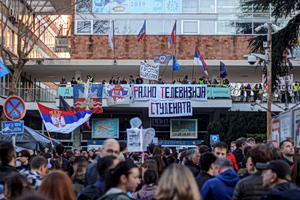
People gather in front of the constitutional court as students protest against government policies, corruption, and negligence, which they blame for the deaths of the victims in the November 2024 Novi Sad railway station disaster, in Belgrade, Serbia, January 12, 2025. REUTERS/Djordje Kojadinovic TPX IMAGES OF THE DAY
The grip briefly loosened between January and April 2025, when the protests were at their peak, and on March 15, as hundreds of thousands filled Belgrade’s streets, Radio Belgrade had 10 reporters on the ground. From May, however, as street turnout thinned, management “entered the stage of revenge”, they say, against anyone who wanted to report freely.
Their testimony is corroborated by independent monitoring. CRTA, the election observer, found that 96 per cent of political airtime on Dnevnik 2, RTS’s flagship evening bulletin, went to the ruling majority between March and September 2026, while the Media Pluralism Monitor 2026 put opposition parties’ share of RTS coverage at 1 to 2 per cent. On December 28 2025, RTS gave 23.5 minutes to the president and a single minute to a student initiative.
Staff did push back, often at personal cost. In April 2025 an informal group, “Our Protest” (Naš pRoTeSt), drafted a letter demanding editorial independence that nearly 400 employees signed. According to the two journalists, the director-general told associates to use every opportunity to be rid of the signatories, and contributors on short-term contracts, some with eight to 15 years at the broadcaster, saw them lapse.
The wider climate was harsher still. The Media Freedom Rapid Response consortium recorded 209 press freedom violations in Serbia in 2025, more than double the year before, and Serbia fell to 104th in Reporters Without Borders’ 2026 World Press Freedom Index, last in the EU-Balkans zone.
The return to the airwaves
Their return followed the student movement’s victory and pressure from Radio Belgrade staff. The day after the election, journalists demanded the resignation of the editor-in-chief and his deputy, and on October 29th some 60 of Radio Belgrade 1’s 78 staff attended a meeting at which the editor-in-chief promised to step down and approved the pair’s return. Most editors nonetheless remain in their positions until they can be lawfully replaced, a legal “interregnum” that may last months. Listeners, however, warmly welcomed the pair back with dozens of messages of enthusiastic support.
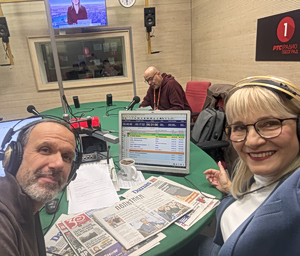
Stojiljković likens the change to a weight being lifted: “Like you had 100 kilos on your shoulders and someone just lifted it.” After nine years of pressure at Radio Belgrade, he says, the newsroom is relearning how to work without fear, and he compares the experience to leaving an abusive home: “You don’t know how to live in freedom.”
Yet a return to the microphone resolves little on its own. The pair speak of rebuilding trust in newsrooms divided by years of compliance, and of a public broadcaster’s duty to account for what it omitted as well as what it reported. They hope to fill what they call a two-year gap in the public record.
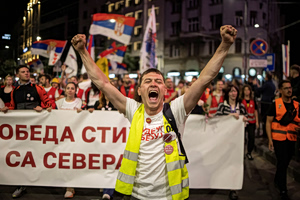
A student cheers as students who walked from different parts of the country arrive to the capital a day before the final campaign rally of their electoral list “Student List – Students Win” in Belgrade, Serbia, October 21, 2026. REUTERS/Marko Djurica
The allegations of reward are specific. Some colleagues, they claim, received special bonuses almost every month, along with cars, apartments and paid trips abroad; they intend to press for the records to be made public. Stojiljković estimates that more than 100, perhaps 200, RTS journalists used their positions to misinform the public and “do not deserve to work as journalists ever again”, though, he insists, that must be established in the courts or by the profession’s own disciplinary boards.
Both urge restraint, arguing that accountability must follow due legal process rather than become political retaliation. The warning is timely, since within two days of the election the Student List had already demanded resignations at RTS and the media regulator. Those demands may prove justified, but how they are pursued will determine whether Serbia’s public media emerge independent or merely realigned.
Changing the government is the easy part
In the snap election on October 25th, the Student List won 140 of 250 seats, against 103 for the Vučić-led United Serbia list, after almost two years of protests triggered by the collapse of the Novi Sad railway station canopy, which killed 16 people in November 2024.
The new parliament convened on November 17th, but the incoming government has yet to take office, and the European Commission’s Serbia 2026 Report, published on November 4, documents continued deterioration in media freedom and political interference in editorial decisions.
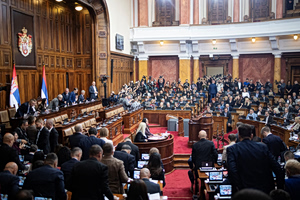
Deputies attend the constitutive session of the newly elected National Assembly in Belgrade, Serbia, November 17, 2026. REUTERS/Marko Djurica
Beneath the figures lies a structural problem. Institutions shaped by years of political appointment and party loyalty are not transformed by an election result. Yet removing officials simply for their perceived allegiances would undermine the very institutional independence the incoming government has promised to defend.
Prague: the battle over who funds public media
Similar tensions are playing out elsewhere in Europe. In the Czech Republic, Prime Minister Andrej Babiš’s government plans to scrap the compulsory licence fee that funds Czech Television and Czech Radio and to finance both from the state budget from 2027, cutting their income by about 15 per cent. The government argues that households deserve relief and that sums fixed in law would shield the broadcasters from political bargaining. Critics, among them the European Broadcasting Union and leading press freedom groups, counter that dependence on the budget would leave them exposed to political leverage, and that the plan sits uneasily with the European Media Freedom Act, which requires public media funding to be adequate, predictable and insulated from political interference.
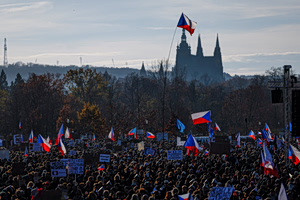
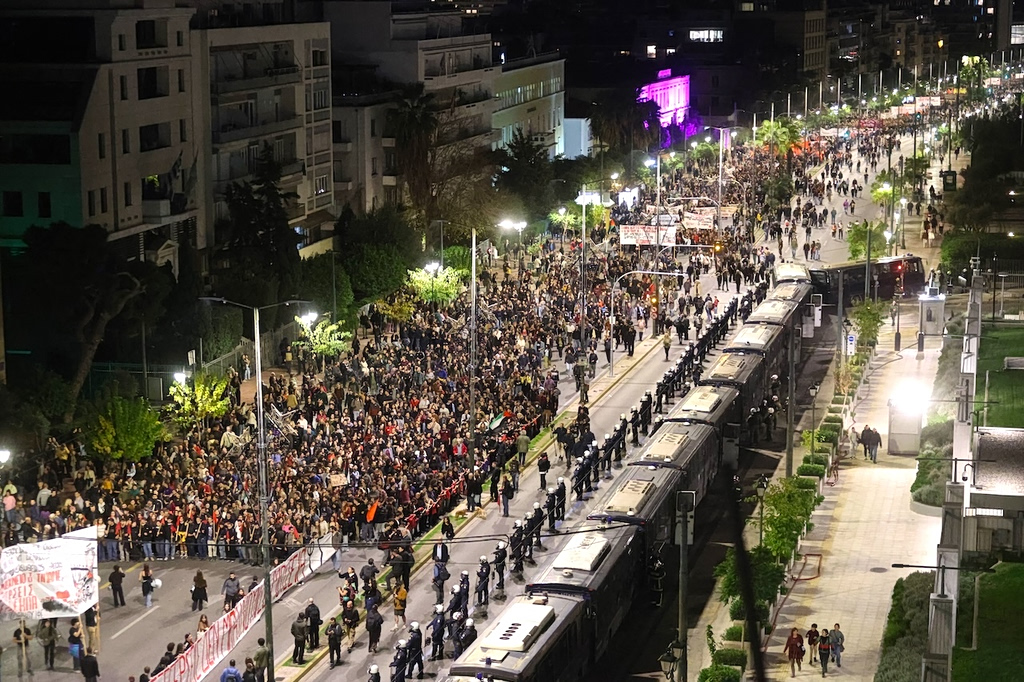
People attend a protest rally in support of public media as the Czech government plans to cut funding and move financing to the state budget, in Prague, Czech Republic, November 15, 2026. REUTERS/David W Cerny REFILE – QUALITY REPEAT
The bill’s first reading, pushed through parliament in a 4:36am vote, carried the dispute onto the streets. On November 15, organisers estimated that between 350,000 and 450,000 people gathered on Prague’s Letná plain to demand its withdrawal, in what has been widely described as among the largest demonstrations the country has seen since 1989.
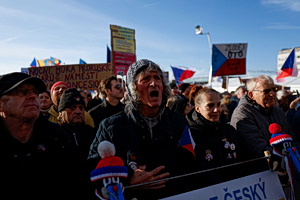
People gather on the day of a protest rally in support of public media as the Czech government plans to cut funding and move financing to the state budget, in Prague, Czech Republic, November 15, 2026. REUTERS/David W Cerny
Budapest: dismantling without imitating
In Hungary, Péter Magyar’s Tisza government, which ousted Viktor Orbán in April, inherited a media landscape shaped by 16 years of political influence. Its most emblematic act has been to abolish the Sovereignty Protection Office, an Orbán-era agency that critics said was used to intimidate independent voices such as the anti-corruption watchdog Transparency International Hungary and the investigative outlet Átlátszó. In October the government settled Átlátszó’s defamation case against the office, agreeing to pay HUF3.8mn (nearly €10,000) in damages.
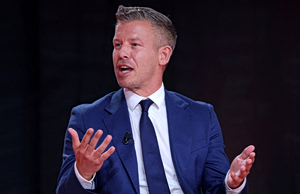
FILE PHOTO: Hungary’s Prime Minister Peter Magyar takes part in the leaders panel on the opening day of Bled Strategic Forum in Bled, Slovenia, August 31, 2026. REUTERS/Borut Zivulovic/File Photo
After a fact-finding mission in November, the Committee to Protect Journalists and its partners hailed a “historic break” with one of the EU’s worst press freedom crackdowns, while urging transparent appointments and stronger safeguards against future interference.
The test of the next election
Across Serbia, Hungary and the Czech Republic, circumstances differ but the underlying pattern is familiar. Political power reaches into public institutions through appointments, financial dependence, regulatory design and unwritten expectation. Undoing those arrangements may require substantial reform, from rewriting the laws that govern public broadcasters to changing how their boards and regulators are appointed and funded. Yet reform pushed through without transparency, due process and institutional safeguards risks merely transferring control to a different political camp, leaving the next government free to repeat the cycle.
For Serbia’s incoming leadership, the challenge is to establish accountability without turning institutional renewal into another form of political control.
For Greek readers the lesson is not abstract. Greece rose from 89th to 86th in Reporters Without Borders’ (RSF) 2026 World Press Freedom Index but has remained the EU’s lowest-ranked member state since 2022, with the Predator wiretapping scandal and the 2021 murder of the journalist Giorgos Karaivaz still unresolved.
As the experience of Stojiljković and Mladenović shows, winning back the freedom to report is only the beginning. The more durable achievement would be institutions capable of protecting that freedom whoever wins the next election, with laws, appointments and funding arrangements that no single government can quietly bend to its will. A free press is often called the guardian of democracy, and with reason, for it is how citizens learn what those in power would rather keep hidden. But the relationship runs both ways. A true democracy is one that guards its press in return, even when the scrutiny is unwelcome, and the measure of Serbia’s new beginning will be whether it builds a public broadcaster strong enough to hold even its own creators to account.