 Μake us preferred on Google
It is truly rare to encounter cordiality and warmth quite like Sophia Kalogeropoulou’s. She’s what they used to call an “old soul.” Perhaps because only people who have tasted everything life has to offer, absorbed its essence and had their fill of joys and disappointments can be so generous with their emotions. From the very first, it all felt unexpectedly familiar, as if we had known each other for the longest time. Her courtesy, unpretentious simplicity, unforced laughter and complete lack of arrogance won me over instantly.
There is a rare naturalness to the way Sophia Kalogeropoulou communicates. Granting you the beauty of her spontaneous smile and treating you to her self-effacing humor and grounded authenticity, she makes you feel as though you are in the home of someone close to you.
Before I could so much as open my notes, our shared love for the opera had set the perfect tone for our conversation. I asked to hear her voice from her time on the operatic stage. Fortunately, her partner, the great Takis Kalogeropoulos, had taken care, unbeknownst to her, to save a record with some of the roles she performed. We listened to it together, with her commenting, sometimes amused and sometimes moved, on moments from that period. I was impressed by the ease with which she transitioned from self-deprecation to the most personal confessions, without ever losing her vivacity and sense of humor.
As time passed, I began to recognize in Sophia Kalogeropoulou the self-same brightness that had so captivated me in her painting. The joy, optimism and joie de vivre; her inexhaustible curiosity. It seemed as if the courageous colors, dreamy characters and fantastic stories that almost always accompany her works’ protagonists were a natural extension of her personality. And this optimism acquires something close to sanctity when you know the difficulties she faced and the losses she suffered, how her highly promising career was cut short so devastatingly. Her biography would need multiple volumes to do it justice. Her Law studies, years at the Vienna Opera, meetings with legendary music personalities, and, later, an entire second life dedicated to painting. Yet she recounts even her greatest moments with a disarming humility, often poking fun at herself. Leaving, I promised myself this: to capture on paper some of the light she had shared with me so generously. The light I already knew from her paintings and which shines bright within her, now and always.
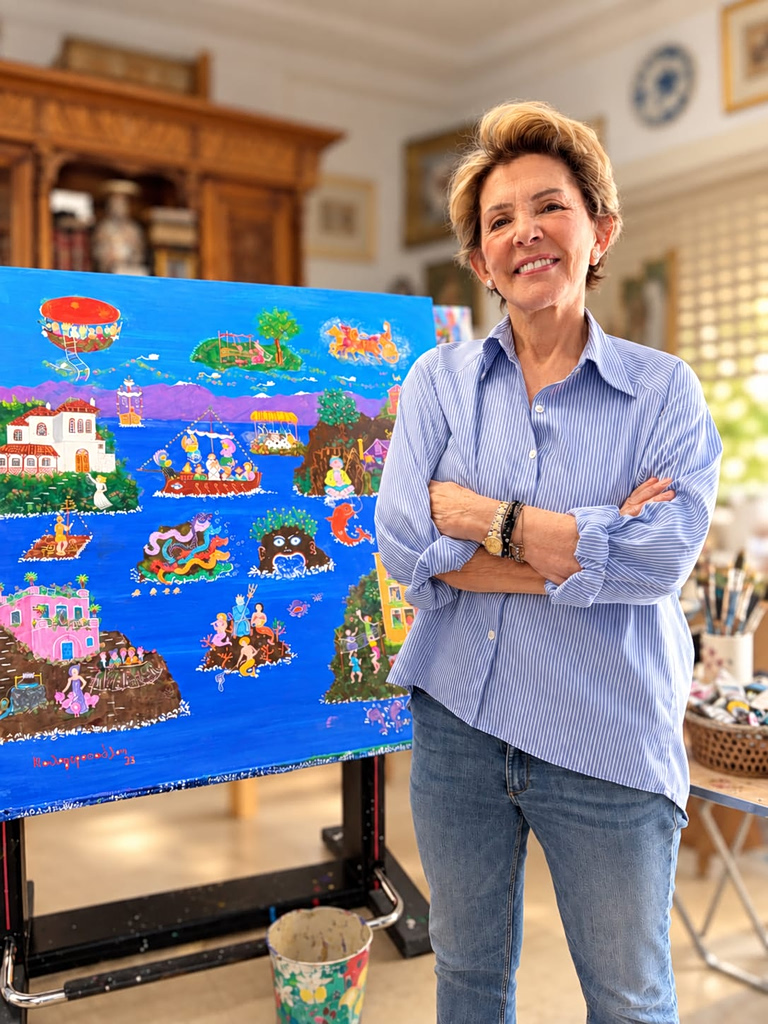
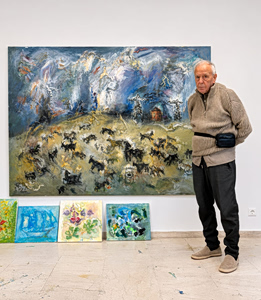
Sophia Kalogeropoulou poses next to her artwork at her painting studio. PANOS KOUGIAS/TO BHMA INTL EDITION
If I were to ask you to introduce yourself today, would you say you were a painter or a musician?
I’ve studied music, but not painting. Which is why, when people asked me what I did, I’d say I was a musician. If you want a more meaningful reply, I’ll say I’m a “lover of the arts.” Art has always interested me, in all its forms. When I lived abroad, I was forever going to museums and exhibitions. I wasn’t just interested in classical painting. I had a great love for modern art, too, along with contemporary music. All of which are, ultimately, connected.
Before painting there was the opera, to which you devoted yourself entirely. What do you recall today from those years?
I had studied a great deal. In Vienna, I had Tito Gobbi as my repertoire teacher. I was supposed to sing Nedda from Pagliacci and Antonia from The Tales of Hoffmann, which was my favorite role. I had studied dozens of operas and knew the roles by heart. The prospects looked excellent, I’d met great people and music was my entire life. But even then, I was already dealing with serious health issues, which also affected my singing. It was a period of great expectations and equally great difficulties.
You also met Maria Callas, whom you admired from a young age.
I adored her. I met her in Milan, and we spoke in Greek. I have kept the photograph and her dedication, which she wrote in Italian. It was a very big moment for me. But I am also moved by the memory of so many other people from the opera world, my teachers, the voices I heard. Those things stay with you forever. And even if your life suddenly changes course, you’ll always have those experiences.
You have spoken with remarkable candor about the anorexia and bulimia you were battling during that period. Looking back today, what do you think helped you the most when it came to overcoming this challenge?
The most important thing was that, at some point, I realized I was sick and admitted it to myself. That’s what saved me. I had suffered for many years, and the situation had taken a terrible toll on my physical stamina. In singing you need breath, you need strength. And I no longer had either. I started receiving treatment in Munich in 1977, and gradually began to confront my condition. I can be humorous about it today, but back then it was so very hard. I also needed quite a few years to recover enough to even think about music again. I remember that when Takis became vice president of the State Orchestra, I found it hard to even attend concerts at the Megaron Concert Hall. Until, at some point, after countless conversations, I decided to go back to what I loved, but in a different way. I would paint the opera. Which is how “The Phantom of the Opera” came into being. And it was so important to me that I could return. I was interested in what happens when a performance is truly great—when the singers, the orchestra and the audience somehow become one. And we are all drawn into the story. So when I painted Aida or A Masked Ball, I didn’t only want to show what happens on stage. I wanted to convey this collectivity, this communion when we all become a living, breathing part of the opera for a time.
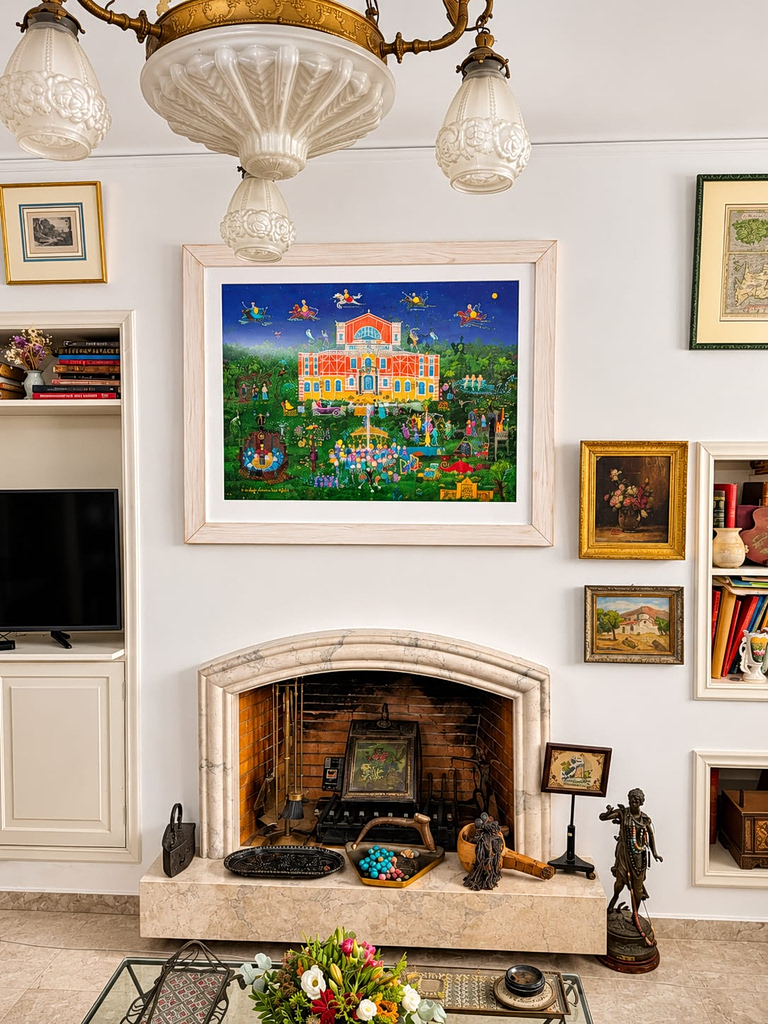
One of Kalogeropoulou’s paintings hangs over her fireplace. PANOS KOUGIAS/TO BHMA INTL EDITION
How did Takis Kalogeropoulos, your partner in life and in music, change your viewpoint on life?
He influenced me deeply. It was music that united us from the start, but Takis was a man of immense cultivation and wide-ranging interests. He read ceaselessly, loved people and was deeply unconventional. He opened up other worlds to me, so I was no longer confined to singing and related matters. We shared a lot and worked together for Greek music. The “Panarmonia” project, later presented as an exhibition, is also connected to this shared path. He was a man with a genuine love for what he did.
You once said: “Music was the love of my life, while painting is a loving relationship”…
Yes, that’s still how I feel. Music was a great passion of mine, and such things simply cannot be replaced. Painting is a love that is perhaps closer to a marriage. That doesn’t mean it’s any less important. It is a different kind of relationship in a different phase of your life. As you grow older, you understand that everything has its time. You don’t need to pretend you’re still twenty years old. There are other joys, a different tranquility and above all more freedom to be yourself.
Painting arrived at a time when your life had already changed direction. Was there a particular moment when you decided to devote yourself to it?
I didn’t decide, painting decided for me! I was going through a very difficult period. I had returned to Greece and was trying to find myself again. At one point, I went to an excellent psychologist who asked me, “What do you know how to do?” I told her I knew a lot about antiques, old porcelain, all the things I had loved since I was a child. But I also showed her a few of my drawings that were hanging on my walls. She looked at them and said, “Choose. One of the two.” That shook me to my core! Imagine. I had finished my studies and already sung on stage, but now I suddenly had to accept the need to start something entirely different—something I might not even be very good at. It was a massive blow to my ego. But it also proved to be my cure. Painting helped me get back on my feet. And then, before I knew it, the exhibitions started coming, the collaborations, a whole new world.
Do you remember when you realized that what you were doing was something special?
I remember being taken to Panayiotis Tetsis and having him view my work. He told me how much he liked my colors. I wanted to learn, to study, to be shown how it’s done. He told me that I didn’t need to try to learn that way. I already had my own way of seeing things. At first, of course, I was happy simply to be taking part in a group exhibition, even if they had hung my work in a rather charmless corner! Then came the collaboration with the Zoumboulakis Gallery. Everything happened without my having planned it.
Did you ever feel you lacked academic training in painting?
No. I had the freedom to do whatever I wanted. In music, there was an entire system. You had to sing this role, to prove that you could do one thing or another. In painting, no one told me what to do. I serve myself, my vision, my desire, my soul. Because I didn’t have a teacher to follow, I could let myself go. And that’s very important. I’m not saying that what I paint is the best that’s ever been put on canvas. But it’s mine.
Your painting is characterized as naïf. What does the term mean to you?
To me, naïf means that the artist is self-taught. That’s all. It doesn’t mean that someone is naive, or that they paint without thought. I love Theophilos very much, but other creators within the naïf tradition, too, both in Greece and abroad. When I participated in international exhibitions, I saw painters from completely different places. At first glance, you might say our works looked alike, but in reality, we were all different. Different lives, different experiences, different worlds. That’s the beauty of it. Everyone brings their entire self to the work.
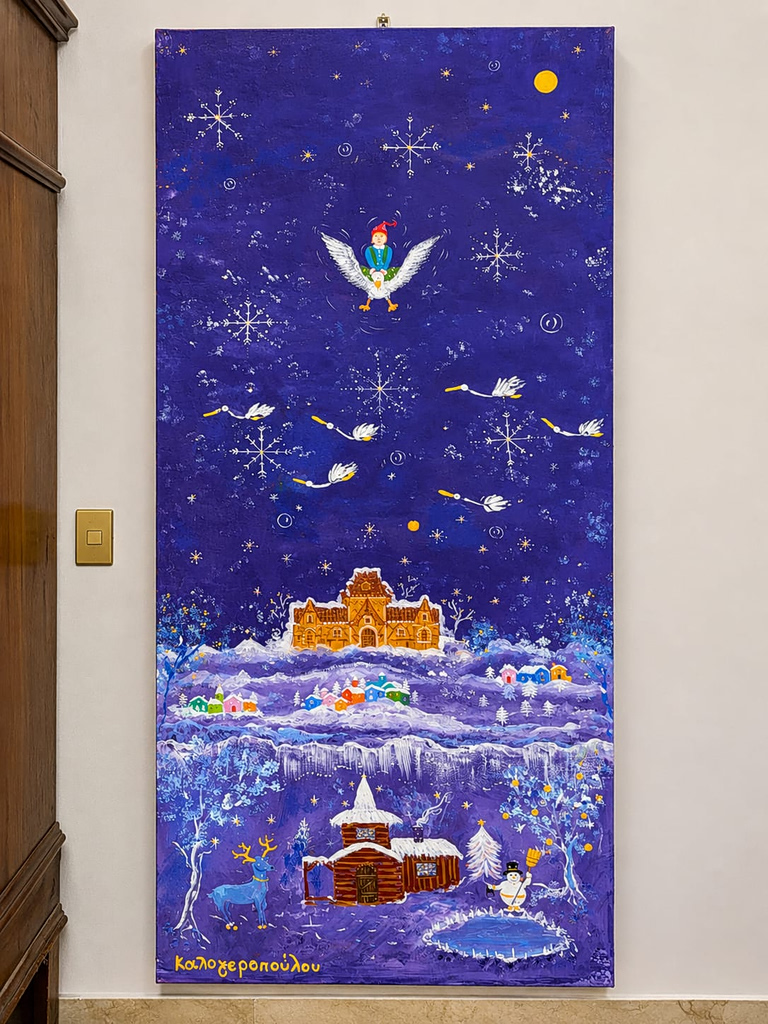
Artwork by Sophia Kalogeropoulou. PANOS KOUGIAS/TO BHMA INTL EDITION
Color is perhaps the first thing one recognizes in your work. Has your relationship with it changed over the years?
No, it has remained constant from the start. I don’t know the rules of color the way someone who has studied painting does. I think it comes down to having an eye for it. Perhaps my great love for fashion also played a role. I used to keep up with it all: I adored Yves Saint Laurent, the combinations and fabrics, the dresses and hats. All of which was a visual education. Color came naturally to me. I didn’t sit down and decide that I was going to paint “brightly.” It’s how I see things.
Your paintings are full of people, animals, birds and little stories. Is that a world you want to live in?
All of it comes from within me. You might be influenced by something you loved, by a painting you saw, by a story you read, but you cannot copy another person’s soul. I like to include every last detail. I want there to be a host of things you can discover by looking. And not all of them are necessarily happy. Even when I tackle dark subjects, I want to pour everything I have into the work. I can’t do something hastily, just to get it out of the way.
Mythology often lies at the heart of your stories. What is it about myth that moves you so?
I view mythology as the true history of humanity, in the sense that it’s the memory of the world’s peoples. One civilization speaks of Noah’s flood, another of Deucalion’s. There is something behind these narratives. And that interests me far more than which politicians were in power and when. I wanted mythological figures to exist in my painting as if they were still walking among us. I wanted to abolish time. Because, in a way, all of that is still here.
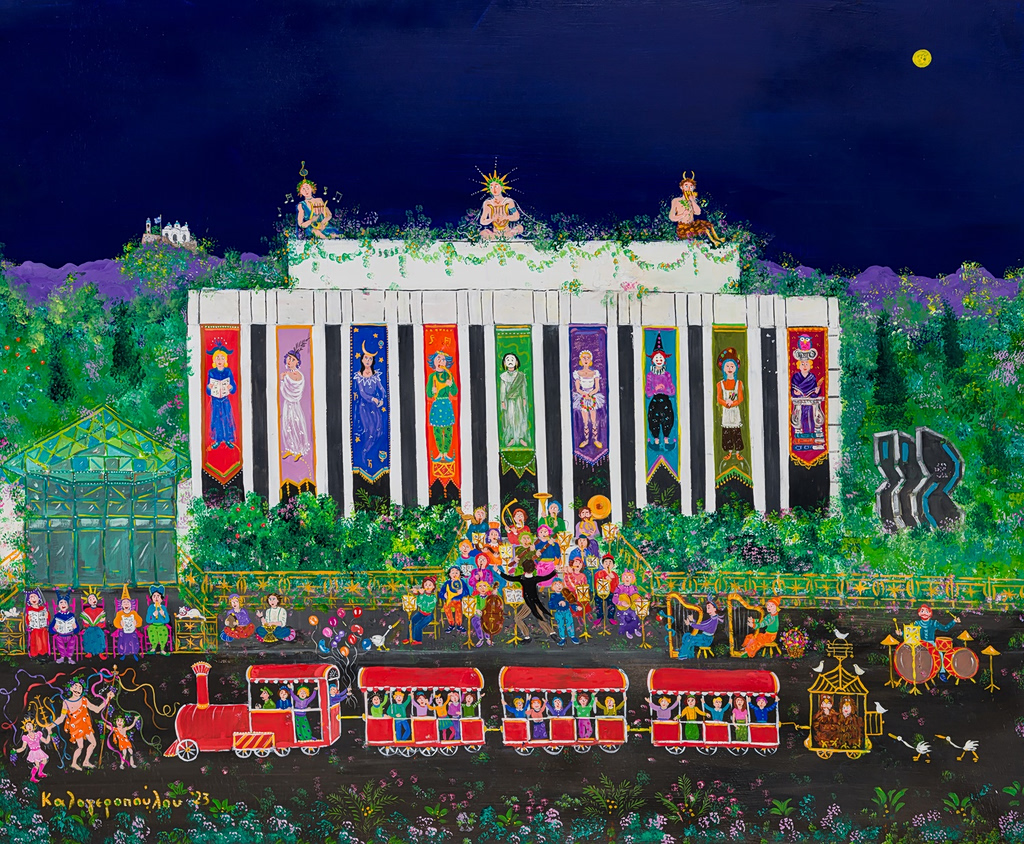
Artwork by Sophia Kalogeropoulou. PANOS KOUGIAS/TO BHMA INTL EDITION
And literature seems to be opening up a new chapter in your current work.
I am very preoccupied with female creativity. I read, I go back to books, I think about the women who wrote them and the heroines they invented. Mary Shelley, the Brontë sisters, Emily Dickinson are figures who move me. I’m not interested in merely illustrating a plot. I might linger on a detail, on a psychological state, on a door that seems open but no one is passing through it. Sometimes it takes a long time to understand how I should paint something. I have works that are still waiting for their moment to arrive.
Are you interested in what your paintings have to say to the viewer?
Very much so. Sometimes I see an enthusiasm I didn’t expect. I think that perhaps the things I paint redeem people somehow. I don’t think it’s just the colors or whether a composition is pleasing to the eye. I have been involved with psychoanalysis for many years, and I know how deeply an image can touch us. There are doors we don’t walk through, stories that recur over and over, desires we dare not confess. All these things find their way into my works, even if the painting may look happy at first glance.
You have lived so many different lives. What is it you don’t want to lose?
The need to do things. I cannot sit and wait. I might have an idea and it might not work out right away; I might leave it, go back to it, think about a color for days. Which is fine. What interests me is being honest. I don’t want to do something because it’s fashionable or because it will be liked more. It takes courage to make art. To say what you believe, even if someone else doesn’t understand it. And to keep going.