The door of the small mini-market opens every so often, briefly allowing the sounds of the street to enter the shop. In the narrow aisles, large sacks of rice are stacked one on top of another, next to legumes, boxes of spices, ready-made sauces, sweets, mobile phone cards, and small everyday necessities. These are not products that would catch the eye of a passerby, yet for the people who stop here after work, they are pieces of a daily life that has been built far from home.
By midday, work in the greenhouses has begun to thin out, and activity gradually shifts from the fields to the village streets. Rahman, from Bangladesh, enters Ula Mohammed’s mini-market wearing his work clothes. His shoes still carry soil, his trousers are stained at the knees, and his expression is tired, as though he has not yet fully left behind the rhythm of the fields.
He says a few quick words to the man behind the counter, who then takes a sack of rice from the shelf and places it in front of him. The exchange lasts only a few seconds. A nod, a couple of words, a transaction carried out almost automatically.
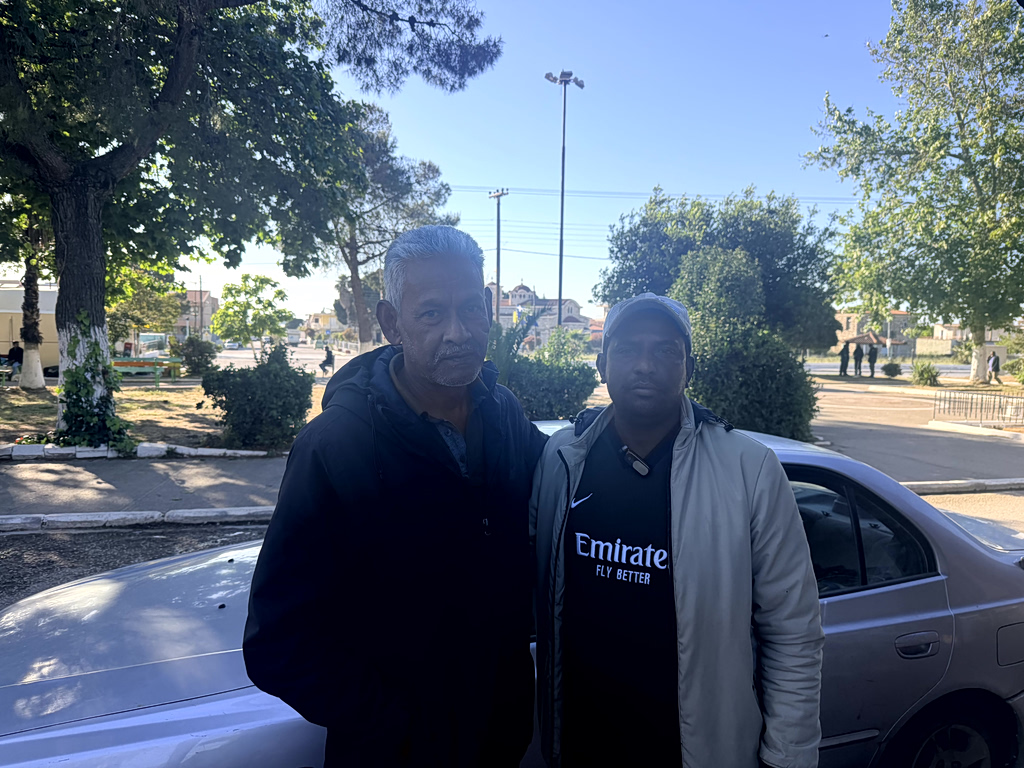
Another Reality
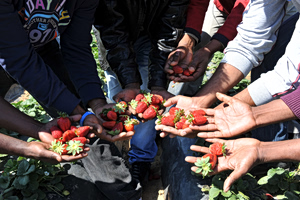
Every year, nearly the entirety of Greece’s strawberry production passes through the wider Manolada area, a market that reaches approximately 100,000 tons. Alongside it, however, another reality has taken shape—less visible, but very real.
Farm workers employed in the strawberry harvest gradually began opening businesses of their own. Most of these are small mini-markets and grocery stores selling products from Bangladesh, India, Pakistan, and other Asian countries. In this way, a second, smaller economy slowly emerged.
Quiet and largely invisible to anyone driving quickly down the main road, it is nonetheless real for the thousands of agricultural workers employed in the area.
Today, fourteen mini-markets operate in Nea Manolada. Another fourteen can be found in Lappa, a few kilometers away. Inside these shops, the atmosphere differs from that of a typical retail store. People stop for a few minutes, charge their mobile phones, exchange words in their native languages, ask about prices, jobs, or someone who recently arrived.
Information circulates about employment vouchers, permit renewals, and which producer may be looking for workers the following week. These shops function as orientation points for the region’s workers in a place that depends on them every day, yet does not fully accommodate them.
Filling a Gap
Ula Mohammed Tajud is one of the people who experienced this transition firsthand. He moves among the shelves of his small mini-market with the ease of someone who knows not only where every product is located, but also who is likely to ask for it.
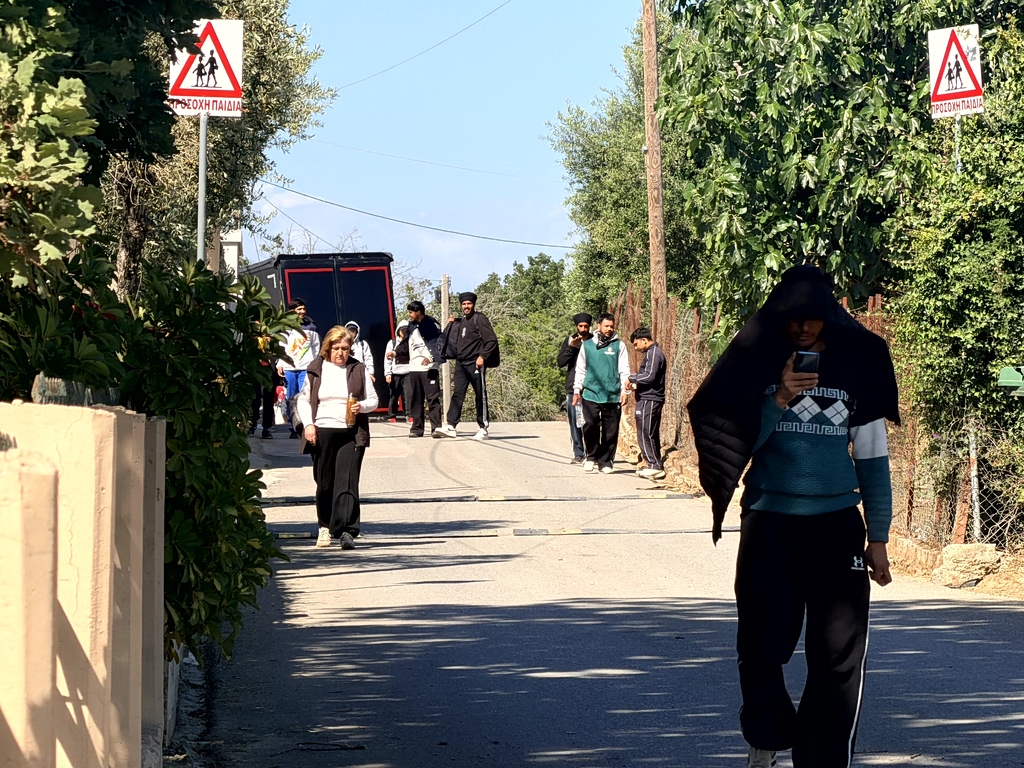
A sack of rice, a phone card, a box of spices—pieces of a daily life that had to be built from scratch in a place where work always comes first.
He came to Greece in 1998, initially settling in Athens. He moved to Manolada in 2006. For years he worked in the fields, like most of his compatriots, before opening his own store in 2015.
He had seen what was missing, what workers around him were looking for but could not easily find. He opened the mini-market with whatever stock he could obtain and gradually managed to fill it.
The composition of the workforce in the area has changed in recent years, and the store reflects that change.
“Everyone wants something different,” he says.
He tries to stock everything, though he does not always succeed.
“We don’t only have workers from Bangladesh anymore,” he explains. “We have people from Nepal, India, Pakistan, Indonesia—many places.”
He glances toward the road, where the flow of people never seems to stop.
“Everyone comes for work.”
“I Wanted Something of My Own”
The reality described by Ula Mohammed did not emerge overnight. Before these shops became part of everyday life in Nea Manolada, there were people who arrived first, stayed, worked, learned the area, and began to understand what the growing community surrounding the strawberry industry needed.
One of them is Faruk Bepari.
He sits in the courtyard of his home, surrounded by pigeons that fly low before returning to their rooftops. From there he points to the shops around him, the open doors, the people coming and going, and the activity that has become part of the village’s everyday landscape.
Faruk arrived from Dhaka, the capital of Bangladesh, in 1989, originally intending to continue on to Italy. Greece was meant to be only a stopover, but it soon became his second homeland.
At first he worked in the fields. Years later, he opened his own mini-market selling rice, spices, sauces, and foods that Bangladeshi workers could not easily find elsewhere in the region.
“I wanted something of my own,” he says.
He married a Greek woman, started a family, learned the local way of life, and became a point of reference for younger compatriots.
He translates, explains procedures, accompanies people to public services, and helps those who do not know how to navigate the system.
“Anyone with a problem comes here,” he explains. “For paperwork, for work, for something they don’t understand.”
His own journey illustrates how this small economy grew alongside the community itself.
“When I arrived, there were very few of us,” he says. “Only thirty people from Bangladesh in all of Greece, not just here.”
Today, looking out at the street, he describes a very different reality.
“Now we have fourteen shops of our own in Nea Manolada and another fourteen in Lappa. Here alone there are more than five thousand workers.”
He says it almost as if he is simply taking inventory of the transformation that has occurred.
The Small Economy
Manolada has not suddenly become a story of social mobility, nor has it resolved its long-standing contradictions.
Hard labor, uncertainty over legal documents, invisible work, and difficult living conditions remain.
At the same time, however, the shops reveal something that can no longer be ignored. Agricultural workers are not present in the area only for the duration of their shifts, nor are they merely the labor force that drives production.
Behind the large economy of strawberries, one can clearly see the small economy of the lives that sustain it—a presence that is beginning to leave its mark on the place itself.
And that mark, however quiet it may be, is changing the way one can speak about Manolada.