 Μake us preferred on Google
 It’s Wednesday, April 17, 2013, in Manolada, a village in the Ilia prefecture of Western Greece. The time is nearly 6 p.m. Dozens of farm workers from Bangladesh decide to protest, demanding six months of unpaid wages for their labor in the strawberry fields. Supervisors carrying hunting rifles open fire on the workers. More than 30 people are injured, eight of them seriously.
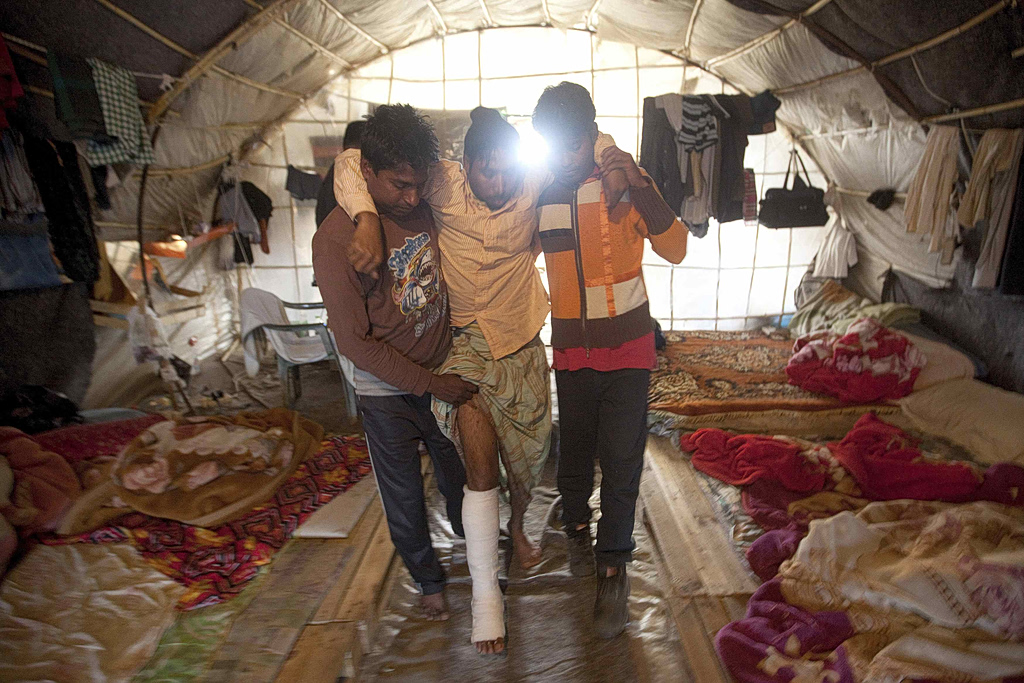
Bangladeshi worker Mohamed (C), 25, is helped by colleagues into a tent in the southwestern Greek town of Manolada April 18, 2013, following a shooting incident on Wednesday evening. Greece’s government strongly condemned on Thursday the shooting of dozens of immigrants at a strawberry farm in southern Greece that left more than 20 slightly injured, the latest violent incident in the crisis-hit country. Three Greek foremen at the farm in the southwestern town of Manolada opened fire at about 200 Bangladeshi immigrants who protested over unpaid wages on Wednesday, police said. More than 20 people were hospitalized but were not heavily injured. REUTERS/Giorgos Moutafis (GREECE – Tags: CIVIL UNREST)
The incident makes headlines in Greece and abroad. Four years later, on March 30, 2017, Greece is condemned by the European Court of Human Rights over the case. The court rules that authorities failed to adequately protect the workers and that their working conditions amounted to a form of forced labor.
The Manolada case is no longer a local story. It becomes a landmark reference point, opening a wider discussion about the system operating behind the production of Greece’s “red gold” — strawberries.
The present day
Thirteen years after the horrific events, living conditions may have changed, but tensions remain. The work is still harsh, insecure, poorly paid and, in many cases, exploitative.
Workers earn just €35 for a seven-hour shift, without breaks. Under the sun, in temperatures reaching 40°C. Inside the greenhouses, beneath layers of plastic, the heat climbs even higher. Humidity and heat become trapped. But the work must be completed on time. No delays are tolerated.
If workers stay longer, they receive €5 per hour. And very often, they have to stay longer. Time pressures are relentless.
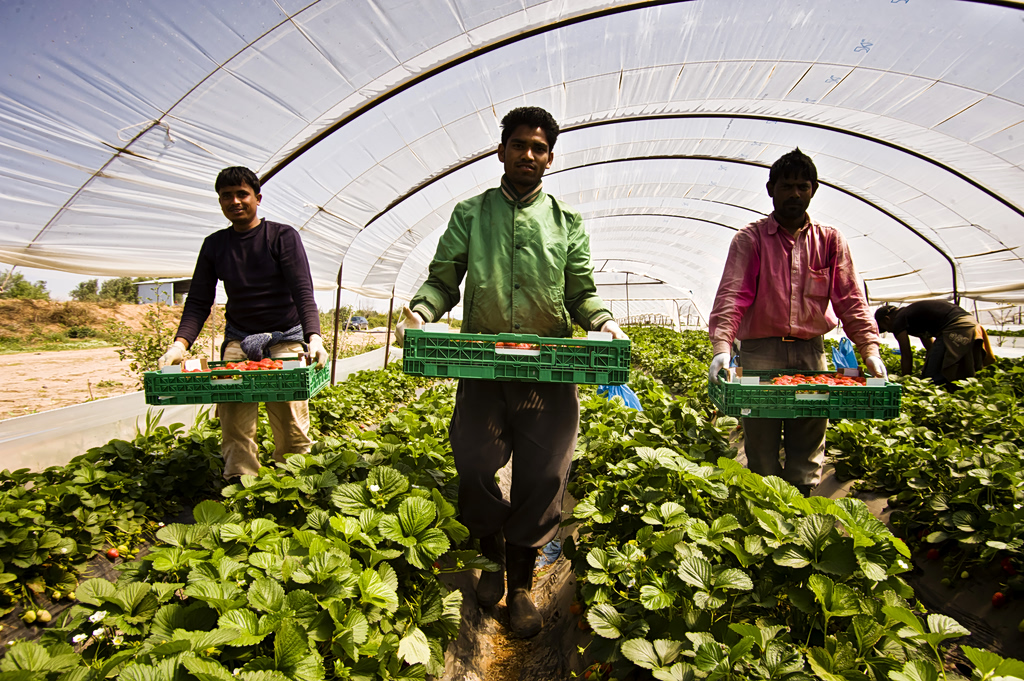
Workers with crates picking strawberries inside a greenhouse.
The wider Ilia and Achaia region produces nearly all of Greece’s domestic strawberry output — as much as 90% — across tens of thousands of acres functioning as one vast system. Every year, more than 100,000 tons of strawberries leave the area for European markets.
“The Manolada case came to light because of the shootings in 2013. Otherwise there would still be silent tolerance,” says Theodoros Fouskas, associate professor in the Department of Public Health Policy at the University of West Attica.
As head of a research team at the Sociology Research Unit on International Migration, Health and Integration Policies, he frequently visits the area, documenting living conditions and examining how they affect the quality of life of agricultural workers. His last visit was in the summer of 2024. Speaking to TO VIMA, he describes the disturbing scenes he encountered.
‘A tomb made of plastic and wire’
“The workers live in makeshift structures known as ‘shacks,’ built from flammable materials — a suffocating environment that traps workers in extreme heat, humidity and unhealthy living conditions. The workers themselves describe them as ‘a tomb made of plastic, wire, bamboo and fabric coverings.’
“In temperatures that often exceed 45°C, they work continuously inside greenhouses wearing simple masks, without adequate protection from chemicals, while water is scarce or unsafe to drink and food is cooked on portable gas stoves because there is no electricity.
“The surrounding ground is damp from stagnant water caused by leaks and irrigation. Garbage, empty plastic bottles, dead animals and insects are common sights. The absence of basic sanitation infrastructure, drinking water, bathing facilities and toilets worsens living conditions, increasing the risks of disease, respiratory problems and injuries.
“Under these extreme conditions, workers frequently report exhaustion, weight loss, respiratory illnesses, musculoskeletal disorders and severe psychological strain.”
Recently, however, the images of improvised shelters have diminished to some extent. Panel-built structures have replaced many of them, offering a more stable, though far from permanent, housing solution.
The ‘privileged’ workers
“In recent surveys, there are people now living in houses too. About ten people in an 80-square-meter apartment. After the tragic events, some farmers took the initiative to build small homes. Of course, those who live there are, in a way, privileged,” says Nikos Odubitan, a second-generation migrant and longtime activist on human rights and migration issues through the NGO Generation 2.0 RED.
Earlier this week, TO VIMA visited Manolada to witness firsthand the living and working conditions of migrant workers in the strawberry fields.
The evening before, workers from different countries had gathered in the square of Nea Manolada, a place more associated with migrant labor than perhaps anywhere else in Greece, to celebrate May Day, in an event organized by the Workers’ Union of Northern Ilia and Western Achaia.
Early Monday morning, the same people who had stood in the village square just hours earlier were walking toward the greenhouses.
“Many walk for miles along the national highway to reach the fields, and that’s very dangerous. There have been many accidents,” Odubitan notes.
Before sunrise
In the fields, work begins before dawn.
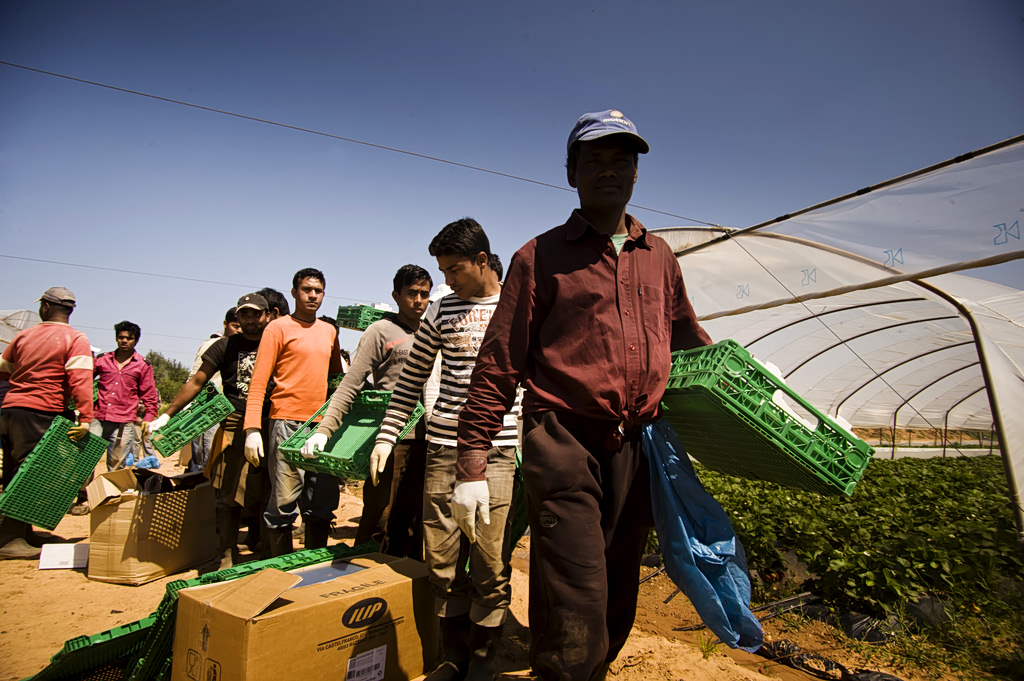
The first crates fill early in the morning and move almost immediately to sorting stations, where size, color and texture are judged at a pace that leaves no room for second thoughts. Nearby, packaging lines operate nonstop, boxes are stacked, trucks are loaded and immediately dispatched.
Inside the greenhouses, movement never stops.
Labor there is often organized through intermediaries.
“They are the supervisors, known as ‘mastores (handymen)’” Odubitan explains. “They know the workers, speak their language, arrange who works where and when, and transfer information and needs from one side to the other.”
The supervisors themselves are not always visible, but their presence is constant.
By midday, the heat in the fields has already intensified. The air is heavy, thick with the smell of soil and moisture. The plastic coverings absorb the sunlight and spread it over the rows of plants.
Nobody talks much.
Hands move through the leaves, searching for fruit, cutting it carefully and placing it into crates. Every movement is repeated dozens of times per minute. The aisles are narrow and movement restricted.
Short answers
Bent over a row of plants, Abdul Haye straightens briefly, sets his crate aside and wipes his hands on his trousers. He is 58 years old and has worked in the fields for nearly three decades.
“The wage is €35 for seven hours,” he says. “There’s no break. If we stay longer, it’s €5 an hour.”
He bends back down almost immediately.
The conversation about working conditions does not last long.
“Things are better now. They pay properly. It’s okay,” he says curtly.
The same phrase, with slight variations, is repeated by others around him.
When asked where they live, he gestures silently behind the greenhouses.
“There, in the houses. Panels.”
These are temporary prefabricated structures with metal frames and panel walls — sturdier than the shacks of previous years, but cramped and equipped with only basic infrastructure.
“Eight people in each room,” he clarifies.
The rooms are narrow, with bunk beds stacked on top of each other, a few personal belongings piled into corners, a shared space that offers little privacy. Daily life unfolds within these few square meters, with the rhythms of work continuing even after workers leave the fields.
A life split between two countries
At another farm several kilometers away, Siraj Maevi pauses briefly from work.
He has been here for 18 years and says he has worked for the same employer the entire time. The farmer cultivates around 500 acres of strawberries spread across different parts of the region, requiring hundreds of laborers to operate.
“It’s better now,” he says. “We have a bathroom, we have a kitchen. Not like before.”
Sharing a small room with eight people remains standard, but he sees it as an improvement compared to earlier years.
His family, including two children, remains in Bangladesh.
“I send money every month,” he says.
He returns once a year for a few weeks — “two months, if I can” — before coming back to the fields.
A life divided between two countries.
‘The village has changed’
Further inside the village, the atmosphere shifts.
On a side street lined with low buildings and small shops facing the main road, 59-year-old Faruk Bepari sits in a small courtyard filled with pigeons.
He has lived in Greece for 38 years. He arrived from Dhaka in 1989, initially planning to continue on to Italy. He never left.
“Back then, we didn’t know Greece,” he says. “We thought it was just a stopover.”
His story mirrors that of many others. He started in the fields, moved through day labor and odd jobs, until eventually opening his own shop.
For years, Bepari has acted as a reference point for the community. He translates, explains procedures and helps migrants navigate systems that remain incomprehensible to many.
“The village has changed,” he says.
Only a few hundred permanent Greek residents remain, while the worker population can reach 10,000 depending on the season.
“In the summer it fills up. It becomes another place.”
He has also witnessed the darker side of this transformation.
“Some things have improved now,” he says. Wages are increasingly paid through official channels. But the picture is far from uniform.
In a labor system based on constant worker movement and daily-changing demands, invisible labor still exists.
“If you don’t have papers, you can’t do much. That’s what we want to change. We want to be able to work normally,” Bepari says.
The ‘available’ workers
For producers, the need is straightforward: laborers immediately available during periods when delays are unacceptable.
For workers, employment is often fragmented and unstable. Teams change, fields rotate and the pace is dictated by production demands.
Within this environment, labor remains flexible, and fragile.
Those without full legal documentation are in the weakest position. They depend more heavily on the networks that connect them to jobs, have limited bargaining power and fewer options for resistance.
“Until 2022, when the bilateral agreement between Greece and Bangladesh for migrant legalization was signed, 90% of the people working in strawberry cultivation had no legal documents,” says Vasileios Kerasiotis, a lawyer specializing in migration and human rights law who represented the Manolada case before the European Court of Human Rights.
“The agreement allowed for 4,000 workers per year to enter Greece legally, but it stalled due to bureaucratic obstacles. Still, the situation improved somewhat after 2022. Most workers obtained legal documents.
“But once they obtained those documents, many left Manolada for other regions of Greece to work in better conditions, mainly in hospitality and tourism. That created a labor gap because strawberry production is extensive and demanding.
“Instead of covering the shortage through legal recruitment, the needs were met by people arriving from Nepal and through refugee flows from Bangladesh via Libya.”
Kerasiotis fears that if this situation continues, Greece risks returning to an era when the overwhelming majority of workers were undocumented.
“The work has to get done, and under that pressure producers will hire whoever is available. Usually, the available workers are undocumented,” he explains.
A ‘strange balance’
Apostolos Papadopoulos, professor in the Department of Geography at Harokopio University and a specialist in rural geographic and social analysis, shares a similar view.
He conducted the first major study on farm workers in Manolada in 2008.
“Many work officially through labor vouchers, while others do not. Many entered Greece irregularly. It’s a strange balance maintained by the state to meet farmers’ labor needs,” he says.
According to Papadopoulos, beyond the agreement with Bangladesh, Greece has also signed a deal with Egypt allowing 5,000 agricultural workers to enter the country for nine months.
“Fewer than 100 have actually arrived. That shows that even the legal migration system does not function effectively in Greece, unlike in countries such as Spain,” he concludes.
Within this environment, cases of exploitation persist.
In recent years, there have been reports involving workers from Nepal who were found laboring under coercive conditions, without any real ability to leave, burdened by debts to intermediaries and with restricted freedom of movement.
These allegations do not concern the entirety of strawberry production. But they illuminate the limits of a system that continues to operate under immense pressure.