Greece’s difficult choices in the Washington–Brussels–Ankara triangle – The European orientation, the Trump factor, and the preservation of calm in the Aegean – Processes ahead of the convening of the Supreme Cooperation Council.
As a vulnerable frontline region, the Eastern Mediterranean cannot allow its future to be shaped by hard power alone; stability and growth depend on embedding energy, defense, and connectivity into credible governance frameworks that support multilateral cooperation and bankable investment.
Supporters of the legislation argue that these projects are essential not only to Europe’s energy resilience but also to the viability of a corridor designed to connect Asian and Middle Eastern supply chains to European markets
What the Agreement on the Conservation and Sustainable Use of Marine Biological Diversity in Areas Beyond National Jurisdiction (BBNJ) covers, which came into force on January 17 – the geopolitical dimensions and its connection to the global struggle over rare earths and maritime trade routes
Libya is not a civil war but a foreign contest that sustains the division by instrumentalizing Libyan factions
Athens is launching a new operations center and unified digital platform to monitor its seas, respond to migration flows, and counter security challenges across the Aegean and the Eastern Mediterranean.
Ankara’s renewed claims in the Aegean, the Eastern Mediterranean, Cyprus and Thrace narrow the room for meaningful talks—even as both sides publicly insist they want dialogue under international law.
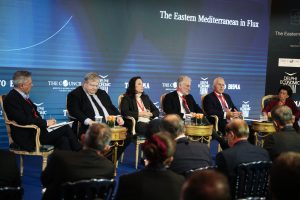
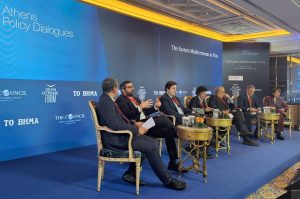
At the Athens Policy Dialogues, diplomats and experts assessed shifting dynamics in the Eastern Mediterranean, highlighting Greece’s 5×5 initiative, rising geopolitical uncertainty, and the need for new regional cooperation frameworks
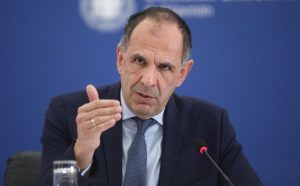
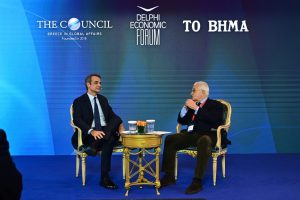
Greek Foreign Minister emphasizes principled diplomacy and respect for international law at the Vima Conference, highlighting Greece’s role in Eastern Mediterranean stability and structured dialogue with neighboring countries, including Turkey and Libya
Athens Policy Dialogues event, entitled "The Eastern Mediterranean in Flux", features panel discussion on the situation in the Middle East after Gaza peace plan, and prospects for a new security framework
The event is being organized and hosted by the Delphi Economic Forum, The Council – Greece in Global Affairs and the historic Athens weekly “To VIMA” (Το Βήμα)
Political leaders, diplomats and security experts from Greece and abroad will gather in Athens on Thursday and Friday for a major conference examining shifting dynamics in the Eastern Mediterranean.
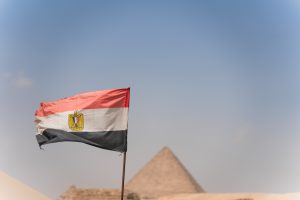
The question, therefore, is twofold: Can Athens prevent a Turkish–Egyptian understanding, and is an extension of the Greece–Egypt EEZ the best possible answer?
Speaking at an off-the-agenda debate in Parliament on Thursday on foreign policy issues, PM Kyriakos Mitsotakis referred to an initiative by Athens for a future meeting of Mediterranean states of the wider region
Sections of the State Reauthorization Act would strengthen the U.S. partnership with Greece, Cyprus, and Israel — known as the “3+1” framework — if lawmakers can overcome a procedural battle that has stalled the legislation
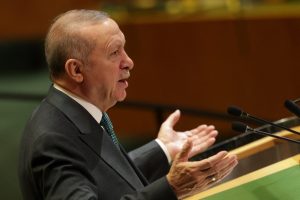
Turkish president again lays out vision for Ankara's suzerainty in the eastern Mediterranean and wider region, warning that no energy project will proceed without Turkey
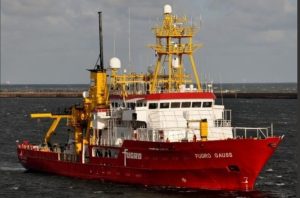
According to a report by state broadcaster ERT from Cyprus, which quotes the source, the only development was an “anti-NAVTEX” issued by Ankara
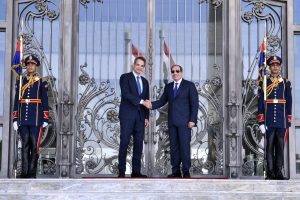
A central theme of the discussion was the continued coordination between Greece and Egypt on matters concerning maritime zones in the Eastern Mediterranean.
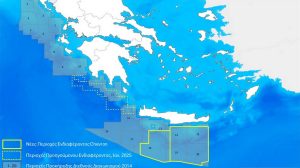
Chevron recently declared its intent to explore a third area, south of the Peloponnese.