Three decades after the Imia Crisis, the incident that brought Greece and Turkey to the brink of armed conflict continues to haunt the Greek collective memory—not only because of its outcome, but also due to the unanswered questions about what actually happened on the night of January 31, 1996, and the crucial 48 hours that preceded it.
“TO VIMA” on November 13, 2005, published a revealing report by Alexis Papachelas on two dark aspects of the crisis: the role of the Greek National Intelligence Service (EYP) and the minute-by-minute events as experienced by the ship commanders in the area, recorded in the radio-telegraph communications log of the Hellenic Navy General Staff (HNGS).
The “Trick” of the Grey Zones
According to the report, Greek intelligence had clear indications that the Turkish strategy regarding the “grey zones” was not a matter of coincidence:
“The critical question is whether Greek intelligence informed in time about the landing of Turkish commandos on West Imia. Officials handling the crisis that night insist that EYP analysts continuously monitored Turkish channels to collect information. As soon as they saw the landing announced, they informed the Hellenic National Defence General Staff Operations Center. They recall that Deputy Minister Mr. Kouris immediately ordered the preparation of a plan to retake the islet. Whether HNDGS was able to communicate in time with Mr. Lymperis, who was in Parliament, is unclear.”
A few days before the crisis peaked, EYP intercepted a conversation of the then head of the Turkish Navy, Admiral Erkaya, who described the grey zones theory as “his own idea” and revealed that he had given orders for a systematic survey of all Aegean islets to prepare for future territorial claims.
The related telegram was forwarded to the Ministries of Foreign Affairs and Defense, demonstrating that the escalation at Imia was part of a broader strategic plan.
Was There Timely Warning?
“The second question that remains unanswered is whether there was timely warning of the Turkish landing at Imia. The EYP station in Alexandroupoli had identified, via open communication channels (which is particularly important), orders from the Turkish Navy to two patrol boats on the afternoon of January 29. The orders were clear: approach both islets and check if there were Greek commandos present and if the Greek flag was flying.”
The information was translated, transmitted, and reached the Hellenic Navy. However, as the report indicates, it was not evaluated with the gravity required, possibly because the headquarters were inundated with continuous reports of Turkish ship movements:
“Kostas Simitis was informed about this document and asked the then EYP chief, Admiral Leonidas Vasilikopoulos, for a copy, which he received on January 31.”
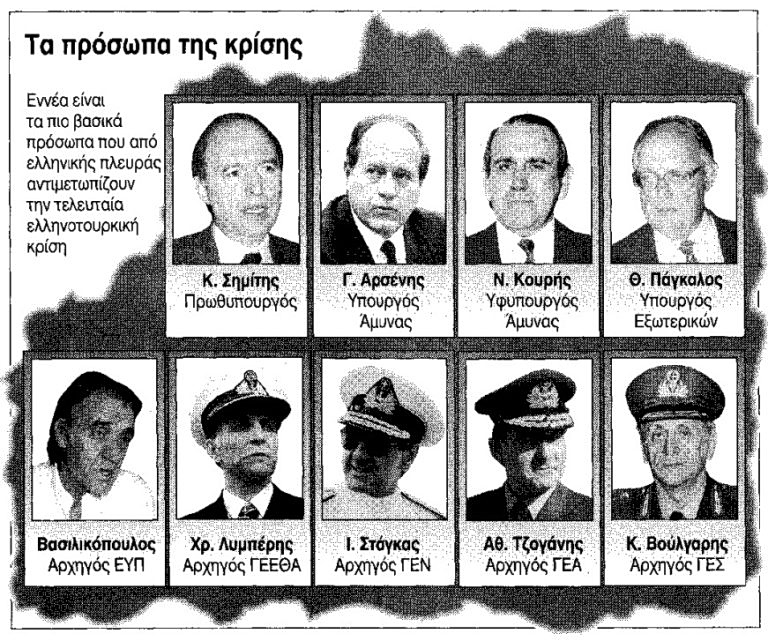
«ΤΑ ΝΕΑ», 31.1.1996, Historic Archive «ΤΟ ΒΗΜΑ» | «ΤΑ ΝΕΑ» “Nine, are the most important people from the Greek side, that dealt with the latest Greek-Turkish crisis.”
Distrust at the Political-Military Level
The report also highlights the climate of distrust between then-Prime Minister Kostas Simitis and senior officers, such as EYP chief Admiral Leonidas Vasilikopoulos and HNDGS chief Admiral Lymperis. The newly elected Simitis “considered them ‘Andrikoi,’ foreign to his own culture and suspicious of setting traps during those critical hours.”
A notable incident occurred during a morning visit by the EYP chief to the Maximos Mansion, where, according to the report, the Prime Minister stood and told him bluntly: “I don’t need you anymore.”
The CIA’s Role and the De-escalation Proposal
Crucial was the intervention of the CIA, through its station chief in Athens and a letter from then-director George Tenet. The Americans proposed a de-escalation formula: a limited withdrawal of Greek forces from Imia as a gesture of goodwill, matched by the corresponding withdrawal of Turkish naval units.
“The EYP chief asked Bill R. if the CIA formula involved removing the Greek flag from Imia. ‘No, absolutely not,’ he replied.”
Vasilikopoulos tried to inform the political and military leadership but could not secure direct communication with the Prime Minister, who referred him to the then-Foreign Minister Theodoros Pangalos.
The Key Figures During the Crisis
While the 2005 report seeks to explain what actually happened, TO VIMA on February 4, 1996, recorded the political management of the crisis as it unfolded, outlining the main actors and their roles.
For Prime Minister Kostas Simitis, the report noted that decisions were made “in conditions of confusion about the actual data, as no central crisis management unit was formed. The positive element was that at the critical moment on Tuesday, he realized in time that he needed to accept the disengagement agreement.”
International Intervention and the American Role
The intervention of U.S. President Bill Clinton was considered decisive; his phone calls to both Athens and Ankara “determined the course of the Greek-Turkish crisis.”
The management was handled by Special Envoy Richard Holbrooke “with his well-known personal style, which likely surprised the Greek interlocutors, resulting in him being declared persona non grata. Nevertheless, Prime Minister Simitis welcomed the results of his efforts when he thanked the United States from the floor of Parliament.”
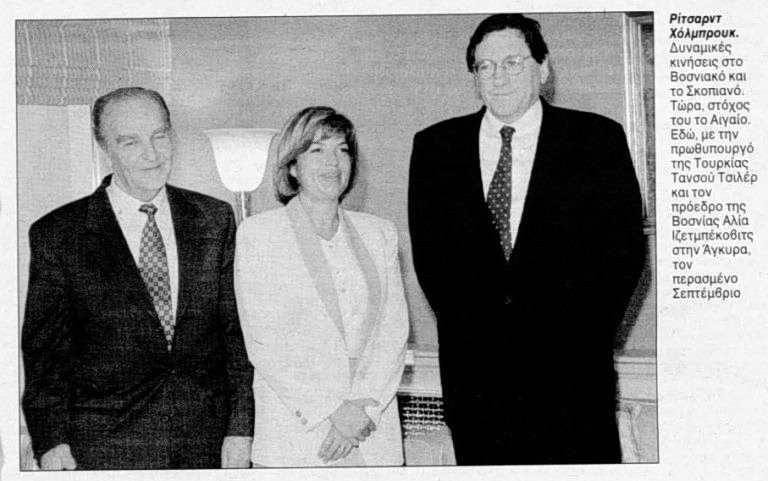
«ΤΑ ΝΕΑ», 1.2.1996, Historic Archive «ΤΟ ΒΗΜΑ» | «ΤΑ ΝΕΑ» In the picture: Richard Holbrook Turkish Prime Minister Tansu Çiller and Bosnian President Alija Izetbegovic
Political Assessment in Athens and Ankara
Turkish Prime Minister Tansu Çiller emerged politically strengthened from the crisis, avoiding provocative moves and presenting an image of effective management domestically:
“Ms. Tansu Çiller was the one who gained the most politically, despite ultimately issuing the order, putting in the least effort […] By avoiding many moves, Turkey did not expose any of its mechanisms to criticism.”
For then-Foreign Minister Theodoros Pangalos, the report notes a strong public presence and “dramatic portrayal of the situation,” leaving open questions about his contacts with the American side during the crisis night:
“During the critical three days, Foreign Minister Mr. Pangalos appeared on television more than in official meetings. His peak moment was when he learned of the upcoming KYSEA session while participating in a TV talk show […] The worst: many dark points remain about what he exactly discussed with Mr. Holbrooke during the long night of Tuesday.”

«ΤΟ ΒΗΜΑ», 4.2.1996, Historical Archive «ΤΟ ΒΗΜΑ» | «ΤΑ ΝΕΑ»; “They left the war for… the media”
For then-Defense Minister Gerasimos Arsenis, TO VIMA notes that he “did not form a clear picture of the magnitude of the Turkish threat and prematurely interpreted certain movements as part of a broader plan:
“He was the instigator of sending the fleet into the Aegean, an action that had as an absolutely necessary condition the prior government decision that the country would go to war if Turkey reacted. The inability to clearly assess the data in the field of confrontation led to disproportionate moves on both sides and Athens’ overreaction.”
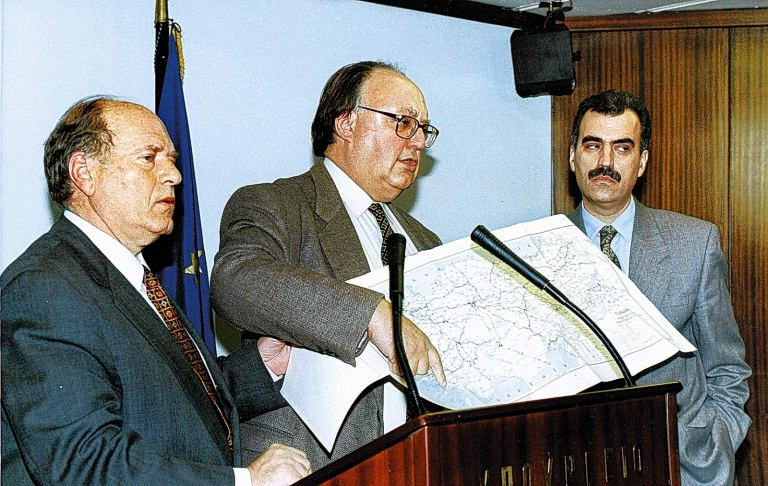
Press Conference with Defense Minister Gerasimos Arsenis and Foreign Minister Theodoros Pangalos. On the right, government spokesperson Dimitris Reppas
The HNGS Log: Minute by Minute Toward the Crisis
The Hellenic Navy General Staff log represents the most dramatic part of the report published by TO VIMA on November 13, 2005. From 00:47 to 07:12 on January 31, 1996, it records orders, warnings, and reports that reflect the tension and confusion of that night.
The Turkish diversionary movements with helicopters, delays in confirming the occupation of West Imia, the frantic effort to control the islet, and finally the loss of the Greek helicopter broadcasting “EMERGENCY EMERGENCY” created a scenario where the conflict was literally avoided at the last moment.