On the afternoon of August 5, 1973, the bustling departure hall of Athens’ Ellinikon Airport—the city’s main international airport at the time—was filled with travelers preparing to board a Trans World Airlines (TWA) flight to New York. Among them were tourists, families, and businesspeople. The summer heat hung heavy in the air. Then, without warning, chaos erupted.
Two armed members of the Palestinian militant group Black September, an organization already infamous for the 1972 Munich Olympic massacre, launched a brutal, indiscriminate terrorist attack. Their target: American and European passengers—people they wrongly assumed were bound for Tel Aviv.
In just minutes, they hurled grenades into the crowd, then opened fire with Spanish-made pistols, turning the airport into a scene of carnage.
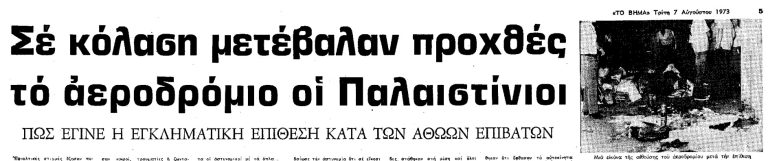
Newspaper headline reading: ‘Palestinians turn the airport into hell day before yesterday’
Blood in the Terminal
Contemporary newspaper To Vima described it vividly on August 7, 1973:“At 3:12 p.m., the building shook with a series of explosions, followed by a storm of bullets. Panic and terror swept through the international departures hall.
The two Palestinians, after spotting passengers gathering for flights to New York and Geneva, tossed ‘Mills’ grenades from behind the airport bar. Then they barricaded themselves and opened fire.
Men, women, and children fell bloodied to the ground. Shattered glass, crumbling plaster, screams, chaos—hell itself.”
The gunmen’s bullets and grenades claimed three lives immediately. Two more victims—16-year-old American Laura Hick and another unidentified passenger—succumbed to their injuries in the following days. More than 50 were wounded. The dead included:
- Jeanne Salandri, 23, from New York
- Elbert Kersing, from New Jersey
- Wolfgang Ullhofen, from Vienna—his body only identified by his shoes
One of the injured survivors, Bill Sementi, lost his wife in the attack. He later recounted:
“Grenades exploded beside us. The terminal turned into a nightmare. My wife lay beside me, covered in blood, her eyes glazed over with death. I can’t believe how senselessly I lost her. Nothing matters to me anymore.”
Eyewitnesses in Shock
Ioulia Evangelinou, a 29-year-old insurance clerk, was standing in line when it began: “I saw something flying through the air—I thought it was a ball. Then there were three or four. They hit the ground and exploded.
I realized I was hit when my legs went numb. I didn’t know if the blood covering me was mine or someone else’s.”
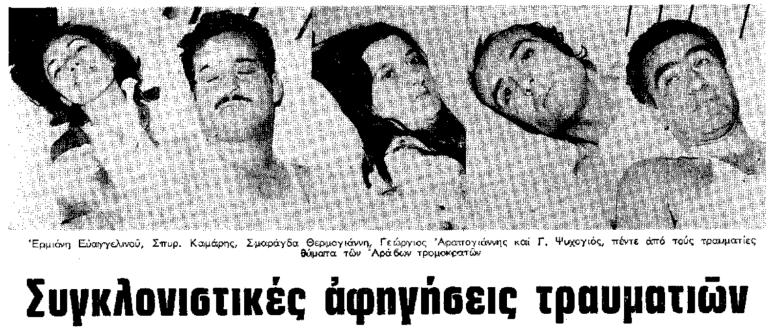
newspaper clipping reading: ‘Shocking stories from survivors’
Her sister Styliani, a 27-year-old teacher from the U.S., added:
“I saw the Arab pull the gun from a black bag. Before I knew what was happening, I was being carried outside, wounded.”
A Hostage Crisis and Arrest
Immediately, Greek airport security forces rushed in. Armed police surrounded the terminal. The attackers took around 30 hostages, including 24 British citizens, forcing them to lie face-down with hands behind their heads.
What followed was a tense standoff, as police held back from a direct assault. Negotiations dragged on until the attackers—realizing they were outgunned and cornered—surrendered.
Trial and Aftermath
The perpetrators, Mohammed Zehhoud and Hussein Talat, were tried in January 1974. During the trial, they claimed their intended target had been passengers bound for Tel Aviv—a misunderstanding triggered by a mislabeling on the departure board. In fact, their victims were heading to New York.
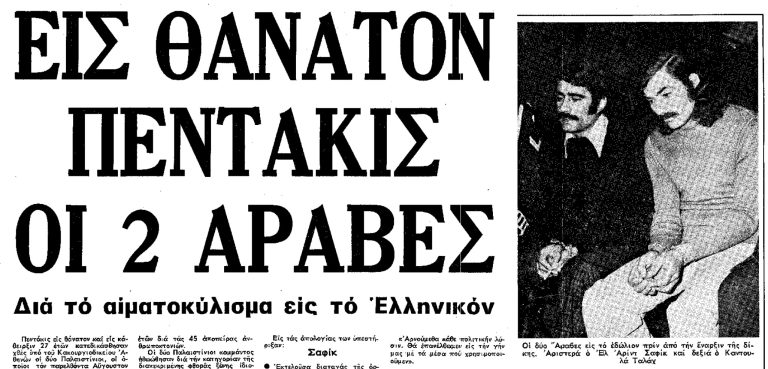
The terrorists were tried and received five death sentences and 27 years in prison.
The Greek court sentenced them five times to death and added 27 years in prison. However, amid intense diplomatic pressure and a broader geopolitical strategy, the Greek government commuted their sentences and later deported the men to Libya.
Forgotten But Not Gone
Despite the scale of the attack and the international victims involved, the Ellinikon Airport massacre remains a little-known chapter of global terrorism. It was one of the most violent acts of international terror to strike Greek soil, a grim echo of the broader Israeli-Arab conflict that reached far beyond the Middle East.
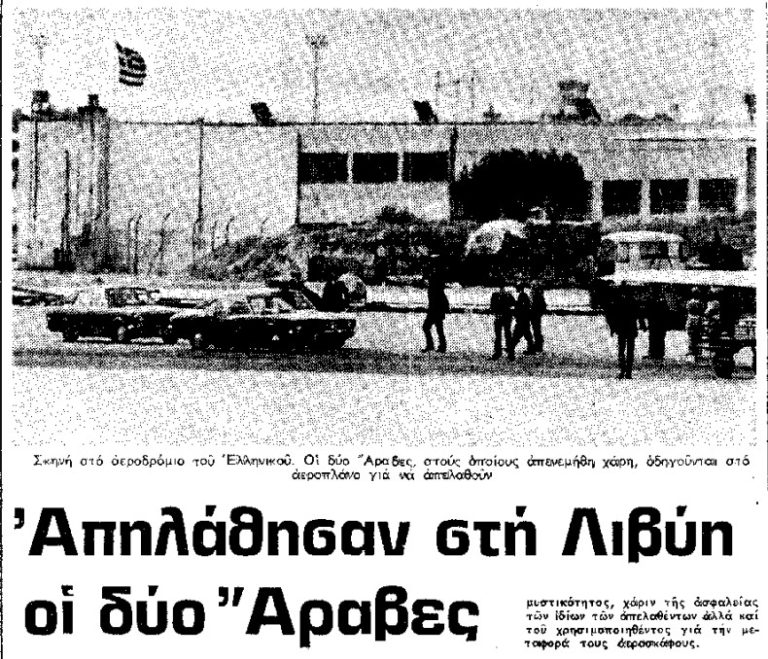
The two perpetrators were eventually extradited to Libya.
Today, Ellinikon Airport no longer exists—replaced by a modern complex ahead of the 2004 Athens Olympics—but the ghosts of that day in 1973 still linger. The victims’ stories, the survivors’ trauma, and the politics of the aftermath remain a chilling reminder of how terrorism can shatter lives in an instant—and how justice, sometimes, takes a different path.
Sources: “To Vima” Historical Archives (1973-1974), eyewitness testimonies, and court records.