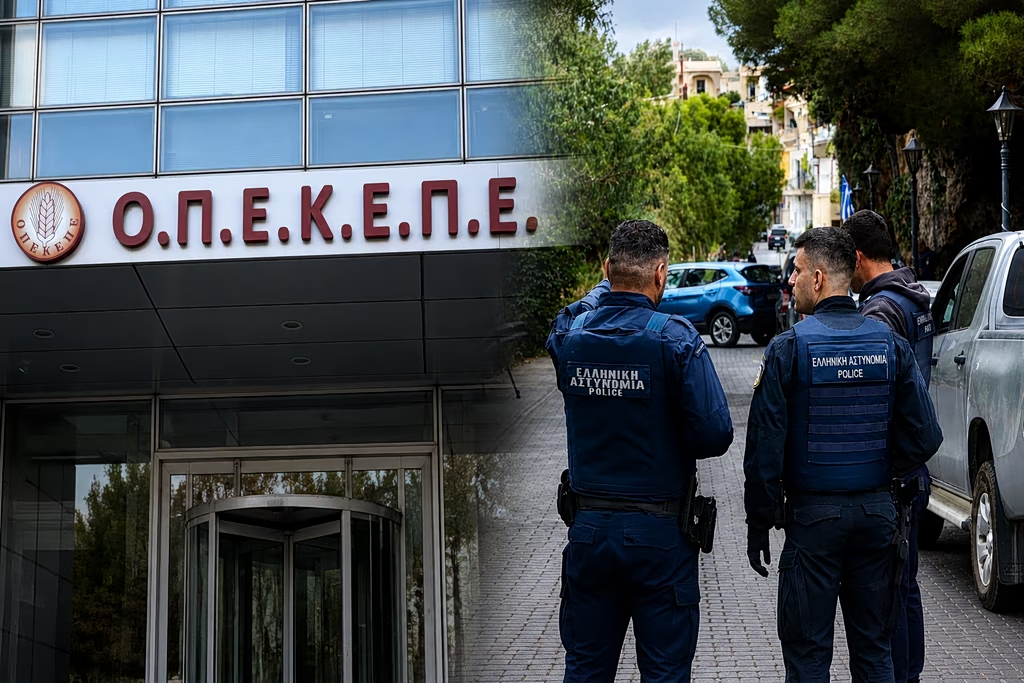
In the wake of the Tycheropoulos report, which effectively cleared many New Democracy MPs whose parliamentary immunity had been lifted in connection with the OPEKEPE scandal, the European Public Prosecutor’s Office (EPPO) now finds itself at the center of judicial proceedings that have reached the Plenary of the Supreme Court (Areios Pagos). Meanwhile, public debate is intensifying over specific actions taken by the Greek delegation of the European prosecutorial institution.
In particular, the handling by Greek EPPO prosecutors Popi Papandreou and Dionysis Mouzakis of the immunity-lifting requests related to the MPs under scrutiny has raised eyebrows, especially after the Tycheropoulos report reduced the estimated public damage from 1.5 million euros to 115,000 euros. Concern has also been raised over the fact that the Tycheropoulos expert report was commissioned after the immunity-lifting requests had already been submitted to parliament.
Questions and Criticism
Additional questions have been raised about the fact that the Tycheropoulos report reached the Greek EPPO prosecutors before parliament had even debated PASOK’s request to establish a preliminary investigative committee regarding former ministers Spilios Liavanos and Foteini Arampatzi. The fact that this report, which was exculpatory for Liavanos, was not immediately forwarded to parliament drew commentary from PASOK. Through attorney Christos Kaklamianis, the party suggested that had parliament been aware of the report, the motion for a preliminary investigation would never have been filed.
While the Greek EPPO prosecutors’ handling of the immunity cases has drawn criticism from some quarters and support from others, the Supreme Judicial Council of the Areios Pagos has already ruled to extend the terms of Popi Papandreou, Dionysis Mouzakis, and Chariklia Thanou for two additional years, asserting that the Supreme Court holds the authority to decide on the renewal of European prosecutors’ mandates. And this is where things get complicated.
The Dispute Over Authority
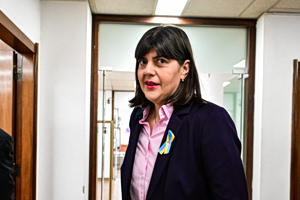
As reported by To Vima last Sunday in its Vimatodotis column, EPPO Chief Prosecutor Laura Kovesi responded to the two-year extension granted to the three Greek European prosecutors by filing an appeal with the Plenary of the Areios Pagos, a move that caused a stir in political, legal, and judicial circles. Reactions to the confirmation of Kovesi’s appeal were mixed: some argued she had the right to file it, while sources from the Supreme Court cite the law and deny the existence of any such right.
What exactly did Kovesi request from the Plenary of the Areios Pagos, which is set to convene on the matter next Wednesday? According to reliable judicial sources cited by To Vima, she has already been summoned in case she wishes to appear and present her position before the Plenary. The substance of her appeal, signed by distinguished constitutional law scholar Spyros Vlachopoulos, is that the three Greek European prosecutors should be granted a full five-year renewal of their terms, not the two-year extension awarded by the Supreme Court. In other words, Kovesi, who had already renewed their mandates for five years, is standing by her decision and legally contesting the Supreme Judicial Council’s ruling before the Plenary of the Areios Pagos.
Over 100 Senior Justices
The issue may sound procedural, five years versus two, but it is anything but. Kovesi is pressing her confrontation with the Greek government and the Greek judicial system, insisting that she, not the Areios Pagos, holds the authority over the renewal of her Greek colleagues’ mandates. Of particular note is the fact that the three prosecutors, who were granted a two-year extension by the Supreme Judicial Council, reportedly stated before that body, with eleven senior justices present, that the Areios Pagos does have jurisdiction over their mandate renewals. What they said on the record, in other words, runs contrary to what Kovesi is now arguing.
The Plenary of the Areios Pagos is set to convene next Wednesday, June 24, to consider Kovesi’s request. More than 100 senior justices and prosecutors are expected to participate, including Supreme Court President Anastasia Papadopoulou and Prosecutor-General Konstantinos Tzavellas. The rapporteur will be experienced Vice President Katerina Chondroризou. According to sources, the rapporteur’s recommendation is expected to go against Kovesi’s appeal, on the grounds that she had no standing to bring it before the Plenary. Under the law, only the affected individuals themselves may appeal rulings by the Supreme Judicial Council on judicial and prosecutorial service matters, and only under specific conditions, namely that at least two senior justices dissented. In this case, the decision to grant the two-year extension was unanimous, with no dissenting votes recorded.
That said, Kovesi’s side is expected to argue that even if her right to appeal before the Areios Pagos is not explicitly recognized, the question of renewing the mandates of prosecutors serving in national delegations falls within the purview of the EPPO College in Luxembourg, and that individual member states cannot reach different conclusions, as doing so would undermine the integrity of the European prosecutorial institution.
Next Steps and the Commission
The most consequential question going forward is whether Kovesi’s next move will be to take the matter to the European Court of Justice, a possibility that cannot be ruled out. However, under EU rules, any such step would have to go through the European Commission.
In any case, the conduct of the prosecutors serving in Greece’s EPPO delegation, particularly in relation to the involvement of political figures in the OPEKEPE scandal, together with the Areios Pagos decision to grant only a two-year extension, signals a series of developments that cannot be predicted with any certainty at this point and are certain to continue.