 Μake us preferred on Google
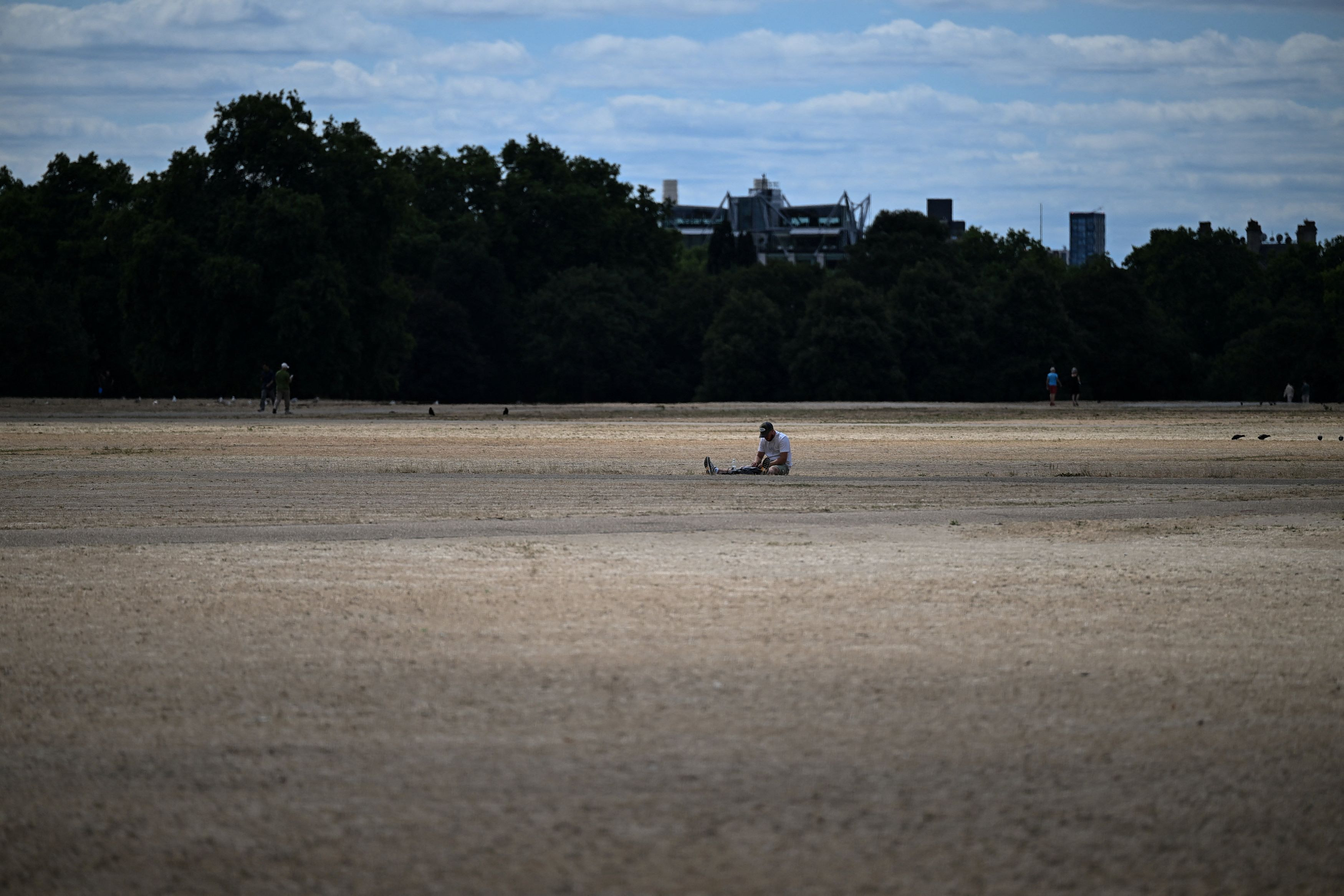
 From above, Hyde Park is a striking sight. What should be one of London’s great stretches of summer green has taken on the color of straw: broad patches of yellow and brown grass, broken up only by the darker green of the trees and scattered pockets that have managed to hold on through weeks without meaningful rain.
On Thursday, August 13, temperatures climbed back toward 36 degrees Celsius, with readings above 36 already recorded near Gatwick Airport, with the UK Met Office warning that parts of England could hit 38 degrees.
London’s parks, gardens, and sports grounds now carry the unmistakable visual signature of an exceptional summer. A photo taken from a police helicopter captures the scale of the change; from above, the capital’s familiar green spaces look almost bleached.
Grass at Hyde Park is scorched by the sun following ongoing high temperatures and lack of rainfall in London, Britain, July 27, 2026. REUTERS/Chris J. Ratcliffe
Britain has now been through its fifth heat wave of the year. On Wednesday, temperatures topped 34 degrees for a sixth straight day, a run not recorded since 1961. The amber extreme-heat warning has spread further west, and hospitals are logging what health workers describe as the busiest summer on record. The Met Office has warned this summer is on track to become the hottest in the history of British weather records.
So what actually happened to the grass? Has London’s famous green really died?
Yellow grass can be misleading
The answer, according to scientists and gardening experts who spoke exclusively to TO VIMA, is reassuring: in many cases, the grass isn’t dead at all. It’s simply gone dormant.
“The yellow grass across London looks dramatic, but much of it is likely dormant rather than dead,” said Yadvinder Malhi, professor of Ecosystem Science at Oxford University’s Environmental Change Institute. “A key point is that grasses grow from their base rather than from the tips of their leaves. So even when all the visible growth has turned brown, the plant can still be alive. As long as the growing points at the base and the roots remain intact, recovery can be remarkably fast.”
Grass at Hyde Park is scorched by the sun following ongoing high temperatures and lack of rainfall in London, Britain, July 27, 2026. REUTERS/Chris J. Ratcliffe
The survival strategy is fairly simple. As conditions get drier, grass slows its growth and conserves water. The outer leaves curl, dry out, and eventually die, while the plant protects its growing points and roots below the soil surface. “If, say, we had several days of substantial rainfall in late August, we could see a significant greening of the parks within a few weeks,” Malhi said. There are limits, though.
“The areas that may not recover as easily are ones where prolonged drought, possibly combined with heavy foot traffic over extremely dry ground, has actually killed or seriously damaged the plants.”
Not just a headache for gardeners, but for wildlife too
Professor Alistair Jump, Dean of Natural Sciences at the University of Stirling, said the phenomenon is a familiar response to prolonged heat and drought, though this year’s scale is unusual.
“The yellowing of grass we’re seeing now in parks and gardens across much of Britain is a regular response to spells of prolonged hot, dry weather. Often that response is fairly localized, but this year the prolonged, widespread drought has turned large stretches of landscape yellow in our towns and villages, as well as in the countryside.” The consequences go beyond appearance.
“This has a real impact on food and shelter for our wildlife, and that impact can be especially pronounced in cities. Usually, when grass yellows, the roots and seeds survive and grass cover comes back once the rains return, but some grass species are more vulnerable to prolonged drought than others.”
The challenge, Jump said, is that this kind of weather may no longer be the exception. “Our climate is changing fast, and we’re seeing these prolonged spells of heat and drought become more frequent and more intense. That may mean we need to shift to different grass species mixes for our parks and change how we manage them, to build more resilience into the plant cover.”
That adjustment matters, since London’s parks aren’t just recreational spaces. “Adapting how we manage our parks and gardens to the new climate is critical, because they provide refuge not just for people, who benefit in many ways from access to green space, but also because in cities they provide vital habitat for a wide range of biodiversity that lives alongside us and helps these urban ecosystems function.”
“Green lawns will come back — until the next drought”
Chris Thomas, professor of Biology and Biodiversity at the University of York, offered an equally reassuring take. “Hidden inside the curled brown grass leaves are living growing tips, waiting for rain to return so they can start growing and turn brown back to green.
Grass is generally pretty good at this, though it may look a bit patchy for a while. Don’t worry — the green lawns will come back, until the next drought, of course.” Still, Thomas thinks the conversation should move beyond whether Britain can simply restore its traditional green lawns.
“Whether we Brits should keep chasing large, uniform stretches of green grass in our gardens and parks is a separate question, rather than wildflower meadows and deeper-rooted shrubs. But changing an entire nation’s attitude toward its gardens isn’t easy!”
Kew: “We can’t justify irrigating vast areas of grass”
Joe Richomme, Botanical Horticulturist and Gardens Supervisor at the Royal Botanic Gardens, Kew, said the grass in London’s parks is proving remarkably resilient. “The vast majority of grass in London’s parks is actually quite drought-tolerant. Even after six weeks with no water at all, the grass stays alive, it’s just dormant, waiting for more favorable conditions.
With the first sustained rainfall it will start greening up again.” For Richomme, the change is mostly cosmetic, and that may require Londoners to rethink what a park should look like in summer.
“The change we’re seeing is largely aesthetic, so we may need to adjust our expectations of what green spaces should look like during droughts. Water is a finite resource, and we can’t justify using it to irrigate vast stretches of grass that we know will bounce back on their own.” The answer may lie both in changing which species get planted and in how they’re managed. “Some grass species are naturally better adapted than others, and there’s work to be done in selecting a varied mix of species that can cope well with these conditions.
We can also look at changes in how we manage some of our grassy areas — letting the grass grow longer, for instance, can make it more drought-resistant.” Such changes could bring an unexpected upside too. “Both of these measures can also boost overall biodiversity, so there’s potential for benefits to come out of our need to adapt to these difficult conditions.”
London’s parks may never look quite the same again
For Professor Malhi, the yellowing of Hyde Park and London’s other green spaces is more than a passing curiosity — it could be a glimpse of a new normal. “If hot, dry summers become increasingly frequent, as climate projections suggest, Londoners may need to get used to parks that are yellow or brown for part of the summer, rather than the steady green landscapes traditionally associated with southern England.”
London’s future climate, he said, may increasingly resemble that of places well to the south. “London’s climate is expected to be characterized more and more by warmer, drier summers, bringing some aspects of its summer conditions closer to those seen today in northern Spain.”
That could force changes both in gardening practice and public expectations. “The climate of coming decades will differ from the one London’s parks were managed for in the 19th century, and our expectations of what a healthy urban landscape looks like in summer may need to change along with it.”
For now, though, London’s yellow grass waits. The roots are still there. Beneath the curled, scorched leaves, the plant’s living growing tips are holding onto whatever moisture remains, waiting for rain. And when it finally comes, Hyde Park could start greening up again almost as fast as it turned yellow.
The harder question is how many more summers Britain can expect before yellow becomes the new green.