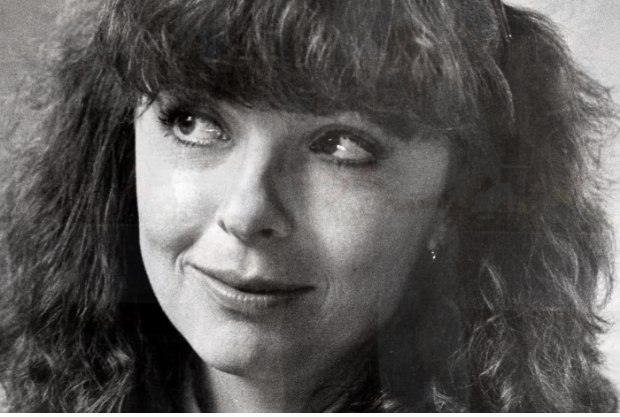
The union already had a Diane Hall, so she tried acting under names like Dorrie and Cory Hall before trading under her mother’s maiden name. So, it was Diane Keaton who walked onstage to audition for a part in “Play It Again, Sam.”
“If Huckleberry Finn had been a very beautiful woman, that’s who was up there onstage,” the play’s writer, Woody Allen , who would become a longtime collaborator, wrote in his memoir, adding: “One talks about a personality that lights up a room, she lit up a boulevard.”
Within three years, “The Godfather” would make her a movie star. Over the next half-century, her emotionally wrenching performances would turn her into an Oscar winner, while her idiosyncratic personal style made her a touchstone to generations of American women.
Keaton died Saturday at the age of 79. A cause hasn’t been announced.
Jane Fonda , who co-starred with Keaton in “Book Club” (2018) and “Book Club: The Next Chapter” (2023) said in a post on Instagram that she was “limitlessly creative…in her acting, her wardrobe, her books, her friends, her homes, her library, her world view. Unique is what she was. And, though she didn’t know it or wouldn’t admit it, man she was a fine actress!”
‘I want to be on the stage’
Diane Hall was born in Los Angeles on Jan. 5, 1946, to Dorothy and John Hall—the first of four children they would have. Her father was a civil engineer. She was particularly inspired by her mother, whom she called “a miracle” and whose personal journals she wove into her 2011 memoir, “Then Again.”
“Don’t forget, she was Mrs. Los Angeles…I was sitting in the audience and just going, ‘Oh no, oh, no, that’s me. I want that. I want to be on the stage,’” Keaton told The Wall Street Journal in 2022 . “And that’s pathetic! And that’s what it was; that’s the truth. These things happen in all of our lives, don’t you think? You see something or something hits you, or you’re just eager to get things for yourself.”
She performed in school plays in high school and studied acting in community colleges in California before dropping out and moving to Manhattan at age 19. She studied at the Neighborhood Playhouse under Sanford Meisner and won a role in the original Broadway cast of “Hair” before being cast in “Play It Again, Sam.” In a letter to her mom in 1969, Keaton wrote, “The rehearsals are going okay. Woody Allen is cute and, of course, very funny.”
Soon after she got the part, the two went out for dinner. Allen was completely taken with her charm, wit, looks—and the way she could destroy a plate of food.
“I never saw a person outside of a logging camp tuck it away like that,” he wrote in his memoir, “Apropos of Nothing.” “Anyway, to cut to the chase, by the time ‘Play It Again, Sam’ opened in DC, we were lovers.”
Keaton, who never married, would go on to have a number of headline-making romances, including with Warren Beatty and her co-star in the movie that made her famous: Al Pacino .
“For me,” she wrote in her 2011 memoir, “the Godfathers, all three of them, were about one thing—Al.”
Playing the role of Kay Adams—a schoolteacher turned mafioso’s wife—opposite Pacino in Francis Ford Coppola’s “The Godfather” (1972) put Keaton at the center of one of the tentpole films in what became known as the New Hollywood movement. Keaton, along with many members of its ensemble cast—including Robert Duvall , James Caan , Talia Shire and Pacino—become among the most recognizable actors of their generation.
The same year, she starred in the film version of “Play It Again, Sam,” also written by Allen. She appeared in the first of what would be seven films directed by Allen, “Sleeper,” in 1973.
‘An affable version of myself’
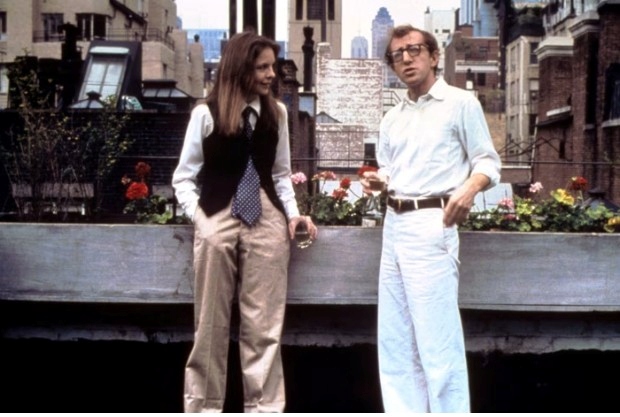
The high point of their collaboration came with “Annie Hall” (1977), in which Keaton plays the neurotic titular heroine, a character inspired by the actress.
In her memoir, she recounted how Allen told her to wear what she wanted to wear for the role, and how she then “stole” the elements of her costume from “cool-looking women on the streets of New York.” Most people assumed the movie was the story of her and Allen’s relationship, she wrote: “Woody and I did share a significant romance, according to me, anyway. I did want to be a singer. I was insecure, and I did grope for words.”
At the 50th Academy Awards in 1978, up for best actress for “Annie Hall,” Keaton heard first a “D sound” and then her name announced as the winner. She rushed up to the podium, still not sure she had won, and gave a speech that lasted less than 30 seconds.
“I knew winning had nothing to do with being the ‘best’ actress,” the famously self-effacing Keaton wrote in her 2011 memoir. “I knew I didn’t deserve it. And I knew I’d won an Academy Award for playing an affable version of myself.” But the award still thrilled her, because it was an acknowledgment of comedy’s significance.
“For some unfathomable reason, comedy is invariably relegated to the position of second cousin to drama,” the actress wrote. “Why? Humor helps us get through life with a modicum of grace. It offers one of the few benign ways of coping with the absurdity of it all. Looking back, I’m so happy and so grateful and so proud to be in a Great American Comedy.”
In 1978, the New Yorker called Keaton “one of the most comedically pure and brainy actresses in our midst.”
“Her prodigious comic gifts are sometimes hidden,” the magazine noted . “She tends to hoard these gifts, as if she were an impostor guest at a banquet tucking away food for friends under the challenging eyes of a portly butler, or as if her talent might run out in some world energy crisis.”
Style icon
Though she won her only Oscar for “Annie Hall,” she was nominated three more times, including for her role as activist Louise Bryant in Beatty’s “Reds” (1981) and alongside Meryl Streep and Leonardo DiCaprio in “Marvin’s Room” (1996). Her final nomination came for the Nancy Meyers rom-com “Something’s Gotta Give” (2003), portraying Erica Barry, a successful divorced playwright who thinks love and sex are in her past until she meets her daughter’s boyfriend ( Jack Nicholson ) at her home in the Hamptons.
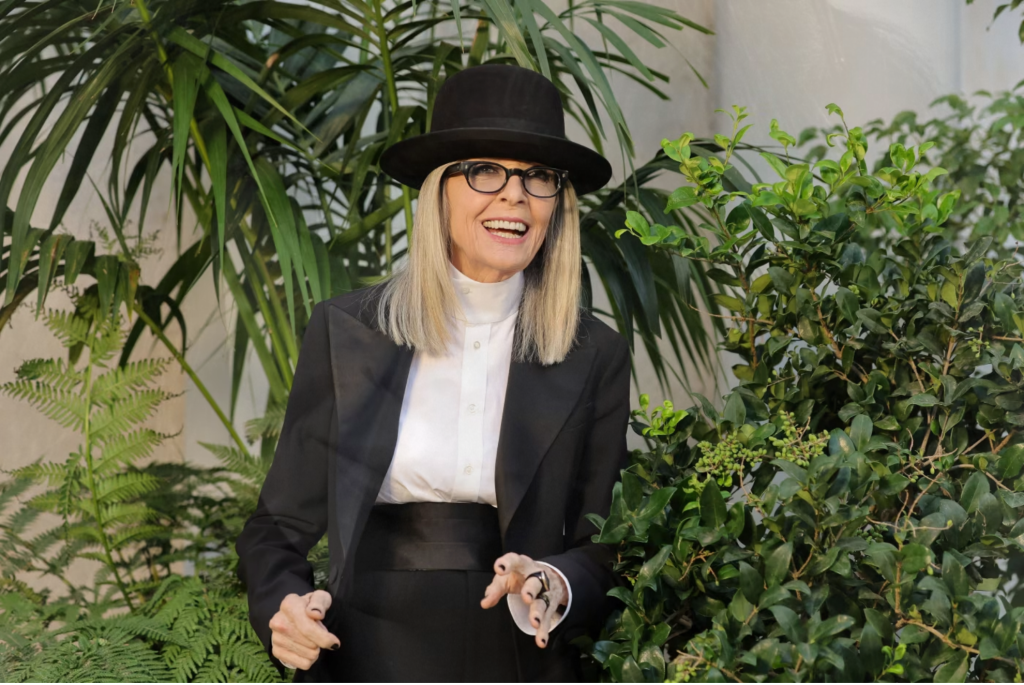
Keaton showed up to the 2004 awards ceremony in a suit (custom Ralph Lauren ) and bowler hat, two of the fashion signatures that made her a style icon to many.
Keaton’s character in the film is swathed in beachy white-and-beige separates. That image has endured through the TikTok era, where young fans anointed her as the ultimate “Coastal Grandmother.” Asked by the Journal in 2022 if she had a secret to putting together her signature, menswear-inspired outfits, Keaton said, “Oh, God, no.”
Keaton’s close collaboration with writer-director Meyers began in the 1980s with “Baby Boom” and led to a comedy-driven career resurgence in her 40s and 50s. She starred opposite Steve Martin in “Father of the Bride” (1991) and played a vindictive divorcée in “The First Wives Club” (1996).
Bookend
Keaton acted through her 70s, including the two “Book Club” films, though not to nearly the critical and commercial reception of earlier roles.
“‘Book Club’ is what it is,” the Journal’s Joe Morgenstern wrote in his review of the first film , “a commercial concoction for (mainly) female moviegoers of a certain age who may feel an uncertain connection with the current state of popular culture.”
She also played Justin Bieber’s grandmother in his music video for “Ghost” (2021).
Off-screen, she liked to be behind the camera. She roamed the streets of Los Angeles taking pictures of abandoned storefronts. And she collaged and collected images. Her visual autobiography, “Saved,” featured an array of “photographic curiosities”—other people’s scrapbook pages, images from a medical book on dental disease—that she assembled over the years. Keaton also enjoyed buying, remodeling and flipping houses. She loved her golden retriever, Reggie, whom she described as “a chirp and a flirt.” She is survived by her children Dexter and Duke.
In her 2011 memoir, Keaton wrote about three things that changed her life: finding a man’s bowler hat at a Salvation Army thrift shop when she was a teenager; her children, who she wrote saved her; and “Annie Hall.”
After the movie opened, she wrote, “I remember people coming up to me on the street, saying, ‘Don’t ever change. Just don’t ever change.’ ”