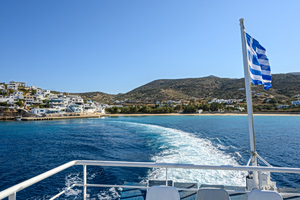
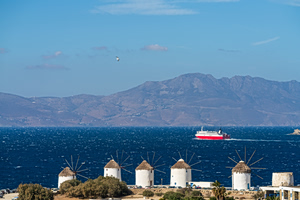
The Aegean Sea appeared calm as Austin Croteau waited to board her ferry. She was traveling with her husband and four kids from the Greek island of Syros to Athens.
Minutes after their boat left the port, huge waves were crashing into the ship as it rocked back and forth. Croteau, 38, could see water engulfing the windows as attendants rushed to assist travelers.
“They were going around fanning people, handing out barf bags left and right,” she said. “It wasn’t even worth trying to get to the bathroom.”
It seemed like half the passengers were hung over after a night of partying, she said. Croteau looked around to see people holding their pale faces in their hands, fighting the urge to vomit.
“I’ve never seen my kid’s face go completely green,” said Croteau, a “digital nomad” mom who’s now based in Syros. “I realize now, that’s where the cartoons get it from.”
Such journeys have become a rite of passage for the millions of tourists who island-hop through Greece every summer, dreaming of beaches, parties and feta. Thousands of social-media posts have documented their Odyssean sea voyages, calling the boats “vomit comets” and your “worst nightmare.”
Emily Savage, 25, had planned a relaxing Greece trip with her best friend. Little did she know, she’d be “holding on for dear life” on the rocky ferry from Naxos to Milos.
“The waves would make the boat jump, and you would fly up a couple inches,” said Savage, a marketing analyst in San Francisco.
The treacherous conditions continued for the next six hours.
The boat made a few stops along the way, and as it picked up or dropped off more passengers, people were “trying to close their eyes, passing around Dramamine,” she said. “It was kind of a bonding experience.”
Petros Zissimos, managing director of the travel agency Hellenic Holidays, said that’s a common experience for travelers bound for Milos due to the strong “Meltemi” wind pattern that blows through the Aegean.
“When you’re traveling from Naxos to Milos, it’s going to be rough no matter what kind of vessel it is, because you’re crisscrossing the Aegean trade winds,” he said.
Summer can be especially windy, whipping up the waters around the Cyclades just as tourists flock to the popular islands of Mykonos, Naxos and Milos. The Ionian islands, located on the western coast of Greece, tend to have calmer seas.
With its golden beaches, whitewashed villages, stunning sunsets and ancient history, it’s no surprise that Greece is an increasingly popular destination for sun-loving tourists. The country welcomed 21% more travelers from January to May compared with the same period in 2025, according to the Bank of Greece. In the past decade, American visitors to Greece nearly quadrupled . Cruise ships now crowd docks in Athens , Mykonos and Santorini.
“Greece is one of the first countries that emerged from Covid quickly,” Zissimos said. “It’s been super popular the past three years.”
In 1966, a Greek ferry sank in the Aegean Sea due to the rough winds. Since then, strict protocols were put in place to forbid ships from sailing in dangerous conditions, according to Spyridon Roussos, a political scientist and ferry specialist from Paros.
If a ship sails, that means the conditions are safe enough to travel—however rocky the water may feel, according to Roussos. “The captains, they are very capable,” he said. “It’s a daily phenomenon.”
Sophie Jansen, 33, of Amsterdam, travels to Greece over five times a year and has taken close to 100 island ferries. Most of her trips—other than one unlucky boat ride—have gone smoothly.
“People like to throw those chaotic videos online,” said Jansen, who works in marketing and runs a social-media account dedicated to Greece travel tips. “It makes it look as if that happens every day, but that’s definitely not true.”
Jansen loves the elaborate Greek ferry system that connects most of the country’s inhabited islands. It’s often more efficient than a plane ride, she said.
To avoid any unwelcome nausea, she’ll opt for a bigger and slower boat that is sturdy on the water—one that’s spacious enough to carry cars.
If you are prone to seasickness, Jansen suggests sticking to islands that are well-connected via larger boats. Even popular routes, like Paros to Milos, can have only one small direct ferry that runs once a day on not-so-calm waters, depending on the time of year.
“It’s all about doing the research and not just throwing yourself into an itinerary that you had in your mind,” she said.
Zissimos advises his clients to not fall for the faster but smaller vessels, since you’ll “get bumped around a little bit.” He also recommends travelers bring motion-sickness patches or chew on gum, which can mitigate some of the issues.
The rocky boat rides were always worth it in the end for Croteau, who moved from New Hampshire to Syros in September after traveling the world with her family for three years.
“Even if you’re scared, do it,” she said. “The Greek islands, there’s nothing else like it.”