
From the Baltic Sea to the Pacific Ocean, a global scramble is under way to protect submarine cables vulnerable to potential sabotage.
Governments, militaries, cable owners and tech startups are taking action to bolster the defenses of the world’s underwater cable network, through which most international data traffic travels.
In Northern Europe, the North Atlantic Treaty Organization is using ships and drones to ward off possible sabotage, after a Russia-linked vessel cut vital cables in 2024.
In Asia, Taiwan is increasing coast guard patrols and penalties for damaging cables, hoping to deter would-be saboteurs . Private cable operators are looking at routes that avoid contested waters such as the South China Sea, where Chinese vessels have clashed with Philippine ships and pressed territorial claims.
The efforts underscore the challenge: There is no foolproof way to defend submarine cables.
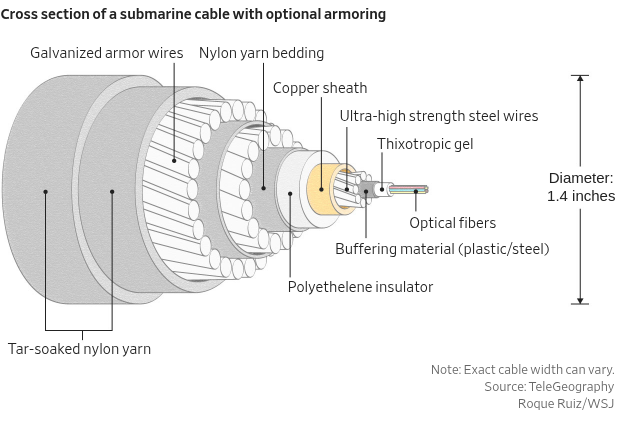
The dragging of ship anchors, a main way cables get taken out, can damage even armored cables, which are wrapped in steel wire but still roughly the diameter of a ping-pong ball. When close to shore, cables are buried, but they can be buried only so deep.
“A determined adversary,” said David Brewster, who researches Indo-Pacific maritime security at Australian National University, “can still cut the cable relatively easily in shallow waters.”
The conflict in Iran has raised new concerns, including that cable-laying and repair ships won’t be able to transit the Strait of Hormuz, delaying much-needed fixes or upgrades.
China and Russia deny being involved in cable cuts. One hurdle for Western officials has been the difficulty of proving a captain acted on orders from Beijing or Moscow, particularly since many ships involved are flagged under third countries.
“This attribution challenge has paralyzed the international community’s response,” Jason Hsu, a former Taiwan legislator now at the Hudson Institute, recently told a U.S. legislative commission in written testimony.
Cable faults are mostly the result of human accidents, natural hazards, abrasion or equipment failure, according to the International Cable Protection Committee, which said last year that it wasn’t aware of any verified incidents of state-sponsored sabotage since World War II. The number of cable faults has been about 150 to 200 a year and has remained stable, the organization said.
“The submarine cable industry goes to great lengths to protect cables, provide resilient networks and minimize disruptions,” said Dean Veverka, the committee chairman and chief technology officer at cable operator Southern Cross. Still, he said, “bad actors too can cause disruptions if they really wanted to.”
Submarine-cable construction is booming as the growth of artificial intelligence drives demand for more network capacity. As of mid-February, there were 119 new cables planned globally, up from 98 in January last year and 66 in January 2020, according to Tim Stronge, chief research officer at telecom-data firm TeleGeography.
There are limits to physically fortifying the cables. Armoring them with steel wires provides some protection against crushing, but can’t reliably stop snag damage if the anchor of a large ship hooks it and pulls, Stronge said.
“Those anchors on the commercial vessels, all the cargo ships, are gigantic,” he said. “A little bit of extra steel is not going to stop it from being ripped up.”
Despite the challenges in attributing cable cuts, some analysts say recent incidents have been so specific that it is hard to believe they were accidental.
Cuts of cables to Taiwan in 2023 and 2025 were notably precise in hitting areas where they would wreak the most havoc, Hsu testified. After an incident last year, a Taiwan court found the Togo-flagged ship’s captain, a Chinese national, responsible for intentionally damaging a cable and sentenced him to three years in prison. China later said a Taiwanese smuggling operation was to blame.
More recently, Taiwanese authorities said they are investigating another Chinese vessel, which was sent to recover a stranded fishing boat, for possibly damaging a cable near one of its outlying islands last month.
China could be seeking to boost its cable-cutting abilities. Some analysts were alarmed by a media report last year that Chinese researchers had developed a device with a diamond-coated grinding wheel that can cut cables at depths of about 13,000 feet, making cables in the deep ocean vulnerable. The researchers characterized the device as needed to help develop marine resources.
Some nations are trying a military solution to ward off potential saboteurs. NATO countries, concerned about possible malign activity from the Russia-linked “shadow fleet” of sanctioned oil tankers, are using ships, drones and aircraft to patrol the Baltic Sea.
The effort, called Baltic Sentry, launched in January 2025 and has yielded results, said Cmdr. Arlo Abrahamson, a spokesperson for the North Atlantic Treaty Organization’s Allied Maritime Command.
After the patrols got under way, there weren’t any suspected malign incidents for about a year, Abrahamson said. Then Finnish authorities took control of a vessel they suspected of damaging a cable at the end of last year.
The alliance plans to use more uncrewed surface vessels in the operation this year, Abrahamson said.
“It’s a persistent mission and it’s difficult to do,” he said. But it demonstrates that “the alliance can achieve deterrence through collective action.”
Singapore is several years along on a plan to double the number of cables connected to the island to more than 50. There are now a little more than 30. Singapore also wants more cable landing areas beyond the two currently in use, said Loh Woon Sien, a senior director at the city-state’s Infocomm Media Development Authority.
“Whatever the reason is for the cut, you will need to go and repair the cable, and you will need some time to do that,” she said. “Being able to divert traffic quickly to another cable is the best way to keep it resilient.”
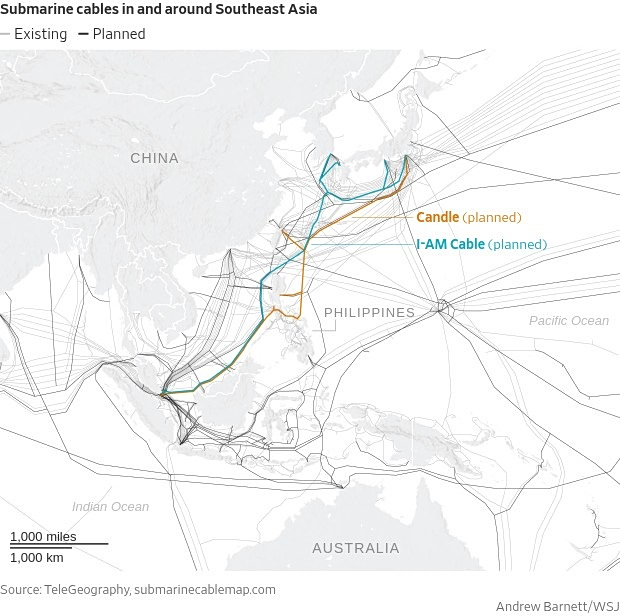
Some planned cables opt for a more geopolitically secure route. The I-AM Cable, for example, will avoid the center of the disputed South China Sea, tracking near the coast of the Philippines, according to a TeleGeography database. Another, Candle, will go east of the Philippines for part of its route.
Some companies are promoting new technology, called distributed acoustic sensing, that they say can let operators know if there is a ship near a cable or if a cable has been damaged. That would be useful particularly if a ship has turned off its location transponder.
With this method, a device called an interrogator shoots laser pulses down the length of a cable, and some of the light bounces back. When sound vibrates the cable, it changes the returning light, revealing what is happening, and where, along the cable.
“We can tell you it’s a tanker, it’s a fishing vessel, it’s a speedboat, it’s a sailing boat,” said Zack Spica, a University of Michigan assistant professor who co-founded Lumetec, which is selling the technology.
Defense-technology firm Anduril Industries says it has developed a device called Seabed Sentry that can deploy to the bottom of the ocean and stay there for months. It can contain a sonar array that detects passing vessels, helping to monitor chokepoints or port entrances.
Write to Mike Cherney at mike.cherney@wsj.com