After President Trump signed a memorandum of understanding with Iran in mid-June, administration officials fanned out to build support for an agreement they hoped would reopen the Strait of Hormuz and start winding down the war.
Iran’s hard-line leaders huddled in Tehran and came up with a different plan, according to Iranian and Arab officials. In their view the pact was likely just an attempt by the U.S. and Israel to take pressure off the global economy and buy time for a bigger attack down the road. Instead of putting faith in talks, they took the past two months to prepare for a bigger fight.
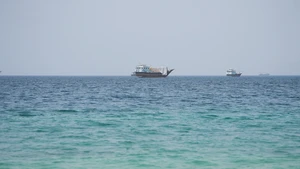
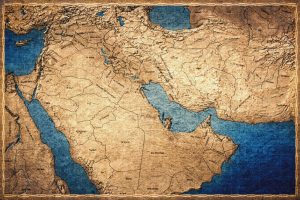
Their efforts include giving the powerful Islamic Revolutionary Guard Corps more control of the country’s regular army, appointing hardened veterans of the war with Iraq and past internal crackdowns to key posts, expanding domestic counterintelligence operations and ramping up production of missiles and drones. The leadership quickly seized the initiative, attacking ships to tighten Iran’s grip on Hormuz and expanding the battlefield to the Red Sea, which Saudi Arabia has used to get around Iran’s chokehold on the Persian Gulf.
Arab intelligence officials have picked up evidence—including communications between Iran and militia allies in countries such as Yemen and Iraq—of a strategic shift inside the country’s hard-line leadership to get their forces ready to widen the war and raise the costs for the U.S., officials familiar with the findings say. Alarming weaker Gulf countries like Kuwait, Iran’s leaders are increasingly talking about offensive operations on enemy territory.
Their overriding goal is to inflict enough pain to ensure the kind of attacks Iran has endured with the 12-day war last year and the continuing conflict aren’t repeated.
“There is also a widespread view in Iran that the main war has not yet begun,” said Mohammad Hassan Sangtarash, a Tehran-based defense analyst close to the Iranian government. “What we have seen so far is increasingly interpreted through the lens of ‘salami-slicing’ tactics—limited, incremental escalation designed to weaken capabilities before a larger confrontation.”
The Iranian preparations point to an enormous gulf between how Washington and Tehran are perceiving this stage of the war. The divergence has driven a hard-line negotiating stance and reluctance to close deals by Iran’s leaders that has persistently flummoxed Trump, who has called them crazy and accused them of lying.
Iran’s readiness to fight also highlights a deep lack of trust that is likely to keep the two sides from reaching a durable deal to end the conflict any time soon.
Iran’s proclamations include plenty of bravado. The country’s military and economic base have been battered by U.S. and Israeli airstrikes. More pragmatic members of the leadership including Iranian President Masoud Pezeshkian have repeatedly warned Iran needs to negotiate a deal to end the war that brings sanctions relief or face the collapse of its economy.
But Iran is rebuilding its infrastructure and restoring access to missile bases much more quickly than expected, a concern to Israeli officials who are familiar with the progress. It also has successfully targeted U.S. bases and retains enough firepower to threaten ships and Gulf energy infrastructure. Arab officials are bracing for continued fighting and an extended disruption of energy supplies.
For the regime, “the baseline is war,” said Alan Eyre, a former senior U.S. diplomat and nuclear negotiator with Iran. “Iran will remain on a wartime footing, preparing for a subsequent attack.”
When Trump signed the memorandum of understanding with Iran on June 17 at the French palace of Versailles, it looked like the biggest hurdle would be convincing American critics that it wasn’t overly generous to Tehran.
The deal promised sanctions waivers to let Iran sell its oil, access to billions of dollars in frozen cash and the prospect of a $300 billion fund to rebuild the country. Iran’s main obligation was to open the Strait of Hormuz to shipping traffic and then negotiate in good faith on its nuclear program.
When Iran started shooting at ships the U.S. was guiding through the strait three weeks later in early July, it caught the U.S. by surprise.
“The very dangerous people from Iran, they’re sick,” said Trump, who also called Iran’s leaders scum. “There’s something wrong with them.”
In fact Iran was pursuing a two-track policy. While his diplomats pursued a peace deal with the U.S., Iranian leader Mojtaba Khamenei was taking steps to prepare the security apparatus for an expanded confrontation that may be initiated by Tehran itself.
The Revolutionary Guard used the calm created by the memorandum of understanding to lay the groundwork with allied militias around the region to step up attacks if needed, sending advisers to Iraq, Yemen and Lebanon to discuss the plans, the officials familiar with recent Arab intelligence findings said.
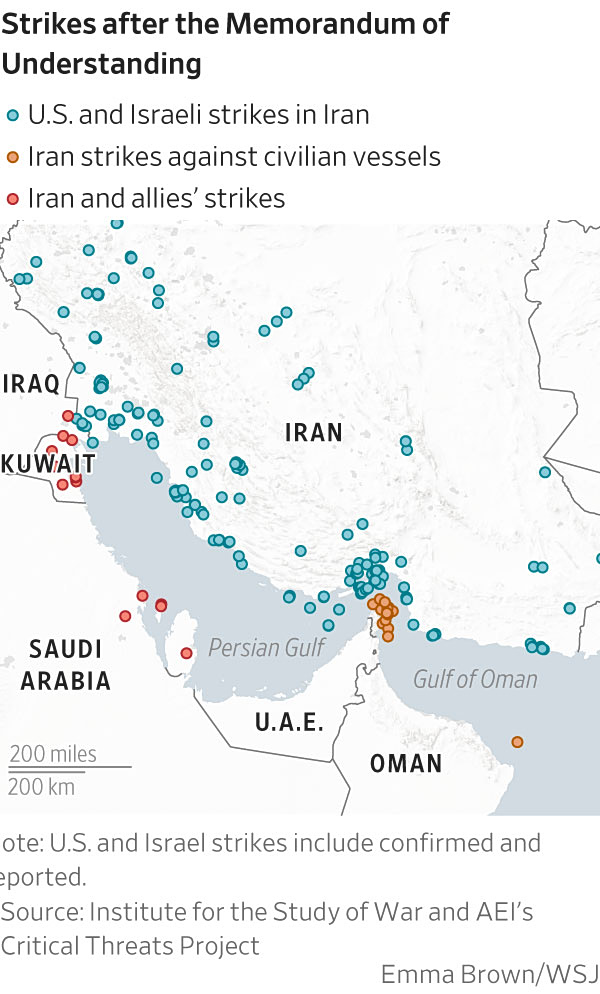
The intelligence including intercepted communications showed the Revolutionary Guard sending commanders to areas controlled by Yemen’s Houthis to plan for a stepped-up confrontation with Saudi Arabia in coordination with Iraqi militias that also are backed by Iran.
The Revolutionary Guard supervised deployments of missiles, naval weapons and drone launchers to positions overlooking the Red Sea. It also provided the Yemeni militants with intelligence, target lists including Saudi ports and energy facilities, and advice on sheltering from Saudi retaliation, the officials said.
The result was fighting that escalated through late July. The Houthis struck Yemeni government forces backed by Saudi Arabia and declared the Bab al-Mandeb Strait that links the Red Sea to world markets closed to Saudi Arabia. The militant group has fired on Saudi ships, complicating the kingdom’s efforts to export its oil and raising the supply risks for global markets.
Around the same time, Saudi Arabia said Iran-backed militias in Iraq had launched drone attacks on its oil facilities .
The Revolutionary Guard threatened Gulf states that it would destroy their energy facilities if the U.S. were to hit similar sites in Iran—going as far as sending detailed lists of individual targets to its Arab counterparts, the officials said.
Iran also escalated its attacks on American troops. Tehran surprised the U.S. by firing five ballistic missiles at Jordan during a lull in the conflict. The attack came two weeks after another Iranian strike in Jordan killed three U.S. servicemembers .
Officials in the Gulf grew more alarmed as they watched the scope of attacks grow and Iranian missiles evade U.S. defenses and hit targets more precisely in Jordan, Kuwait and Bahrain. The fighting spilled into August, with Iran striking six United Arab Emirates ships over the past two weeks as they tried to transit the Strait of Hormuz.
“We took full advantage of the ceasefire period,” Revolutionary Guard spokesman Brig. Gen. Hossein Mohebbi said in an interview with the Guard-affiliated Tasnim news agency in July. “We enhanced our capabilities, accelerated our missile production rate and improved missile accuracy.”
Behind the scenes, Supreme Leader Khamenei was positioning his forces for a more aggressive fight, lining up seven key security leaders to run revamped military and repression institutions in a reorganization that was unveiled a week ago.
The appointments came with aggressive goals that included tightening the military chain of command, turning an ideological militia into a neighborhood intelligence agency and emphasizing an offensive approach.
Mohsen Rezaei, who led the Revolutionary Guard during the war with Iraq in the 1980s, was named secretary of Iran’s top decision-making body, the Supreme National Security Council, where he will be Khamenei’s representative. In the past week, the council squelched progress on a deal to gradually open Hormuz.
To step up internal security, Khamenei returned veteran Hossein Taeb, a close associate who led a deadly crackdown on protests in 2009, to the helm of the Basij. The supreme leader tasked him with pivoting the volunteer force into a “popular intelligence network” in the wake of two wars that showed how thoroughly Iran had been breached by Israeli intelligence.
Iranian government advisers see the next stage of the confrontation going beyond conventional warfare to include external attempts to foster domestic unrest. The government brutally suppressed protests over the country’s economic crisis in January and fears it’s only a matter of time before the continued deterioration under U.S. pressure brings demonstrators back to the street.
Khamenei also consolidated Revolutionary Guard influence over the regular army by unifying control of the two military arms under Brig. Gen. Ali Abdollahi, a veteran Revolutionary Guard senior commander and military leader who has aggressively advocated attacks on Arab states hosting U.S. bases around the Persian Gulf.
New Revolutionary Guard Commander in Chief Ahmad Vahidi—who has been unofficially on the job since March—was formally given the position and tasked with “powerful offensive operations against the enemy,” the decree appointing him said Monday. The next day, Gen. Mohammad Reza Naghdi, an adviser to Vahidi, said the paramilitary force must be prepared to take operations into enemy territory.
“Vahidi’s elevation is consistent with a leadership preparing the security establishment for a period of sustained confrontation rather than a return to normal peacetime politics,” said Saeid Golkar, an expert on Iran’s security services at the University of Tennessee at Chattanooga.
The Revolutionary Guard— an armed force nearly 200,000 strong —has devised new plans for further escalation including pre-emptive strikes, according to Iranian officials and public statements. Among the options: sabotaging internet cables in the Persian Gulf, creating political unrest in countries with Shia communities such as Kuwait and Bahrain, and potentially even ground operations in Kuwait.
Kuwait takes those risks seriously. In early May, the tiny Gulf sheikhdom said its security forces had intercepted six Revolutionary Guard troops that used a rented fishing boat to land on a Kuwaiti island separated from Iran only by a thin strip of Iraqi territory. Some Iranian political figures have suggested the Revolutionary Guard could launch ground raids via southern Iraq if the U.S. were to threaten Iranian territory like Kharg Island .
Some Gulf officials said Iran’s recent behavior is fueling uncertainty about relations with the much larger, newly more aggressive neighbor after the war. They say it remains difficult to assess the extent of the damage the U.S. and Israel did to the Revolutionary Guard’s capabilities. Still, it’s clear the organization hasn’t been defeated or deterred, and its hold on Hormuz has strengthened its regional position, they said.
That reality has helped push Gulf states to support even unfavorable deals that would acknowledge Iranian oversight of the strait if it stops further escalation. But regional leaders are also growing more frustrated by the lack of fundamental changes in Tehran’s behavior in response to diplomatic outreach.
Iran’s security-minded leadership, they said, appears to be growing more confident in its demands.
Mediators in the talks said Iranian diplomats agreed early in the month on a deal with Oman to set up and oversee routes through Hormuz that would lead to the gradual reopening of the strait. Those efforts were blocked by the Revolutionary Guard, which went back to attacking ships.
With negotiations blocked and Iran not backing away from escalating the fight, Trump has stepped back to see if the economic pressure from sanctions and the Navy’s blockade will soften Iran’s position, U.S. officials said.
But Iran’s leaders are deeply skeptical of Trump’s motives and are slipping into a survival economy aimed at holding out.
People close to Iran’s top negotiators have warned peace talks could be just an interlude before more conflict. Mehdi Mohammadi, a strategic adviser to chief Iranian negotiator Mohammad Bagher Ghalibaf, described the current stalemate Tuesday as the calm before the storm.
In an earlier social-media post, Mohammadi said the drivers of continued conflict include a “generational project for blood vengeance” for the killing of Supreme Leader Ali Khamenei, Mojtaba’s father, in the opening strikes of the war.
“The Iranian nation still has much unfinished business with Trump,” said Mohammadi, who is also a member of Iran’s negotiating team. “Iran is prepared for the great confrontation.”
Write to Benoit Faucon at benoit.faucon@wsj.com and Summer Said at summer.said@wsj.com