In the early 1960s, when Robert Duvall was struggling to make it in New York City, he palled around with a couple of fellow actors also trying to find their way in the business. One was married, but the other was single, so the bachelors lived together.
As the three looked for work together, they lent each other money and talked about Marlon Brando. “If we mentioned Brando’s name once, we’d mention it 25 times in a day,” Duvall told NPR in 2010. “He was kind of like our guy that we looked to.” To get by, they worked jobs washing dishes, delivering messages and moving furniture.
“If we had been at a party with a bunch of unemployed actors and somebody had said, ‘See those three? They’re going to be Hollywood stars,’ ” Duvall’s roommate told Vanity Fair in 2013, “the whole place would have erupted, and we would have been part of the laughter.”
The roommate was Dustin Hoffman. The married friend was Gene Hackman.
More than just Hollywood stars, the three became featured players in the New Hollywood movement of the 1960s and ‘70s: Hackman as the lead in “The French Connection” and “The Conversation,” Hoffman as an avatar for a generation in “The Graduate.”
Duvall’s role in the movement was different.
While his friends were among the era’s pre-eminent leading men, Duvall had significant roles himself, but became best known as a character actor in supportive yet unforgettable performances. His Tom Hagen, the German-Irish adopted son and consigliere to the Corleone mafia family in Francis Ford Coppola’s “The Godfather,” had the head of a dead racehorse left in the bed of a movie mogul who wouldn’t bend to the will of his boss. As the war-and-surf enthusiast Col. Bill Kilgore in “Apocalypse Now” (1979), he delivered one of the era’s most iconic lines: “ I love the smell of napalm in the morning.”
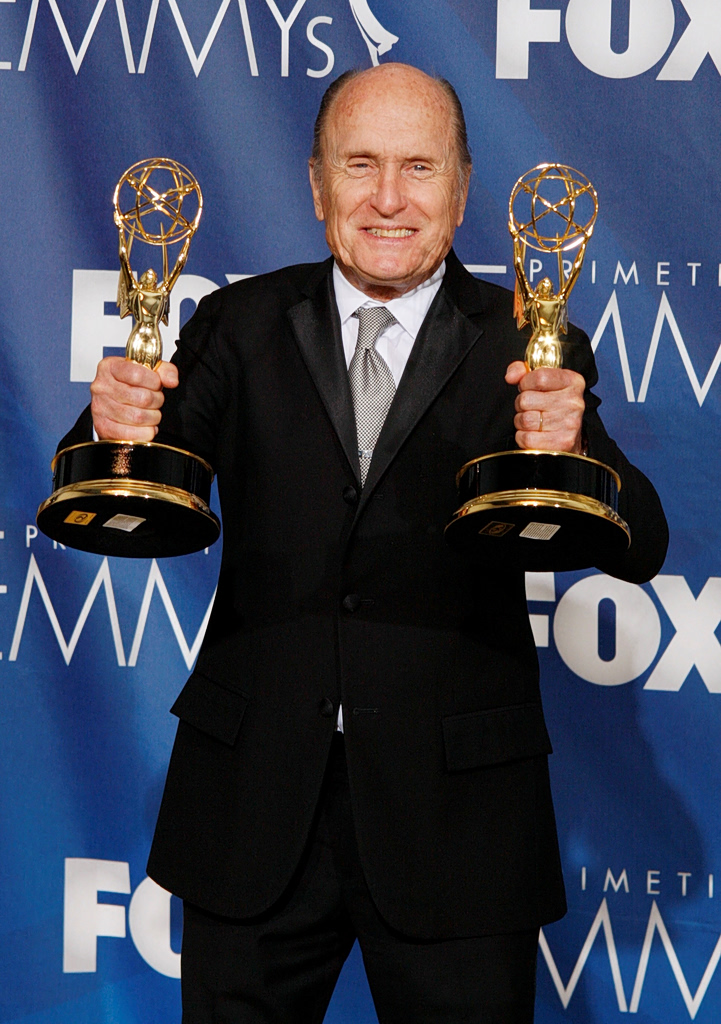
FILE PHOTO: Actor Robert Duvall holds the two Emmy awards he won as Outstanding Lead Actor in a mini-series or movie for “Broken Trail’ and as executive producer for ‘Broken Trail’ which won for Outstanding mini-series at the 59th Primetime Emmy Awards in Los Angeles, California September 16, 2007. REUTERS/Lucy Nicholson/
Duvall died Sunday at the age of 95, his wife, Luciana, announced in a statement.
In a film, TV and stage career that spanned eight decades, Duvall was nominated for seven Academy Awards, winning best actor for his portrayal of Mac Sledge, a washed-up country singer putting his life together in “Tender Mercies” (1983). He was also a ruthless news executive in “Network” (1976), Tom Cruise’s Nascar crew chief in “Days of Thunder” (1990) and a Pentecostal preacher in “The Apostle” (1997), a film he also wrote and directed.
Duvall was particularly drawn to the western, a genre he returned to repeatedly throughout his career. As the outlaw “Lucky” Ned Pepper, he went up against John Wayne’s Rooster Cogburn in “True Grit” (1969); he portrayed a cattleman alongside Kevin Costner in “Open Range” (2003); and saw his star rise exponentially as former Texas Ranger Augustus “Gus” McCrae in the hit TV miniseries “Lonesome Dove” (1989)—based on the novel by Larry McMurtry—which he called his favorite role.
“That’s my ‘Hamlet,’ ” he told the New York Times Magazine in 2014. “The English have Shakespeare; the French, Molière. In Argentina, they have Borges, but the western is ours.”
‘We got some nice new linoleum…’
Robert Selden Duvall was born in San Diego on Jan. 5, 1931, to Mildred (Hart) Duvall, an amateur actress, and William Duvall, an officer in the Navy. The middle son of three boys, he was raised primarily in Annapolis, Md., and graduated from high school in St. Louis. His father was away from home so much, Duvall later recalled, that on one of his return visits, his younger brother didn’t like the way their father spoke to him and told their mother: “tell that man to go home.”
Duvall studied drama at Principia College in Illinois. After graduating in 1953, he joined the Army, just after the Korean War. While stationed at Fort Gordon in Georgia, he appeared in a production of “Room Service.” He left the Army in 1954 and moved to New York to study with Sanford Meisner at the Neighborhood Playhouse School of Theater.
While Duvall and Hoffman were young actors living together in New York, they were on the prowl for more than just work. “We were obsessed with sex,” Duvall told Vanity Fair.
He later said that Hoffman was much more successful in that department, and “got more women than anybody…More than Joe Namath.”
“I was just the worst,” Duvall told Esquire in 2014. “My pickup lines, they were terrible. I’d see some Puerto Rican girls out in the street, and I’d run up to them, say something like, ‘Why don’t you come up to our apartment? We got some nice new linoleum on the floor.’ ”
Duvall’s early theater jobs in New York included roles in Horton Foote’s “The Midnight Caller” and Arthur Miller’s “A View from the Bridge.” He also appeared in TV shows such as “The Twilight Zone” and “The Outer Limits.”
Duvall made his film debut as Boo Radley in “To Kill a Mockingbird” (1962).
“God gave [Duvall] certain attributes,” Foote, who won Academy Awards for writing the scripts for “To Kill a Mockingbird” and “Tender Mercies,” told the New York Times in 1989. “He was born with an extraordinary ear [for] the specifics of an accent and the characteristics of a character. His sense of hearing, his sense of observation are extremely acute. He absorbs himself, not intellectually but viscerally, in his roles. He does his homework more thoroughly than any actor I’ve ever known, and I’ve known many actors.”
Over the next decade, his film credits included a supporting role in Brando’s “The Chase” (1966), playing Maj. Frank Burns in “M*A*S*H” (1970) and starring in George Lucas’s directorial debut “THX 1138” (1971). The next year, he appeared in “The Godfather.”
The making of the film was famously difficult—as dramatized in the 2022 Paramount+ miniseries, “The Offer”—but Duvall and his colleagues found ways to lift spirits on set, even if it meant dropping their pants.
“I remember one time Brando went for his belt, and I went for my belt,” he told Esquire in 2014, “and Francis [Ford Coppola] says, ‘No! There are women and children! You can’t moon—you can’t.’ And we did it anyway.”
The film was a huge success that helped usher in the blockbuster era. Duvall’s portrayal of Tom Hagen earned him an Oscar nomination for best supporting actor and, at 41, made him a bona fide Hollywood star. He reprised the role in “The Godfather Part II.”
“He’s a brilliantly realistic actor, and I think the reason he isn’t even more prominent in the public eye is that he came along at a time when film construction became so disheveled that a film needed a vaudevillian to hold it together,” the film critic Andrew Sarris told the Los Angeles Times in 1992. “He won’t overplay. De Niro has a fantastic reputation, but he’s uneven. Duvall is subtler and better.”
An extraordinary ear
Duvall’s next Oscar nominations came for his roles in “Apocalypse Now” and as a Marine pilot in “The Great Santini” (1979), before winning his only statue for “Tender Mercies.”
“Duvall’s aging face, a road map of dead ends and dry gulches, can accommodate rage or innocence or any ironic shade in between,” the film critic Richard Corliss wrote in Time magazine. “As Mac he avoids both melodrama and condescension, finding climaxes in each small step toward rehabilitation, each new responsibility shouldered.”
Although Duvall said he liked a good Hollywood party, for decades he lived in northern Virginia.
Duvall was married four times. He never had any children. His first three marriages ended in divorce. He is survived by his fourth wife, Luciana—41 years younger than him, to the day—whom he met in Buenos Aires in 1996. Her father is more than 20 years his junior and joked with the actor that he didn’t know whether to call him “father or son.”
“When she told me how young she was,” Duvall told CBS in 2004, “I started yelling, ‘ Policia, policia , come arrest me.’ ”
Duvall declined to return to his role as Tom Hagen for Coppola’s “The Godfather Part III” (1990). He said through the years that was because the film’s star, Al Pacino, was to be paid five times as much as he was. He didn’t expect equal pay. If Pacino had only made two to three times as much, he told Bob Costas, “that would be acceptable, but not ideal.”
“I think everybody did it for money,” he said in the interview. “I mean, why wait 15 years to do a sequel or whatever you call the third one?”
Not that Duvall was above working for a paycheck. In an interview with The Wall Street Journal, he said that was part of the recipe for his longevity. “I did a lot of crap,” he told the Journal in 2017. “Television stuff. But I had to make a living. And like my wife said, ‘It’s amazing how you survived all these years.’ ”
Duvall continued working through his 80s and into his 90s, appearing in both the sports drama “Hustle” and the thriller “The Pale Blue Eye” in 2022.
He received his final Oscar nomination for “The Judge” (2014), in which he played an aging jurist and father. Although he never won a second statue, “The Apostle” did earn him a letter of praise from Brando.
“The letter,” he told the Los Angeles Times, “…is maybe more important than my Oscar.”