STEUBEN, Maine—After a brisk 20-minute voyage through the wind-whipped, aquamarine chop of Pigeon Hill Bay, our quarry was in sight. Seen with the naked eye from the stern of our 40-foot tour boat, the dark blobs bobbing in the restless sea didn’t look like much. But through the high-power binoculars our guide passed out to the 23 passengers, the creatures revealed themselves in all their diminutive glory.
Puffins.
Atlantic puffins are the harlequins of the sea, colorful as a rainforest parrot—black backs, white bellies, quad-colored beaks and intensely orange feet and legs. Add orange-rimmed eyes with jet-black pupils set against white cheeks, a dashing black under-eye line and a radiant round orange bill hinge, and the puffin looks like something invented by a talented circus makeup artist.
These bold, colorful birds are drawing thousands of visitors to coastal Maine each summer. In the state’s Midcoast and Downeast regions, about a dozen tour operators have sprung up to serve the burgeoning puffin-cruise business.
“Puffins are cute and colorful, no doubt that is part of the lure,” says Renee Patterson , owner of Bold Coast Charter in Cutler, Maine, a cruise operator. “They also have personality.”
The challenge of sighting puffins adds to their allure: Like Maine’s other photogenic wildlife icon, the moose, puffins are genetically wired to stay elusive. They spend most of the year on the open ocean, far from land. During breeding season—roughly late April through most of August—they nest in underground burrows on offshore islands where mammalian predators such as mink, rats and foxes can’t get at them or their young.
Hot ticket
Our tour boat was run by Acadia Puffin Cruise, which runs daily two-hour tours in season, at $75 for adults. Other popular cruises include excursions run by Cap’n Fish’s Cruises out of Boothbay Harbor to nearby Eastern Egg Rock, a 7-acre rocky island hosting about 80 breeding puffin pairs. Those tours, with National Audubon Society narration, attract about 10,000 paying visitors a year, at $71 for adults.
Bold Coast Charter’s trips allow participants to land on an island and spend a couple of hours in blinds to see and photograph at close range puffins gathered on rocks above their nesting burrows. Bold Coast limits its cruises to Machias Seal Island to 15 passengers per trip—and charges $275 to $325 per person, depending on the date.
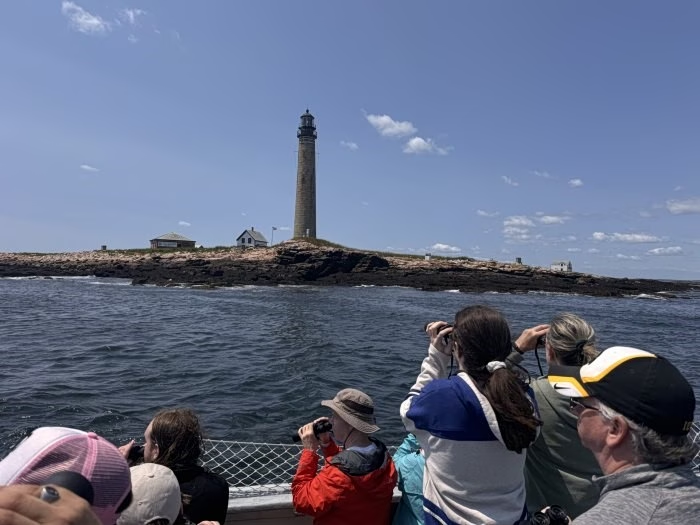
Passengers on the Acadia Puffin Cruise. Ken Wells for WSJ
Patterson says her tours mainly attract serious birders and professional photographers who pony up the hefty fee even though foul weather sometimes makes landing impossible (and there is no refund if that happens). One testament to the scale of puffin mania : “We put the entire season online each year and this year we sold out in 15 to 20 minutes,” she says.
The puffin season is winding down, but those interested in a cruise can soon start reserving seats for next summer. Some of the operators will open their online bookings for 2027 this fall or in early December, although those wanting to nab a space on the Machias Seal Island landing tour will have to wait until a date in March still to be determined.
Back from the brink
What’s made all this puffin tourism possible is Project Puffin, a continuing effort to boost the numbers of a bird that not so long ago was on the verge of disappearing from the islands off Maine.
The Atlantic puffin isn’t endangered—Iceland, Norway and Newfoundland are collectively home to millions of the birds. But Maine’s population, which numbered in the tens of thousands, had dwindled to about 70 breeding pairs on two islands by the early 1970s, mostly because of overhunting for their meat, eggs and feathers, and habitat disruptions caused by predatory rats that arrived on nesting islands as stowaways on ship and boats.
Alarmed, puffin supporters realized they needed a rescue plan. It arrived in 1973 when Stephen Kress , a 28-year-old graduate student working with the Audubon Society, had what most serious bird researchers thought was a daft idea: He would move puffin chicks from Newfoundland, where the birds are plentiful, to Eastern Egg Rock, with the hope that the chicks would fledge and return to the island. Like many seabirds, puffins return to their original nesting sites year after year.
Resistance at first was fierce, since the idea had never been tried and putting puffin chicks at risk seemed antithetical to the Audubon Society’s creed. But Kress eventually prevailed upon Newfoundland wildlife authorities to allow him to proceed, and the technique worked.
To address the threat of predators, seabird conservation organizations such as Friends of Maine Coastal Islands National Wildlife Refuge have joined with state and federal wildlife agencies over the years to support rigorous rat-eradication programs.
Today, an estimated 1,500 breeding pairs nest on five Maine islands, and by some estimates as many as 8,000 breeding pairs nest on Machias Seal Island, which lies in disputed waters claimed by the U.S. and Canada.
There are still challenges, says Don Lyons, director of conservation science for the Audubon Society’s Maine-based Seabird Institute. Those include events called ocean heat waves—hotter than normal currents, related to climate change, that can radically change the mix of fish available for puffins to feed on. But “we do have a robust population,” Lyons says.
Love wins
And the payoff from Project Puffin has echoed far from the shores of Maine, says Elizabeth Gray, chief executive of the National Audubon Society. About 850 seabird-restoration projects are in operation worldwide today, according to Audubon’s Seabird Restoration Database, and a good number of them are succeeding by adopting techniques pioneered and refined in Maine’s success story.
That’s why Gray is also thrilled to see the Maine puffin become the focus of a thriving tourism niche. Once people get to know the puffin and the puffin story, she says, it almost certainly increases their interest in bird conservation in general. With a 70% decline in seabirds worldwide since the 1950s, Audubon can use the help.
“People go out and fall in love with the Atlantic puffin because they are so charismatic, colorful and fun to watch,” says Gray. “And I do think people protect what they love.”
Love was in the air on the recent Acadia Puffin Cruise. Sean and Jenny Taggart, 40-something Philadelphia residents on a camping sojourn through nearby Acadia National Park, had their binoculars fixed on puffins swimming off the stern of the tour boat . The couple consider themselves “casual birders.” But when they googled “things to do” near Acadia and came upon a puffin photograph and a listing for this tour, they were hooked. They spent much of the week before traveling to Maine listening to puffin podcasts to prepare themselves.
And having seen puffins?
Sean smiled. “Way beyond expectations,” he said.