 Μake us preferred on Google
 The Greek alphabet may have emerged centuries earlier than traditionally believed, while its role as the ancestor of other Western and Anatolian writing systems is also being called into question, according to new research by Leiden University scholar Willemijn Waal.
Waal, an associate professor at Leiden University in the Netherlands and head of the research project “From Aleph to Alpha: The Spread and Evolution of Alphabetic Writing Across the Mediterranean,” presents the theory in a lecture at the Netherlands Institute at Athens titled “The Real Age of the Greek Alphabet: Reconsidering the Transmission of Alphabetic Writing from ‘East’ to ‘West.’”
The research challenges the traditional account of how alphabetic writing reached Greece, suggesting that the process began around or before 1050 B.C. rather than around 800 B.C. It also questions the idea that the Greek alphabet was the direct ancestor of all subsequent Western and Anatolian alphabets, proposing instead that these writing systems may have developed from a shared, unidentified predecessor.
Rethinking the traditional account
The conventional theory draws on classical tradition and accounts by ancient writers, including Herodotus, who attributed the introduction of writing to Greece to Cadmus, a Phoenician prince, and the so-called Phoenician letters.
According to this account, the collapse of the Late Bronze Age around 1200 B.C. was followed by the disappearance of Linear B, the syllabic writing system used in Mycenaean Greece. The region then entered a period of approximately 300 years commonly described as a “Dark Age” of illiteracy.
Around 800 B.C., the Greeks are believed to have come into contact with the Phoenicians, adopted their writing system, adapted it by adding vowels and rapidly spread the resulting alphabet throughout the Mediterranean.
Waal questions several elements of this narrative. She argues that words containing the term phoinix, traditionally associated with Phoenicia and its people, do not necessarily refer to the Phoenicians. They could instead refer to the palm tree or palm leaves, which were used as writing materials.
Early Greek inscriptions point to earlier contact
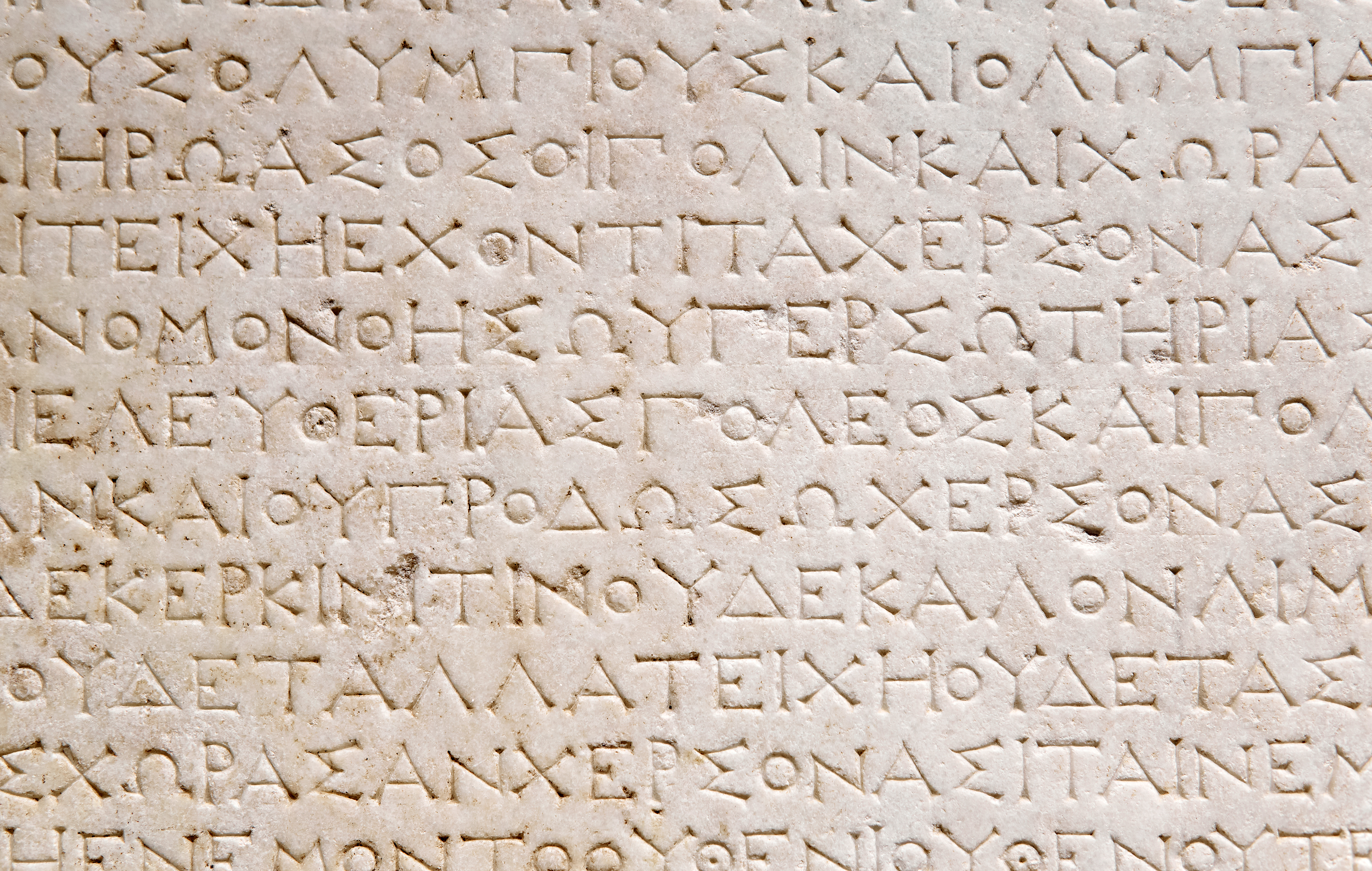
One of the central arguments concerns the diversity of early Greek writing. Inscriptions dating from the beginning of the eighth century B.C. do not display a single standardized script. Instead, researchers have identified 33 different local variants across a wide geographical area.
Waal’s research argues that such rapid geographical spread and diversification within a short period would be statistically and historically unlikely if the system had only recently been adopted.
The earliest Greek inscriptions also display features that differ from the standardized Phoenician writing system of the period.
Their direction of writing was not fixed: texts could run from right to left, from left to right or in boustrophedon, a style in which the direction alternates from one line to the next. These practices resemble those found in older West Semitic texts dating from before 1050 B.C.
By that time, Phoenician writing had already become standardized to run exclusively from right to left.
The early Greek use of different writing directions, along with word separators absent from later Phoenician texts, suggests that contact between the two traditions may have occurred much earlier than the conventional account indicates.
Writing in Greece may date to before 1050 B.C.
The new study places the introduction of writing to Greece around or before 1050 B.C., several centuries before the earliest surviving inscriptions on durable materials.
The conclusion draws on a combination of epigraphic, linguistic and archaeological evidence, as well as new radiocarbon dating using carbon-14.
Waal’s research proposes that the earliest forms of writing, as elsewhere in the ancient Near East, were used mainly for administrative and economic purposes and were recorded on perishable materials, including papyrus, wood and leaves.
Such materials would not have survived under Greece’s climatic conditions, potentially explaining the absence of earlier surviving evidence.
The appearance of inscriptions on stone and pottery in the eighth century B.C., therefore, may not mark the birth of writing in Greece. Instead, it could indicate the point at which writing began to be used more widely on durable materials.
Was the Greek alphabet the ancestor of other scripts?
The research also challenges the Greek alphabet’s traditional status as the direct ancestor of other Western writing systems, including those used in Italy and Iberia, as well as scripts developed in Anatolia, in what is now modern Turkey.
These include Phrygian, Lydian and Carian writing.
Recent archaeological discoveries and the redating of the earliest Phrygian inscriptions to around 800 B.C. suggest that they are contemporary with, or possibly older than, the earliest surviving Greek inscriptions.
Researchers have also identified shared linguistic features and symbols that do not appear in Greek writing.
Taken together, these findings have prompted a different model of how the alphabets developed. Rather than treating the Greek alphabet as the sole source of these other writing traditions, the study suggests that Greek and other Western and Anatolian alphabets may have descended from a common, unidentified ancestor.
Under this interpretation, the Greek alphabet would not be the “mother” of the other scripts but would instead be related to them as a sister system.
The proposed shift would substantially change the understanding of how alphabetic writing spread across the Mediterranean and the relationships between the region’s ancient writing traditions.