When Venezuelan Vice President Delcy Rodríguez gave a speech condemning the U.S. capture of Nicolás Maduro , she was accompanied by two men who can make or break the regime’s future.
Interior Minister Diosdado Cabello and Defense Minister Vladimir Padrino command Venezuela’s police and military, the forces that kept Maduro in power for more than a decade with deadly crackdowns on dissent.
Trump said Rodríguez is the de facto leader of Venezuela. She is someone who despite her anti-U.S. rhetoric has privately assured Washington that she will do its bidding with Maduro facing prison, Trump said on Saturday.
But Cabello and Padrino “could very easily take action against her and sideline her immediately,” said Brian Naranjo , a former senior U.S. diplomat who served in Venezuela.
“Those are the two guys who control Venezuela right now,” Naranjo said. “These are the guys who command people with guns.”
Cabello and Padrino are displaying unity with Rodríguez, but they represent a wild card for President Trump ’s bet that the remnants of the regime will fall in line to avoid Maduro’s fate . The country relies on the military as the only national institution that comes close to being functional, said Juan Cruz , a former National Security Council official in charge of the Western Hemisphere.
“In Venezuela’s storied history, the military has been responsible every single time for the elimination of democracy and the restoration of democracy,” he said. “They hold the ultimate vote.”
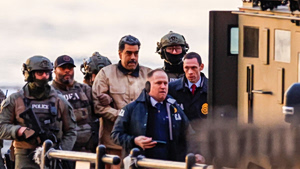
For now, Cabello and Padrino appear to be playing ball after the large-scale strike that took out Maduro’s personal security apparatus and led to his capture, along with his wife, Cilia Flores .
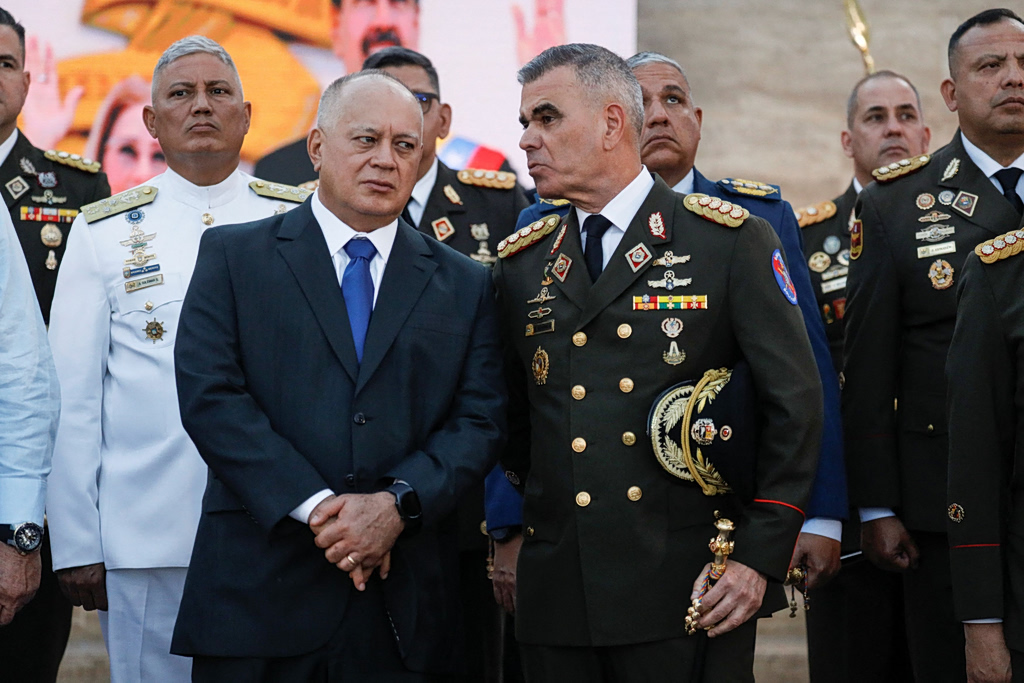
Venezuela’s Interior Minister Diosdado Cabello and Defence Minister Vladimir Padrino Lopez attend the ceremony “Promotions and Decorations for Heroes and Martyrs”, honouring Venezuelan and Cuban military and security personnel who died during a U.S. operation to capture Venezuela’s President Nicolas Maduro and his wife Cilia Flores, in Caracas, Venezuela January 8, 2026. REUTERS/Leonardo Fernandez Viloria
“They’re humiliated by the paper tiger that is the Venezuelan military,” Cruz said. “They are still in power. The cupola is intact. But they don’t sleep at night.”
Cabello and Padrino have a lot to lose if the regime falls after more than a quarter-century in power, led first by the late Socialist firebrand Hugo Chávez , who ruled from 1999 to 2013, and then by Maduro.
Their role will largely determine whether Venezuela maintains a level of stability, or if it descends into chaos. The country is rife with armed groups including leftist Colombian guerrillas who criticized the capture of Maduro.
They will also determine whether the regime abides by U.S. demands, including giving access to Venezuela’s oil wealth .
However, Cabello and Padrino may not have much of a choice after U.S. commandos were able to snatch Maduro and his wife. Trump has threatened a second, larger attack if the regime rebels.
Still, their continued hold on power is one reason people in Venezuela say they haven’t celebrated the downfall of Maduro, who was widely unpopular.
“People are still terrified because they are still in charge,” said Douglas Farah, a Washington-based international security consultant who closely covers Venezuela. “Removing Nicolás Maduro does not create total chaos in the repressive structure.”
Cabello and Padrino have been indicted in the U.S. on drug smuggling charges. The U.S. has offered a reward of $25 million for information leading to Cabello’s arrest and/or conviction and $15 million for Padrino.
Along with Maduro, Cabello and Padrino are accused of being the leaders of a drug trafficking network of senior military officials called the Cartel de los Soles , or Cartel of the Suns, which the Trump administration has labeled a foreign-terrorist organization.
Cabello, the 63-year-old who has long been seen as Maduro’s enforcer, was one of the first senior officials to appear publicly after U.S. commandos arrested Maduro on Saturday. On Sunday, Padrino blamed the U.S. for killing soldiers, civilians, and “a large part” of Maduro’s security team.
“We’ve learned how to survive,” Cabello said from a street in Caracas, wearing a bulletproof vest and a helmet while surrounded by armed security forces in black uniforms.
Both men have military backgrounds, but took different paths to power.
Cabello has been a crucial link between the regime’s civilians and the military. As a teenager, he was a member of a far-left group called the Bandera Roja, or Red Flag. Later, he became an early follower of Chávez. He was jailed after participating in Chávez’s failed 1992 military coup.
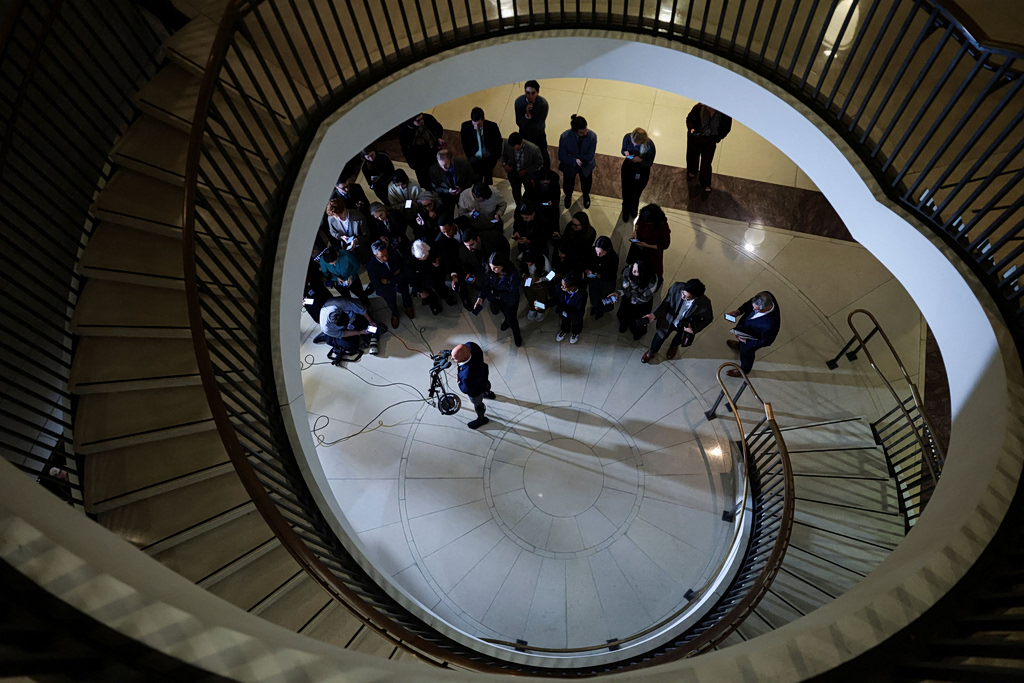
Chairman of U.S. House Foreign Affairs Committee Rep. Brian Mast (R-FL) speaks to reporters after members of Congress were briefed on the situation in Venezuela, on Capitol Hill in Washington, D.C., U.S., January 5, 2026. REUTERS/Evelyn Hockstein
After Chávez took power and was briefly ousted in 2002, Cabello rallied Venezuelan soldiers to help bring Chávez back to power.
Under Maduro, Cabello was largely seen as the second most powerful man in Venezuela. He is known for his rants against political rivals and the U.S. on his state television nighttime show, “Hitting It With a Sledgehammer,” where he holds a spiked club.
He oversees paramilitary units on motorbikes, a tool used by the regime to crush protests. Chilean prosecutors call him the mastermind behind the 2024 kidnapping and murder of an exiled Venezuelan military dissident living in that country. Cabello has denied involvement in the killing.
Padrino, a four-star general whose parents named him after Vladimir Lenin, became a follower of Chávez only after he took power in 1999 and began installing loyalists in the military and purging it of dissenters.
In his early years, Padrino was sent to the U.S. for infantry training at Fort Benning, Ga., which he said provided insight into American culture, what he called “the monster in its entrails.”
“I learned the culture of vocation for expansionist, colonialist power of the United States,” Padrino said in a 2021 interview with a former Venezuelan communications minister.
As the head of the military since 2014, Padrino kept soldiers in line for Maduro amid several attempts by the opposition to foment a coup.
While Cabello is a more hard-line nationalist, Padrino had closer ties with Cuba and Russia, said Martin Rodil , a Venezuelan who has helped U.S. officials build criminal cases against Maduro and other regime officials.
“He’s more ideological,” said Rodil. “Russian intelligence has been supporting him in his job to control the Venezuelan armed forces, with technology, training and other activities.”
Under Maduro, Padrino’s power derived not just from his position with the military but also from his control over social programs and ports. Padrino also oversaw the military as it expanded its reach into illegal activities such as fuel smuggling, illegal gold mining and cocaine trafficking, which helped Maduro maintain power as the economy collapsed, according to U.S. officials.
“By allowing them to more openly engage in illegal activities, he was kind of buying stability in the ranks, in allowing those ill-gotten earnings to lubricate the military,” said Naranjo, the former U.S. diplomat.
Write to Ryan Dubé at ryan.dube@wsj.com