
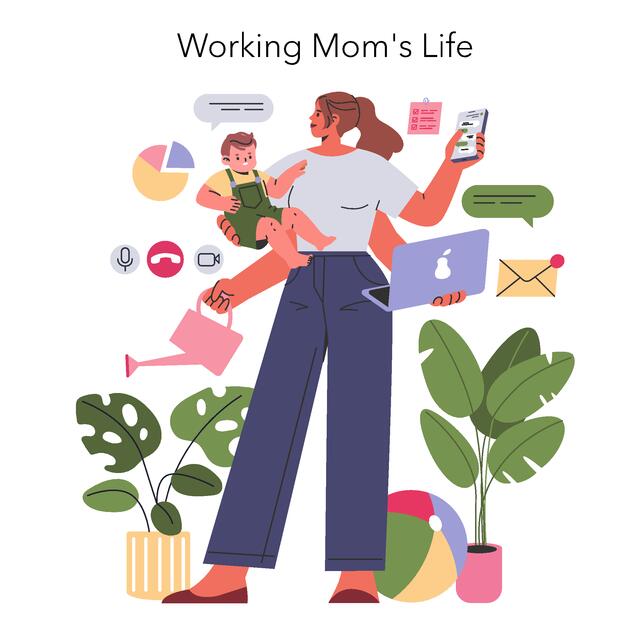
For years headlines and social media have been telling us to “bring your whole self to work,” and I tried. I brought my whole self everywhere: to work, to bedtime, to date night. But I didn’t feel whole; I felt fractured, and one day I broke.
It wasn’t dramatic. I was sitting in a closet-turned-lactation room in my corporate office near Wall Street, balancing a pump on my lap, my baby in one arm, and my phone in the other. Then I sprinted to a meeting, to daycare, and back home, where the nightly relay race began: make pasta, take bath, dress the kids in pajamas, read “Goodnight Moon,” try to find a missing stuffed rabbit.
When the apartment finally went quiet, I opened my Notes app and typed: “You. Can. Have. It. All.” The words looked triumphant—and wrong. Which “you,” exactly, was supposed to have it all? At work I always felt guilty about not being with my kids; with my kids I was thinking about my career road map; with my partner I was present in body but my mind was elsewhere.
Self help gurus and HR departments teach us that finding your “whole self” is an enlightened goal. But that night I realized no one is a single self. We all contain a cast of characters, each with different goals and values. It’s impossible for all of them—the executive, the caregiver, the partner, the creative type—to share the spotlight all the time.
So I stopped trying to be my whole self everywhere, and gave myself permission to prioritize and compartmentalize. When I’m an executive, I solve problems. When I’m a mother, I actually look at my kids’ faces, not just their schedules. As a loving partner, I laugh, flirt and lean over for a kiss without a laptop in the way.
I noticed that certain tiny rituals helped me shut one mental room and open another. A bath helps me transition between work and mom mode. Listening to music in the shower before date night helps wash away the workday. Swapping my workout clothes for jeans became less about aesthetics and more about role-change. The routine is not the point; the message to my brain is. Taking a beat—30 seconds, three minutes—lets the previous role make its exit, so the next one can make its entrance and steal the show.
Do things still collide? Constantly. My sick kid calls during a critical meeting; a work crisis erupts at dinnertime. I used to interpret this friction as failure—proof I was unbalanced. Now I see it as a simple matter of two roles requesting attention at once. I choose one with purpose, and later return to the other via a transition.
Bringing my “whole self” to every moment left me threadbare. Giving each self a turn means I can give 100% to work and 100% to home—not simultaneously, but by choosing the role that belongs in each scene. Life can feel like a movie where the only actor is you. But you don’t have to play every role yourself—take the director’s chair, define the scenes, and choose your cast from the parts of yourself that serve the story you truly want to tell.
Amanda Goetz’s new book, “Toxic Grit: How to Have It All and (Actually) Love What You Have,” was published Oct. 21 by Sourcebooks.