On 19 September 2025, the High Seas Treaty, known officially as the Agreement under the United Nations Convention on the Law of the Sea on the Conservation and Sustainable Use of Marine Biological Diversity of Areas Beyond National Jurisdiction (BBNJ Agreement), reached its 60th ratification. Upon achieving the milestone, the 120-day countdown to its entry into force began, meaning the treaty will become legally binding for its signatories on 17 January 2026.
The treaty is the first global, legally binding framework to protect ocean areas beyond any national jurisdiction, known as the “high seas”, which account for nearly two-thirds of the world’s ocean area. It includes the seafloor and water column, and sets mechanisms for establishing marine protected areas (MPAs), requires environmental impact assessments for activities in areas beyond national jurisdiction, regulates marine genetic resources and their digital sequence information, and addresses capacity building and the transfer of marine technology.
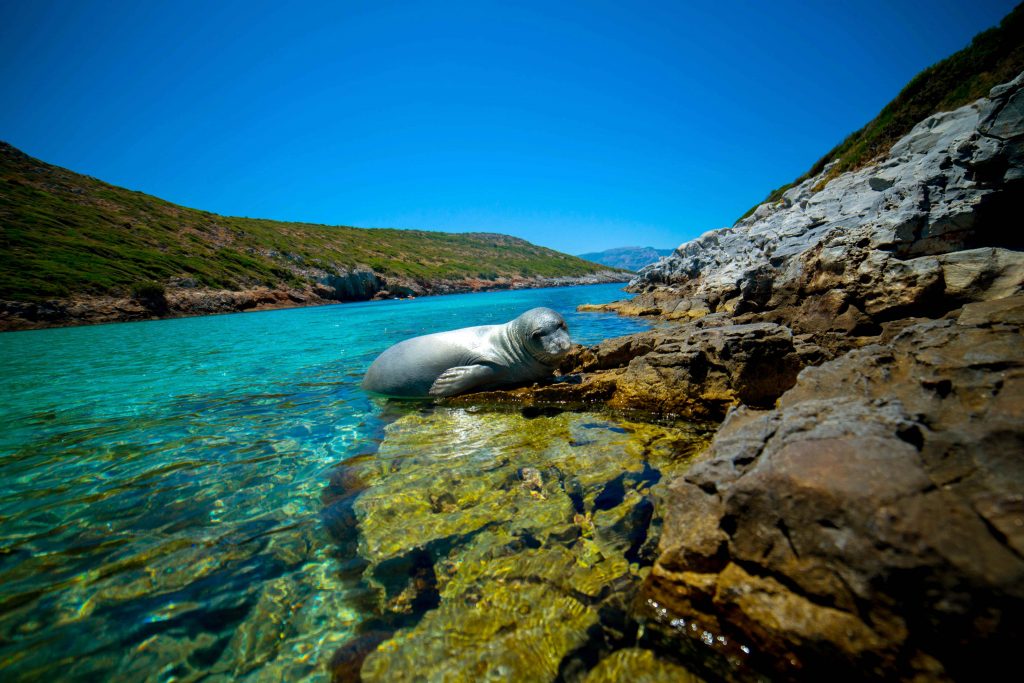
A Mediterranean monk seal in the shores of Samos island, eastern Aegean.
Who Hasn’t Joined
While many countries have signed the agreement, several major players have signed but not ratified. For example, the United States has signed, but the Senate has not ratified the Treaty and is unlikely to do so under the Trump administration on account of its explicit rejection of international treaties related to climate change and environmental protections. The full list of countries which have signed and or ratified the treaty can be found at the High Seas Treat Ratification tracker.
Rebecca Hubbard of the High Seas Alliance captured the fragile optimism in her announcement upon reaching the 60th signatory:
“This historic moment is the culmination of years of dedication and global diplomacy by governments and stakeholders…Achieving 60 ratifications is not the finish line–it’s just the starting block,” said Hubbard. “The Treaty’s true strength lies in universal participation. While we must celebrate this incredible progress, we urge all remaining nations to join this historic Agreement and help us go from 60 to global.”
The first Conference of the Parties (CoP) will need to convene within a year after the treaty entrs into force to set up governance, financial rules, and oversight. Whether the Treaty becomes more than a symbolic achievement will depend on how quickly hesitant countries ratify and how well the new legal obligations are implemented in practice.
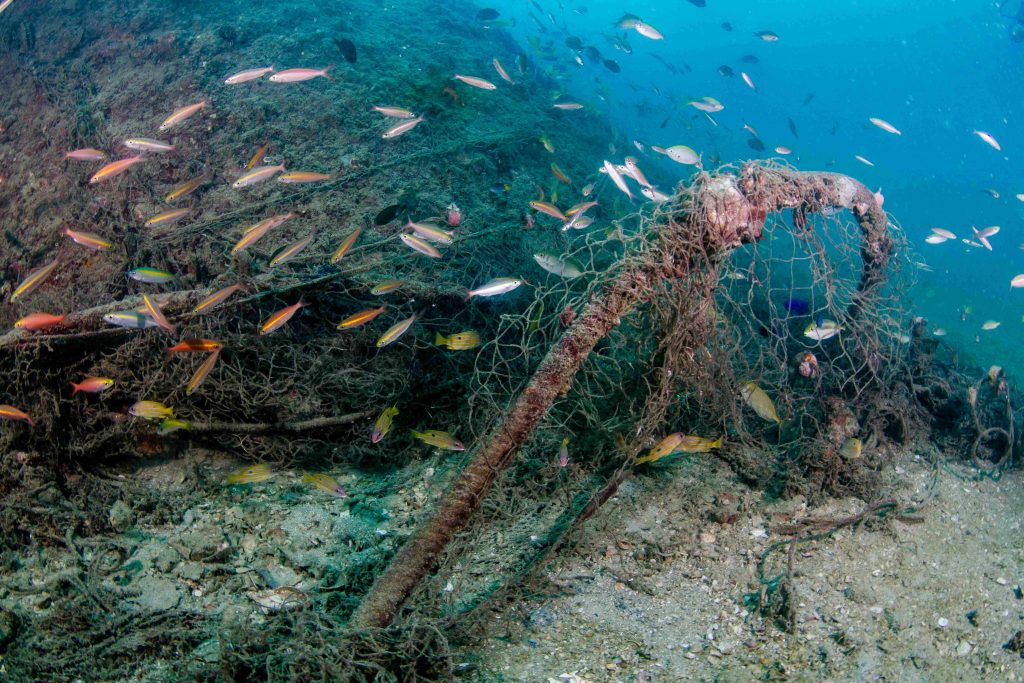
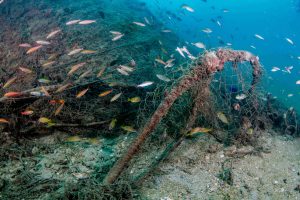
Abandoned ghost fishing net left at the bottom of the ocean that causes environmental problems and damages marine life.
Greece’s Position
Greece ratified the BBNJ Agreement recently and is one of the European Union member states contributing to the push for global ratification.
Greece has also expressed its committment to meeting 30X30 targets (protecting 30% of land and sea by 2030), halting deep-sea trawling in marine protected zones, recently announced the establishment of two new marine parks, and is partnering up with Google satellites to enable better monitoring of its territorial waters, including marine parks.

The Big Picture
Experts say the 30×30 target cannot be achieved unless large areas beyond national jurisdiction are also safeguarded. The BBNJ Agreement is viewed as essential to closing that gap: without protection in the high seas, many scientists argue that efforts within national jurisdictions alone will fall short.
However, due to the fact that major countries have not ratified, or in some cases have not even signed the Treaty, there are elevated concerns about its enforcement and effectiveness. Key issues that remain unresolved include: how monitoring will be carried out, how enforcement across international waters will work, how financial mechanisms will support implementation especially in developing countries, and how disputes will be handled when non-party states are involved.
Meanwhile, many BBNJ supporters are watching the race for rare earths with concern—particularly among the U.S., China, and Russia—and the growing interest in deep-sea mining. While the BBNJ focuses on protecting marine biodiversity in areas beyond national jurisdiction, deep-sea mining is governed by another body known as the International Seabed Authority (ISA). ISA has been in a deadlock over finalizing a regulatory framework for deep-sea mining amid fears that the activity will wreak irreversable havoc on marine ecosystems on the one hand, and mounting international tensions and political pressures to deregulate on the other.
Despite concerns over the environmental impact of deep-sea mining and the absence of a clear international regulatory framework, the U.S. Department of the Interior (DOI) recently annouced plans to accelerate the initiation of deep-sea mining in U.S. waters, effectively enacting President Trump’s executive order to fast-track deep sea-mining.
For now, the BBNJ Treaty and the ISA will have to coexist, but it is highly likely that deep-sea mining will be the BBNJ’s first serious political test.
The coming months will be critical for BBNJ’s future, as the Treaty enters into force in January 2026, its supporters attempt to gain more signatures, and the first Conference of Parties is held, likely in late 2026.
Write to Cheryl Novak at cnovak@tovima.com