For 15 years, I have looked at Mount Parnassos, its dark green firs standing out against the uniquely Greek-blue sky. The mountainside, dotted with the occasional grey rock and bordered by fields and sparse shrubs, has long drawn shepherds seeking fodder, and hikers and day-trippers in search of shade and adventure.
On a recent visit, accompanied by a local representative of Greece’s Natural Environment & Climate Change Agency (NECCA) and through scattered conversations with locals, I came face-to-face with a forest in transition—one whose decline scientists have been warning about for decades.
Dying Fir Tree Forests
Several years ago, locals and visitors alike noticed subtle changes. Tree tips, scattered throughout the slopes, turned reddish brown, while browned and brittle firs toppled with increasing frequency. At first it seemed a curiosity rather than a crisis.
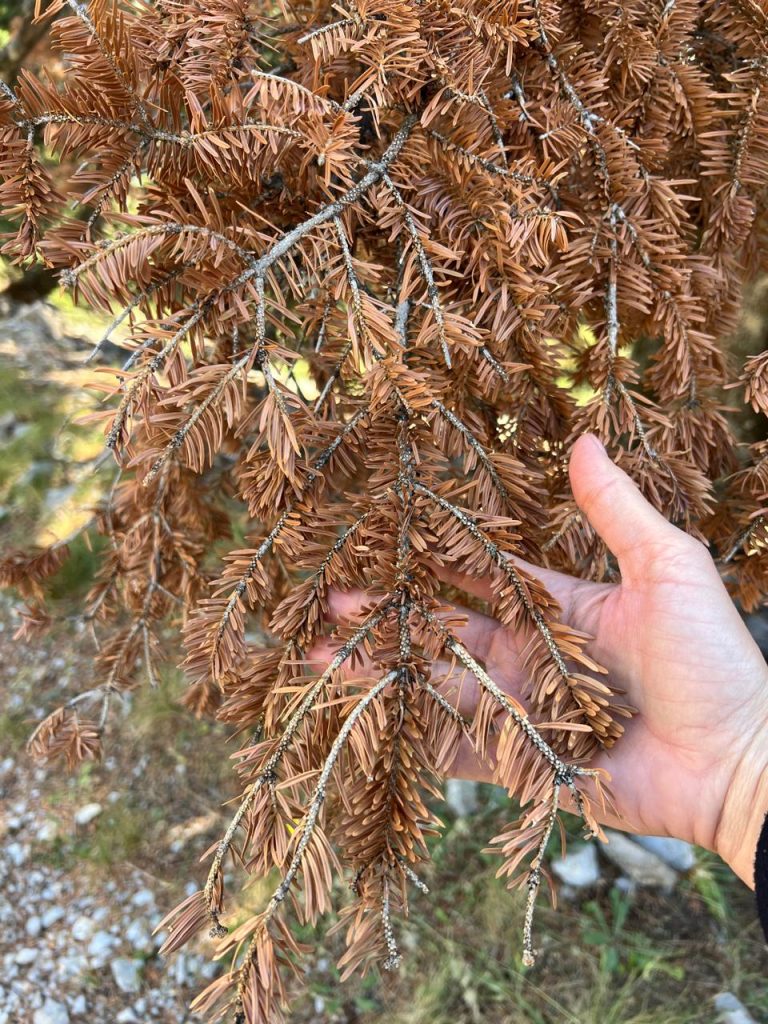
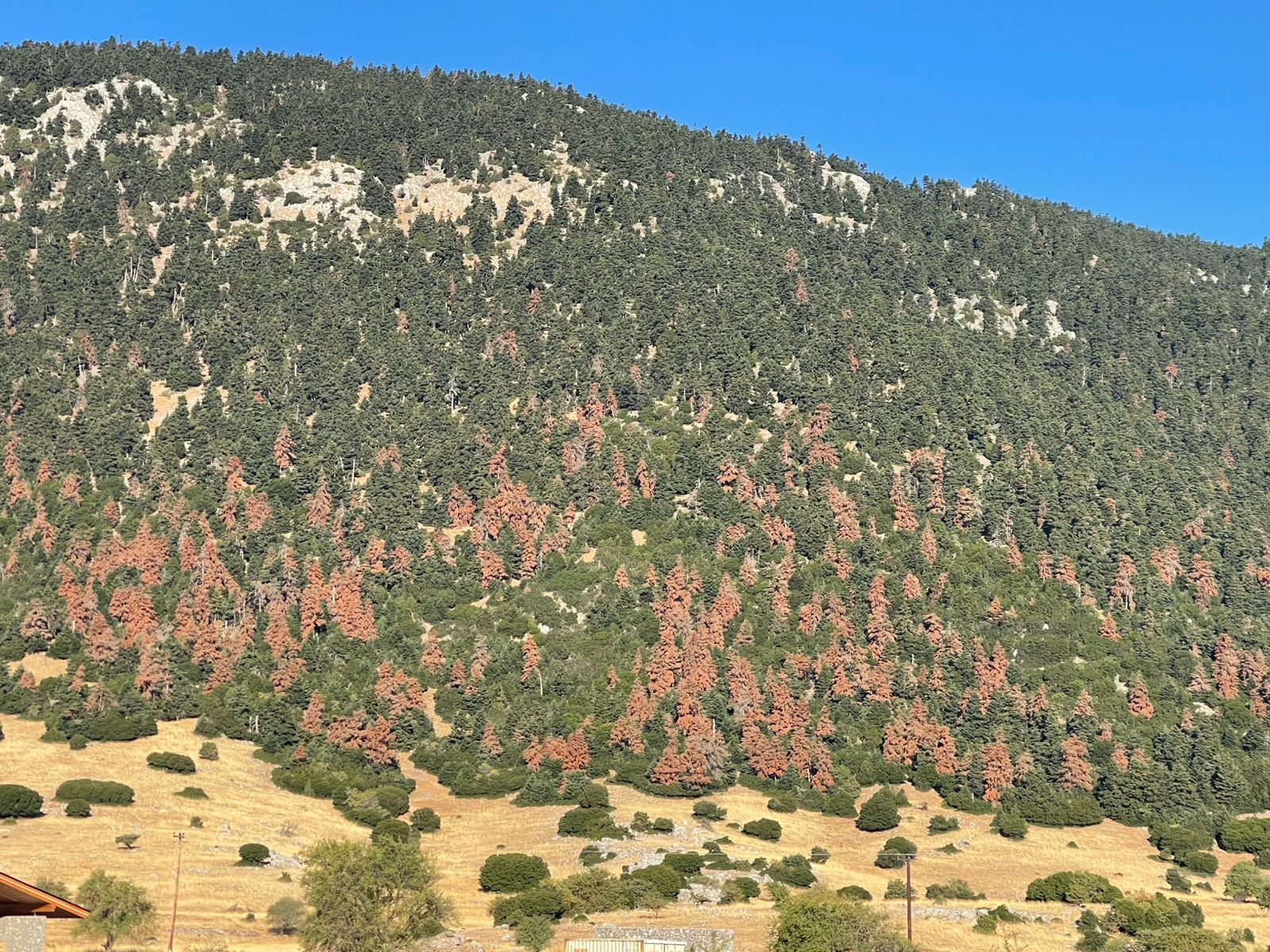
Fir trees throughout Greece can be seen turning brown. The phenomenon usually starts with branches turning brown, until the entire tree is overcome and dies. / Photo by Cheryl Novak
That changed in the summer of 2025, when whole swaths of fir trees on the mountainsides in the greater region of Parnassos turned brown. Media reported similar scenes in other parts of Greece.
Experts attribute the die-off of the native Abies cephalonica (Greek fir) to a lethal combination: hotter summers, prolonged drought, reduced snow over the winter, and outbreaks of bark beetles and other wood-boring insects that thrive when trees are water-stressed.
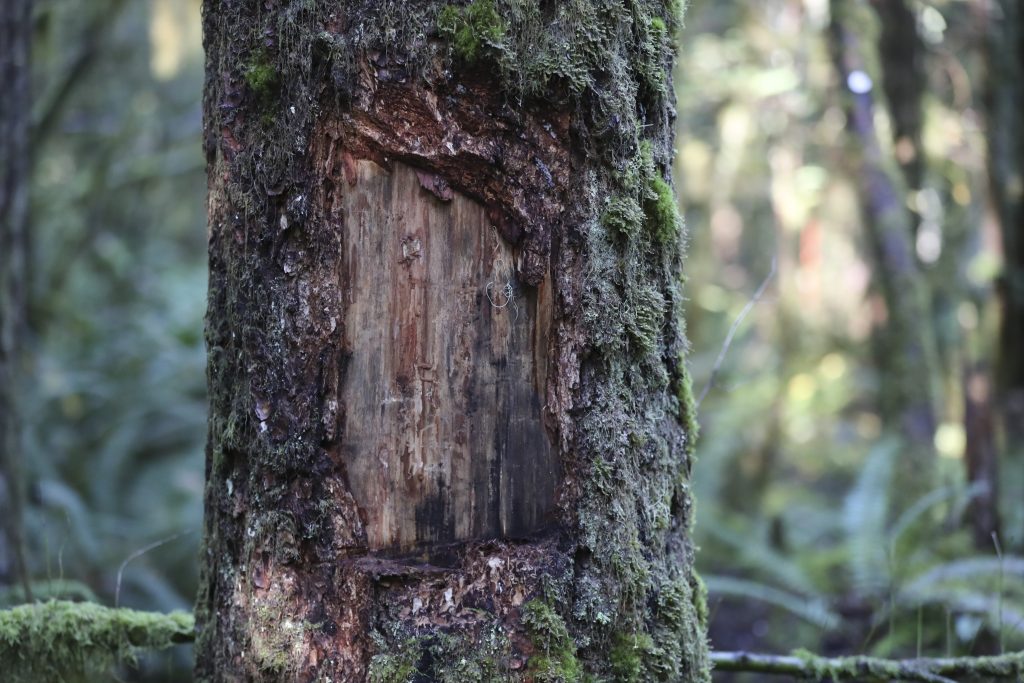
A section of a Douglas fir tree with the bark removed by scientists to examine insect damage that led to the tree’s death following heat stress in the Willamette National Forest, Ore., Friday, Oct. 27, 2023. (AP Photo/Amanda Loman)
A local Parnassos taverna owner recalls: “I remember this happening before, when I was young. The trees turned brown and died, but then new ones appeared. But it seems different this time.”
The standard “treatment” for infested fir trees is to remove dead and weakened trees, but experts say this approach is unworkable when vast areas are affected.
We Should Have Seen it Coming
The slow death of Greece’s fir forests should not come as a surprise. Scientists have been documenting die-off events since at least the late 1980s, pointing out how drought primes trees for insect attack.
In a 2023/24 Springer study modeling Mediterranean firs, researchers projected that Greek fir habitats will generally perish at lower, hotter elevations (900–1,100 m), depending on soil quality and temperatures, with this range potentially spreading upslope and northwards as climate change intensifies. The paper also discusses the assisted migration of the most threatened fir tree species as one possible response or planting more resilient taxa in their place.
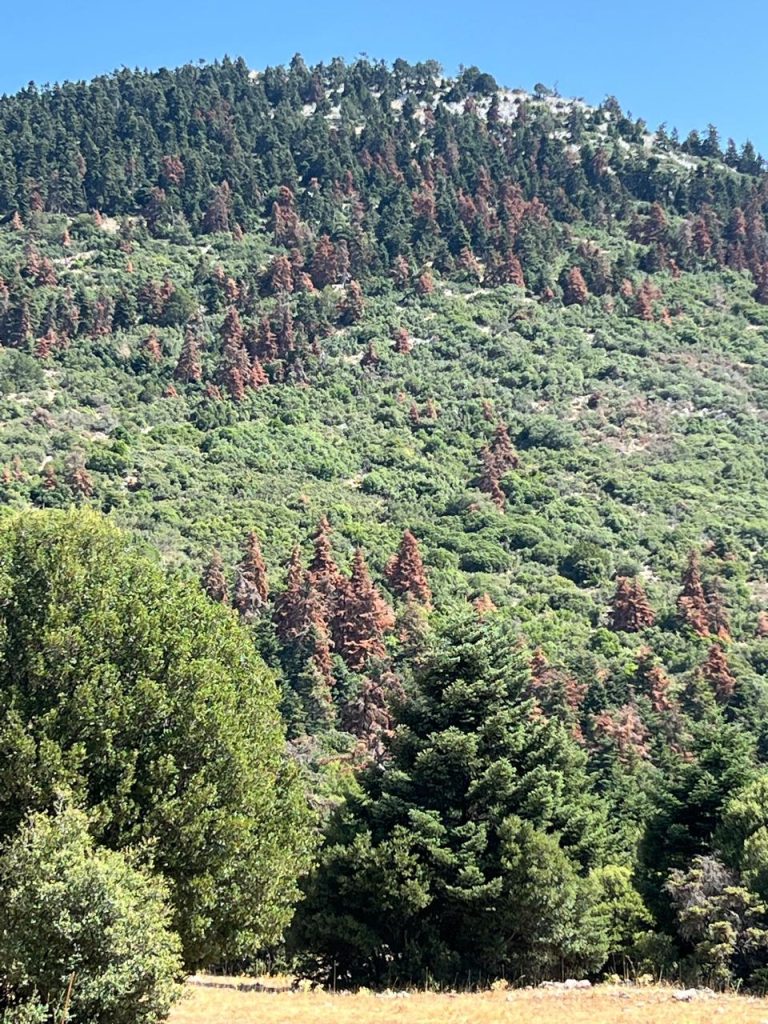
During the summer of 2025, whole swaths of fir trees on the mountainsides in the greater region of Parnassos turned brown./ Photo by Cheryl Novak
Other species, such as the Abies borisii-regis (Bulgarian fir), have been suggested as candidates for trial plantings in zones where the Greek fir is in decline, though recent studies caution that their climate sensitivity is site-specific, and that hybridization carries risks. Any test introductions need to be done carefully and on a small scale.
A recent statement by a Peloponnesian MP noted that a modest amount of funding has finally been released to allow Greece’s forestry service to begin clearing dead trees in the region. Yet, experts stress that the severity of the crisis demands coordinated, large-scale interventions across the country.
When asked about management options, NECCA’s representative admitted that large-scale intervention on Parnassos is unlikely: “The main problem is climate change, not just beetles. At lower elevations of around 1,000m, firs will be naturally replaced by shrubs. Introducing other species carries too much risk.”
Cascading Impacts
Beyond the die-off of firs on Mount Parnassos, the seemingly inevitable loss of Greece’s forests at lower altitudes is more than an aesthetic blow. Ecologists and climatologists warn of cascading impacts- secondary consequences over and beyond the immediate phenomenon- of forest die-off. Some of the impacts revealed in a broad intersectoral literature review include:
Reduced Carbon storage: Mature Mediterranean fir forests typically store several times more carbon than shrublands. For example, one study measured that fir forests sequester approximately 198 Mg C per hectare compared to much lower totals in shrublands. Shrubs (sclerophylls) are hardy under drought and heat, but sequester far less carbon.
Increased Fire risk: Sclerophyll shrublands are among the most fire-prone vegetation types in the Mediterranean. The shift from closed, moist forest to open, flammable shrubland could raise wildfire risk.
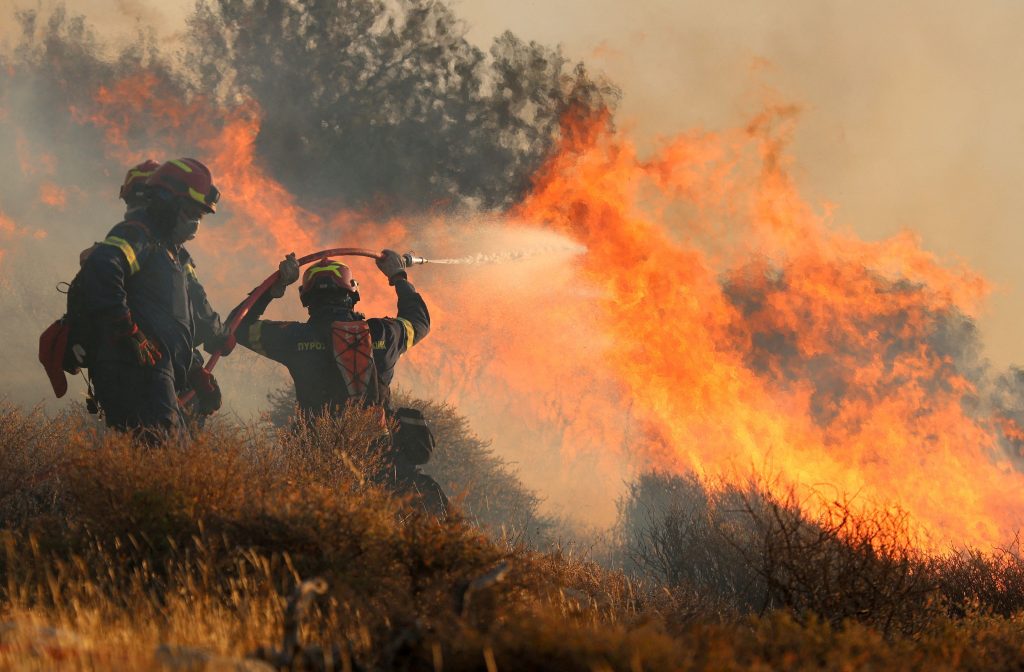
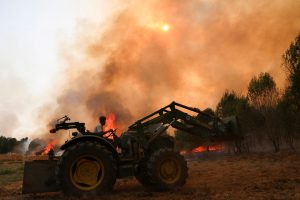
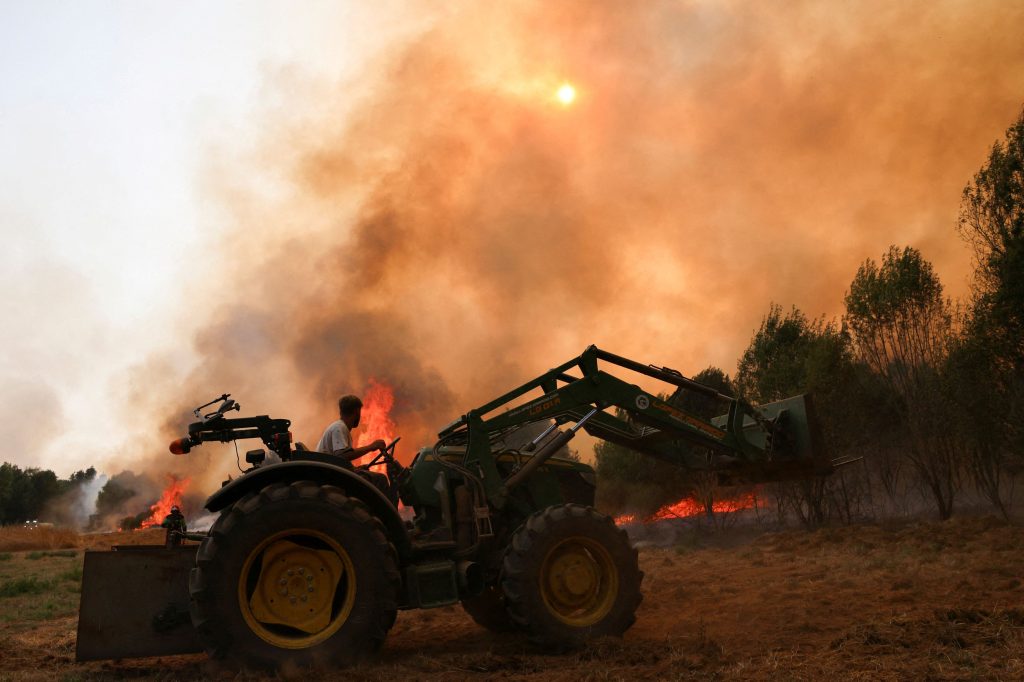
Firefighters try to extinguish a wildfire near Ierapetra, on the island of Crete, Greece, July 3, 2025. REUTERS/Stefanos Rapanis TPX IMAGES OF THE DAY
Biodiversity Loss: As canopy cover disappears, shade-loving plants, fir-symbiotic fungi, and moist-habitat amphibians may vanish. Large mammals such as bears and wolves, which use forests as cover, are likely to roam more often into farmland and villages in search of food, a phenomenon already being observed in northern Greece. Meanwhile raptors, and other birds used to nesting in treetops may lose nesting grounds. These impacts are predicted on the basis of ecological logic and experience from other parts of Europe, though species-specific monitoring in Greece is still limited.
Hydrology and hazards: Fir forests help regulate snowmelt, stabilize soils, and slow runoff. After major fires, Greek catchments have shown higher flash-flood and erosion risks in the first years. Local studies on flood risks at Parnassus reveal the same dangers are expected as fir cover thins: more erratic streamflow, potential flooding, and landslides.
The Tip of the Iceberg
My discussion with the NECCA representative took place in the heart of Parnassos forest, at around 1,100 meters, which was well within what should have been the healthy fir zone. As he explained that all trees below 1,000 meters would likely vanish, we both took in the sobering reality and observed that dead and dying firs already surrounded us, their decline creeping higher up the 1,400-meter slope before us.
We joked—if only to keep despair at bay—that we might have to become early birds, climbing before the midday sun scorches the unshaded slopes. Yet the truth was undeniably heartbreaking: the die-off is no longer confined to low elevations. The entire mountain is transforming before our eyes, not in some distant future, but now, in line with the scientists’ extreme warnings.