The oldest surviving fragment of Homer’s Odyssey is now on display at the Metropolitan Museum of Art in New York, offering a rare glimpse into how the ancient epic was transmitted and preserved.
Dating to approximately 285–250 B.C., the fragment was produced in Egypt during the early Ptolemaic period. It is written in remarkable detail on papyrus, one of the most widely used writing materials in antiquity, using a combination of charcoal and water applied with a reed pen.
Most strikingly, the fragment contains three lines that do not appear in the standard version of the Odyssey known today.
The fragment is displayed in Gallery 162 of the Met’s Department of Greek and Roman Art, alongside six other objects connected to the famous Greek epic.
A fragment from the 20th book
The papyrus comes from Book 20 of the Odyssey, in which Odysseus has returned to Ithaca after his 10-year journey home and is preparing to confront the many suitors seeking the hand of his wife, Penelope.
During a troubled night before the confrontation, the goddess Athena appears to Odysseus in a dream to reassure him, while Zeus sends a thunderbolt as a favorable omen for the battle ahead.
The copy preserved on the fragment contains three lines that are absent from the standardized text of the epic.
At the Met, the papyrus is displayed vertically in a glass case that allows visitors to see its blank reverse side as well as the pattern of the fibers used to make the ancient writing material.
The rare object dates to a period when the Odyssey was already more than 500 years old. It is also described as the first archaeological find of its kind.
The Odyssey had many versions
The fragment also highlights an often-overlooked aspect of the history of Homer’s epic: the Odyssey was originally performed orally by poets known as aoidoi.
“We know that there were many versions of the Odyssey and Iliad of Homer,” Sean Hemingway, a curator in the Met’s Department of Greek and Roman Art, said in a video posted on the museum’s Instagram page.
“They were oral poems recited by aoidoi throughout the country, who would sometimes embellish them and present different versions of these stories,” he said.
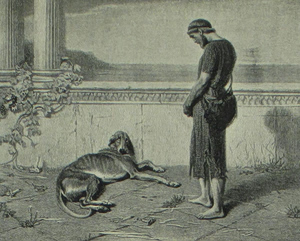
The Met notes that, like the Greek warrior depicted in another object in its collection, the papyrus is a reminder that the story of the Odyssey itself has traveled its own distinctive path through history.
Papyrus fragments such as the one at the Met preserve some of the oldest known versions of Homer’s Odyssey and Iliad, according to Ellen Wexler, who wrote about the subject in Smithsonian magazine in July 2026.
These copies largely resemble the version familiar to modern readers, Wexler explained, but contain small differences. Some include lines absent from later standardized versions, while others omit lines that appear in those texts.
None of these variations, however, significantly changes the plot.
A possible link to the Library of Alexandria
The papyrus was created around the same period that the Library of Alexandria was established.
It is possible that the book containing the fragment was once held at the famous library, which was founded at approximately the same time the copy was produced.
According to the Met’s catalog, the Library of Alexandria was “the most important repository of Homeric texts in the Hellenistic world” and “the first comprehensive public library ever created.”
The possibility of a connection to Alexandria adds another dimension to the fragment’s significance, although the text does not establish that the papyrus was actually held there.
More Odyssey-inspired objects at the Met
The papyrus is part of a wider Met display featuring objects inspired by Homer’s Odyssey.
The collection includes a clay tablet dating to about 460–450 B.C. depicting one of Athena’s final interventions on behalf of Odysseus, as well as a clay vessel used to mix wine and water that shows Odysseus pursuing the goddess Circe.
Other objects include a fresco titled Polyphemus and Galatea in a Landscape and a carnelian scarab depicting the Trojan Horse, dating to approximately 500 B.C.
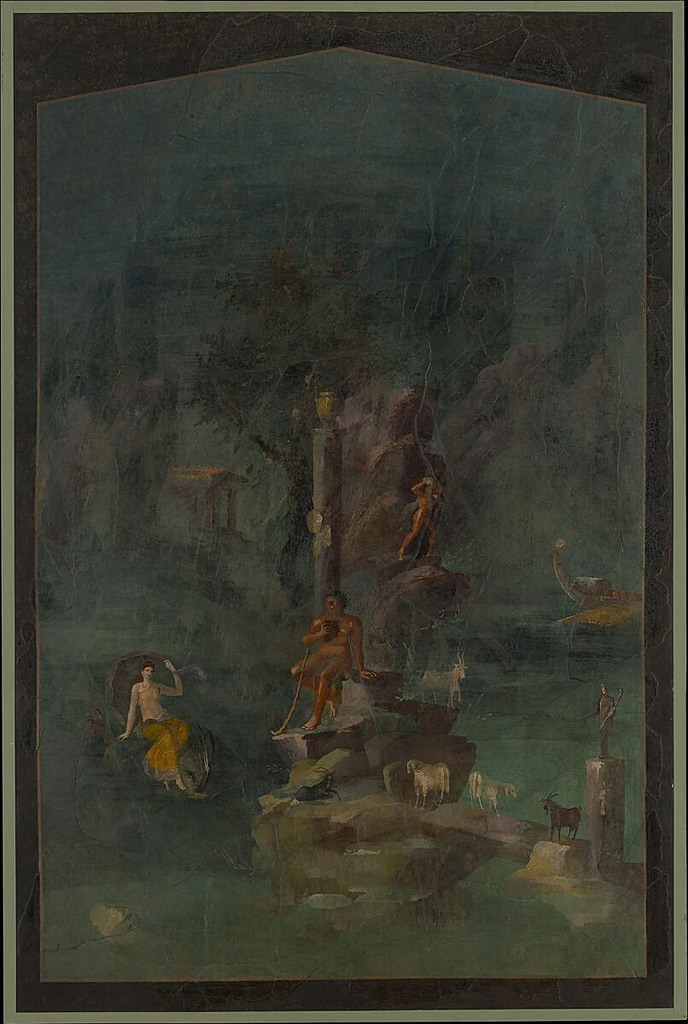
Papyrus fragment with lines from Homer’s Odyssey Early Hellenistic. Gift of Egypt Exploration Fund, 1909. Public Domain via The Metropolitan Museum of Art.
Together, the objects illustrate the enduring influence of the Odyssey while the ancient papyrus provides a tangible record of how the epic existed in different forms long before the standardized text reached modern readers.