 Μake us preferred on Google
SÃO PAULO—President Luiz Inácio Lula da Silva , a defining figure of the Latin American left, has won over Brazilians for decades. To win Sunday, he must rekindle the magnetic hold he once had on voters who turned out in droves for his everyman appeal.
Days away from turning 81, da Silva is fighting what is likely his last presidential election, narrowly trailing Flávio Bolsonaro , son of former President Jair Bolsonaro , his bitter political rival. With few voters likely to switch sides ahead of Sunday’s divisive runoff, pollsters say, a fourth term now rests on mobilizing Brazilians who abstained from the first round of voting on Oct. 4.
Voting is compulsory for most people here, but some 33.4 million Brazilians—more than one in five voters—stayed home for that election, the highest abstention rate since 1998. Many Brazilians said they were so fed up with an election dominated by scandal, mudslinging and personal vendettas that they opted to pay the small fine levied for flouting electoral rules.
Da Silva trailed Bolsonaro by just 2.2 million votes in the first round, a gap he could close Sunday by winning over a fraction of those who stayed home. A Quaest poll last week suggested he has an edge among those who abstained or cast blank or invalid ballots, with 40% backing him against 36% for Bolsonaro.
But winning their support is one thing. Getting them to the polls is another.
History offers da Silva little encouragement. Since Brazil’s return to democracy, seven of nine presidential elections have required runoffs, all won by candidates who won the initial round. Abstention rose between rounds in six of those seven elections, with 2022 the lone exception, when it remained roughly stable.
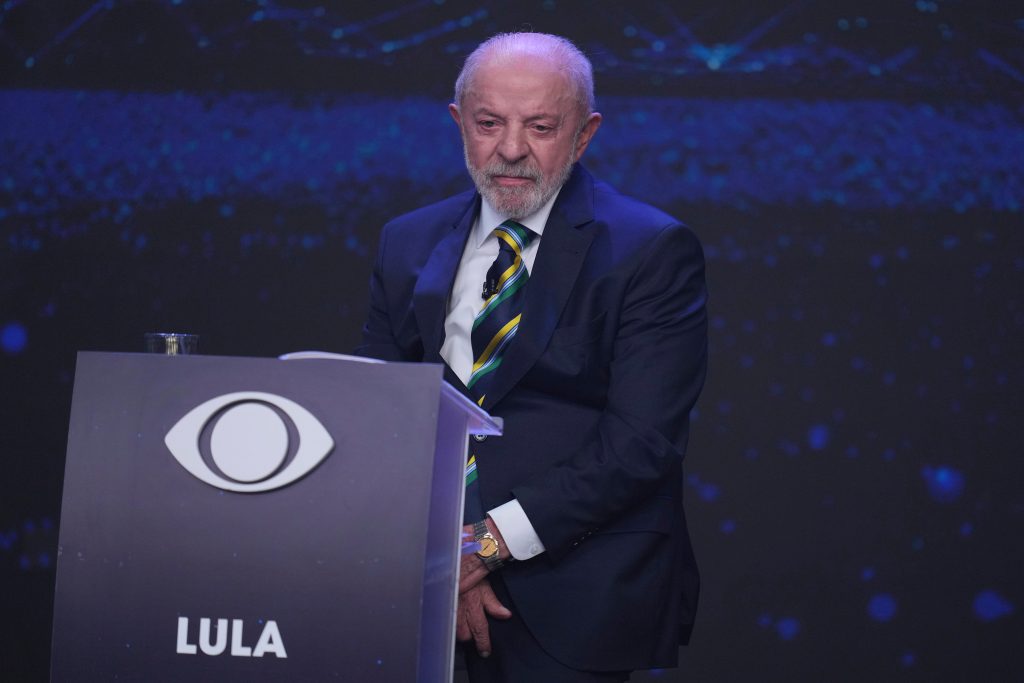
Brazilian President Luiz Inacio Lula da Silva, who is running for reelection, takes part in a televised presidential debate one week before the presidential runoff election in Sao Paulo, Brazil, Sunday, Oct. 18, 2026. (AP Photo/Andre Penner)
Enthusiasm for this election is particularly low among women. While 62% of men said they were very interested in the race, according to a recent BTG Pactual/Nexus poll, just 49% of women felt the same way.
“My God, this whole fight is unbearable,” said Paula Moraes, an administrative assistant from São Paulo.
She left her family’s WhatsApp group this week after relatives began attacking one another over their political allegiances. The feud is all the more exasperating, she said, because “Lula and Bolsonaro are equally bad.”
For all their ideological differences, da Silva and Bolsonaro have come to represent, for many voters, the same tiresome political spectacle that has played out for years.
Da Silva was jailed in 2018 on corruption convictions later annulled, while his son now faces separate graft allegations. He denies wrongdoing. Flávio’s father, Jair, is under house arrest for plotting to overturn the 2022 presidential election da Silva won. Flávio himself has faced questions over his efforts to secure financing for a film about his father from a banker at the center of a major fraud scandal. He also denies wrongdoing.
While the election has been cast as a showdown between left and right, both candidates have embraced the same populist measures in recent weeks, promising more benefits for the poor and a shorter working week.
“Two phonies,” said Felipe Moura Brasil, an author and political commentator, of the first televised debate between the two candidates last Sunday. “Each trying to clean himself in the other’s dirt.” As the candidates circled each other onstage, da Silva called Bolsonaro a liar and a thug, while his rival sniped back by suggesting the president might steal his wallet.
Brazil has long sought to promote voting, making it mandatory in 1932, introducing electronic balloting in 1996 and offering free public transportation on election day.
Yet abstention has risen in the first round of every presidential election since 2006, from 16.8% that year to 21.1% earlier this month. Illness and practical obstacles keep some voters at home. But political scientists say growing disillusionment—particularly with da Silva, first elected to the presidency in 2002—is also driving absenteeism.
In the first round, 21.3% of voters in the poorest voting areas where da Silva draws much of his support stayed home, compared with 20.3% in the wealthiest, electoral data show.
In Brazil, those who miss an election without justifying their absence face a fine of less than $1. Unpaid penalties can prevent them from obtaining a passport or voting. Last year, electoral authorities struck some five million people from the rolls for missing three consecutive elections without providing an excuse or paying a fine.
Turnout has fallen in countries from Britain and Italy to Japan and South Africa. Globally, the share of voting-age adults casting ballots fell from 65% in 2008 to 56% in 2023, according to International IDEA, a democracy watchdog. Bitter political battles amplified by social media can energize loyal supporters but also deepen polarization, erode trust and fuel voter apathy worldwide, IDEA said.
In Brazil, da Silva, who first took office in 2003, faces the added burden of incumbency.
For voters disillusioned with politics, casting a ballot to preserve the status quo can be a difficult sell, political scientists said. Meanwhile, Bolsonaro has benefited from a broader shift to the right across South America, where conservative leaders have swept to power amid fears over violent crime and anger over economic hardships.
In a final scramble for votes as polls have tightened in recent days—with some now showing a statistical tie—da Silva is targeting Brazilians over the age of 70. Voting is optional for this group, and nearly half stayed home in the first round.
“If I’m 80 and I’m here jumping around and running for president, why would a 70-year-old say, ‘Oh, I don’t need to vote?’ ” da Silva asked at a recent rally. “Get off your backside and go vote, my friend. Brazil needs you.”
His supporters have also embraced a nonpartisan social-media campaign called “Vovó Vota,” or “Grandma Votes,” which encourages young people to take their grandparents to vote.
Many older Brazilians lived through the military dictatorship, when Jair Bolsonaro served as an army captain, and remember da Silva fondly as a union leader who challenged the regime, long before corruption controversies tarnished his moral standing.
“It is my right and, above all, my duty,” said Zita de Moura Leal, 74, a legislative consultant and public servant, who said she planned to vote for da Silva to ensure “the continuity of democracy in Brazil.”
Write to Samantha Pearson at samantha.pearson@wsj.com