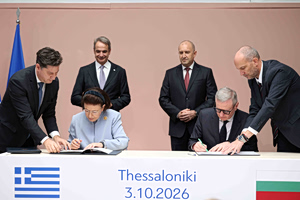
The main reactions to the recent Memorandum of Understanding signed by the culture ministers of Greece and Bulgaria have come from the opposition, from members of the archaeological community, and from part of the Church. The memorandum was ratified on Saturday, October 3, at an official ceremony at the Museum of Byzantine Culture in Thessaloniki, in the presence of the two prime ministers, Kyriakos Mitsotakis and Rumen Radev.
The disagreement and criticism focus, among other things, on the fact that the repatriation of 48 historic relics, looted from Greek churches and monasteries in 1917 during World War I, represents a valuable but small ecclesiastical treasure. At the same time, thousands of Byzantine manuscripts and priceless relics were left out of the agreement. These remain in Sofia, in violation of international treaties that require the return of cultural property acquired as spoils of war.
A Fair Exchange?
As those opposed to the agreement point out, Greece handed Bulgaria a “disproportionately high price”: a historic relic of enormous national, geopolitical, and symbolic value for its neighbors. These are the remains of Tsar Samuel, discovered in 1965 in the Basilica of Agios Achilleios on Mikri Prespa.
Bulgarians consider Tsar Samuel (997-1014 AD) an emblematic figure of their historical identity, a national hero who dedicated his life to defending Bulgarian independence against the Byzantine Empire. Samuel’s story is tied to one of the most dramatic chapters of their past, when Basil II (known as the Bulgar-Slayer), the victor of the Battle of Kleidion (1014 AD), ordered the blinding of thousands of Bulgarian soldiers. According to the sources, this ultimately led to Samuel’s death from a heart attack a few months later.
International Law and the Next Negotiations
In response to criticism that Greece gave up its strongest bargaining chip too early, the government points to a comprehensive long-term plan, starting with the protocol for receiving the 48 church relics. In other words, the diplomatic pragmatism of a gradual approach.
Kyriakos Mitsotakis made this point in his speech in front of his Bulgarian counterpart at the Thessaloniki ceremony, as did Culture Minister Lina Mendoni at the signing of the Memorandum on September 29. Both stressed that the initial agreement will be followed by more.
Specifically, it was stated that “the two sides agreed to continue negotiations to identify historical objects of mutual interest that were not included in the current agreement and to include them in a follow-up agreement.” It is also unclear what other finds of great importance to the Bulgarian side were left out of this agreement, possibly, though without official confirmation, Samuel’s tunic.
At the center of the critics’ case is the argument that Greece handed over the finds of a legal Greek excavation in order to recover relics that were taken by force. It is a fact that for decades, despite what international law provides and what is self-evident, Greece has faced an uncompromising Bulgarian stance on its request for the return of its looted treasures. Bulgaria’s explicit legal obligation to return these cultural treasures without conditions (as set out in the Treaty of Neuilly in 1919) has remained a dead letter.
Holy Synod: “An Important Agreement”
Those who welcome the agreement point out that this act of goodwill on Greece’s part resolves a long-standing diplomatic issue and builds an axis of strategic and political cooperation in the Balkans.
Along the same lines, the Holy Synod said in a statement that it welcomed “with particular satisfaction the important agreement for the return of the relics to our country after more than a century.” The Holy Metropolis of Serres and Nigrita also responded positively, describing it as a “particularly important event for the local church and the people of Serres.”
Reactions From Metropolises and the Association of Greek Archaeologists “Eos”
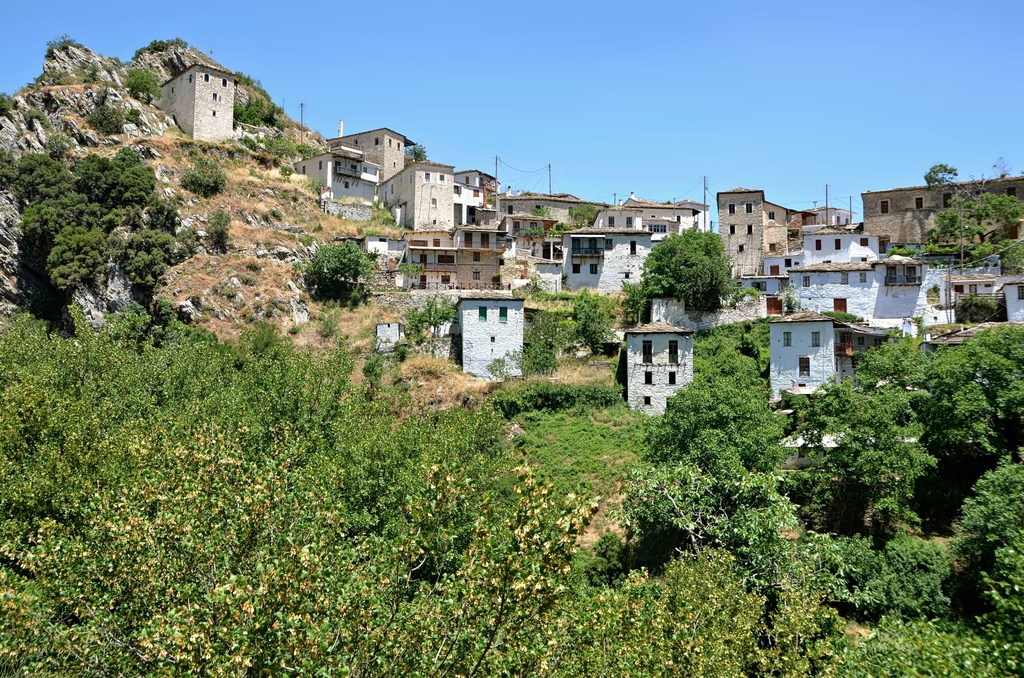
On the other hand, Metropolitan Dorotheos of Drama was cautious. In a letter to Culture Minister Lina Mendoni, he said he had not been informed about the talks and expressed serious reservations about Sofia’s assurances and about “the benefit we as Greece gain from the agreement, when the sacred relics stolen from the Holy Monastery of Eikosifoinissa alone number 800 and the manuscripts 430.” The Metropolis of Xanthi also reacted negatively, calling for the repatriation of relics looted from local monasteries “outside any logic of exchange.”
The Association of Greek Archaeologists also took a strong stance, speaking among other things of a process of “secret diplomacy” and “political exploitation” by both sides involved. It pointed out that “it is rather unlikely that the Bulgarian side considers the 48 objects to be of equal importance to the ‘bones of Samuel.'”
The Parthenon Marbles: A Worthy Parallel
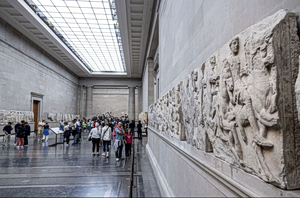
It is worth noting that The Guardian, in an article on the agreement between Greece and Bulgaria, stated, in its headline no less, that “Greece returns priceless relics and suggests the UK follow its example on the Parthenon Sculptures.” The article noted that the Greek prime minister hopes that handing Tsar Samuel’s remains over to Bulgaria will convince Britain that the time has come for “truth, reason, justice, and morality.”
Concerning the Parthenon Marbles, Mitsotakis stressed that Greece’s campaign is neither driven by a vague national claim nor a challenge to the role of museums around the world. He said the same principle behind the Greek-Bulgarian deal, the integrity of a monument, underpins Greece’s efforts to reunite the sculptures, describing the Parthenon as a universal monument that remains violently dismembered. He repeated that Greece will not accept any arrangement that implies recognition of foreign sovereignty or the borrowing of its own treasures.
The Guardian also recalled that the sculptures were removed from the Parthenon in the early 19th century on the orders of Lord Elgin, then Britain’s ambassador to the Ottoman Empire, and were acquired by the British Museum in 1816, where they have been on display ever since.