 Μake us preferred on Google
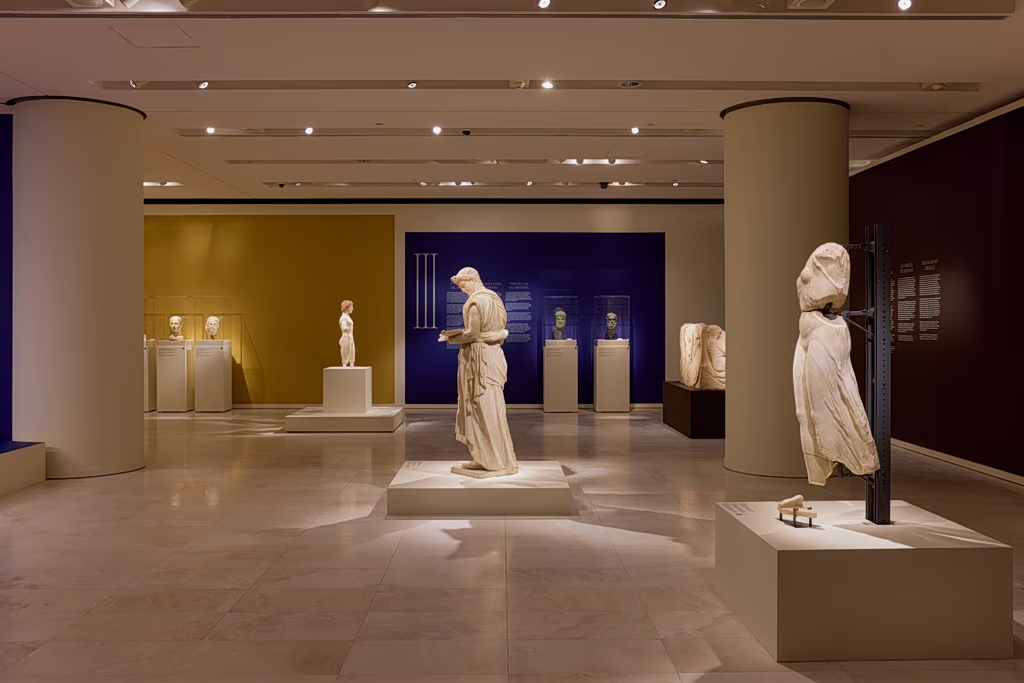
 Nereids riding Tritons with dolphins at their feet, and Aurai whose garments have become billowing sails filled by favorable winds, have flooded the temporary exhibition hall of the Acropolis Museum. Across its blue expanse, whether Adriatic or Mediterranean, they share the space not only with a stern Kouros in Parian marble, but also with one of the daughters of Niobe, desperately trying to flee the arrows of Artemis.
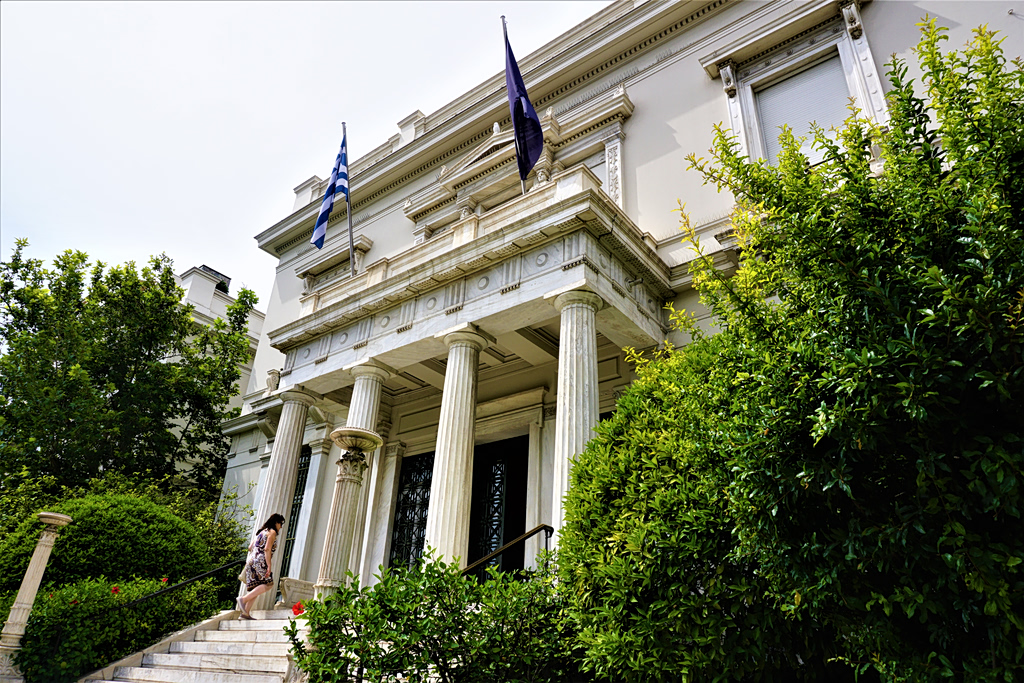
These outstanding sculptures are just a few of the protagonists in the new temporary exhibition “Inspiration: Ancient Greek Art in Italy,” which opened yesterday at the Acropolis Museum. The 38 exhibits, comprising 33 antiquities and five modern paintings, come from 22 Italian museums, and several of them are traveling outside Italy’s borders for the very first time.
Seven Chapters
The exhibition’s goal, as the museum’s General Director Nikos Stampolidis explains, is to highlight the journey of ancient Greek art in Italy as a complex process of multilayered cultural exchange. Stampolidis co-curated the show with Alfonsina Russo, head of Italy’s cultural heritage valorization directorate.
The result is a collection of singular antiquities gathered on the Acropolis Museum’s ground floor, works one would otherwise need to visit many different Italian cities to see. The objects breathe freely, inviting visitors to uncover the many hidden stories they carry, making the exhibition’s seven sections feel almost invisible as the eye lingers on what clay, bronze, or marble has to whisper, and on the stories of pieces that changed hands through trade or colonization, vanished to the seabed, were looted, or were reproduced in local workshops.
Beyond the sculptures floating on the sea-like base at the center of the hall, prompting gasps of surprise from visitors entering the room, who would not want to hear the story of the Kore of Vulci, dated to the 5th century BC? Unearthed just two years ago in the area of a monumental temple at Vulci, one of the most significant centers of ancient Etruria, it is making its first journey outside Italy. It is among the very few sculptures that allow us to understand what the eyes of ancient statues looked like, since both the paste that filled the iris and the bronze traces of the eyelashes are preserved.
Or the Ludovisi Throne, also traveling outside Italy for the first time? The birth of Aphrodite on its main face, with the Hours who accompany her standing on pebbles, is arresting, but the show is stolen by the young naked flute player depicted on a side panel, wearing nothing but a hair net. The bronze bearded head recovered from the seabed near Reggio provocatively displays its crimson lips to the onlooker. The small but powerful bronze Zeus of Ugento seems to be raising the thunderbolt in his right hand to hurl it, but what exactly was he holding in his left? An eagle, perhaps, now lost, with only the trace of its tail remaining. The iconic Euphronios krater, returning to Athens for a second visit since its repatriation from the United States to Italy, depicts a scene from the Iliad: the moment when Hypnos and Thanatos lift the body of the fallen Sarpedon in the presence of Hermes. A bronze hydria from the 5th century BC reveals its identity through an inscription on its rim, confirming it was a prize at contests held at the sanctuary of Hera in Argos. And at some later point in its life, a spout was fitted into a hole in its body.
The most observant visitors, moving among the works, will also have the opportunity to notice the differences between an Archaic Kouros, such as the one at the entrance dating from the 6th century BC with its carefully styled long hair, and a later Roman piece, such as the bronze torch-bearing Apollo from the 1st century BC, which tries to imitate the Archaic style through very fine, almost invisible curls. A subtlety that did not seem to concern the elite of Pompeii, who had converted it into a lamp stand adorning the dining room of a Roman villa.
Five paintings, including works by Giorgio and Andrea de Chirico (Alberto Savinio), provide the epilogue, tracing the influence of Greek antiquity on artistic production well into the early 20th century.