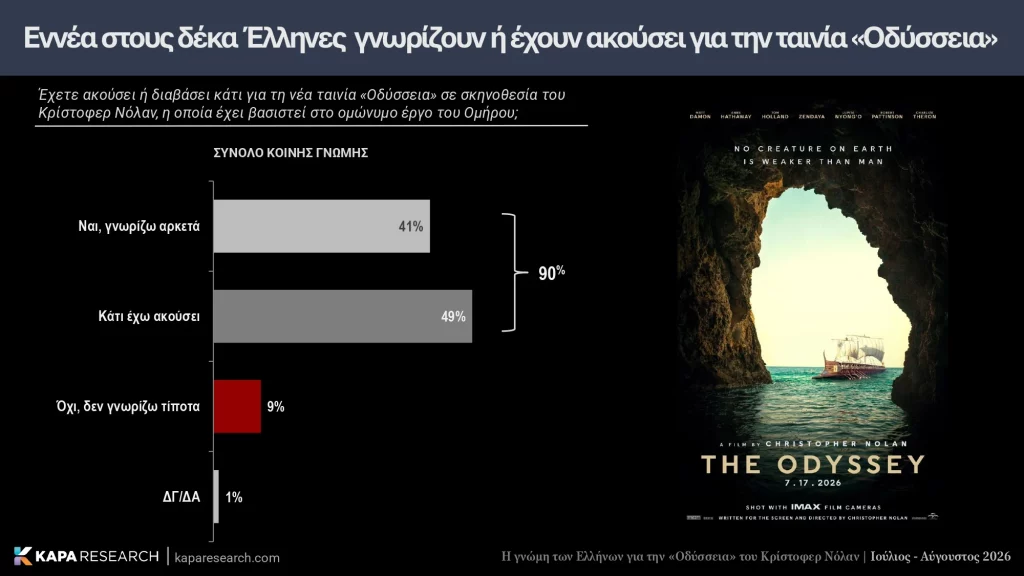
Public opinion in Greece appears to have embraced Christopher Nolan’s The Odyssey as both a major cinematic event and an opportunity to promote the country abroad, while remaining divided over how freely Hollywood should reinterpret one of the foundational works of Greek culture and Western civilization.
A new Kapa Research survey found that 90% of respondents in Greece are familiar with the blockbuster The Odyssey or have heard about it, while 48% have already taken part in discussions about it. Nolan’s involvement appears to have been a major factor in its appeal, with 64% of the general public expressing a positive view of the director and that figure rising to 90% among people who have seen the film.
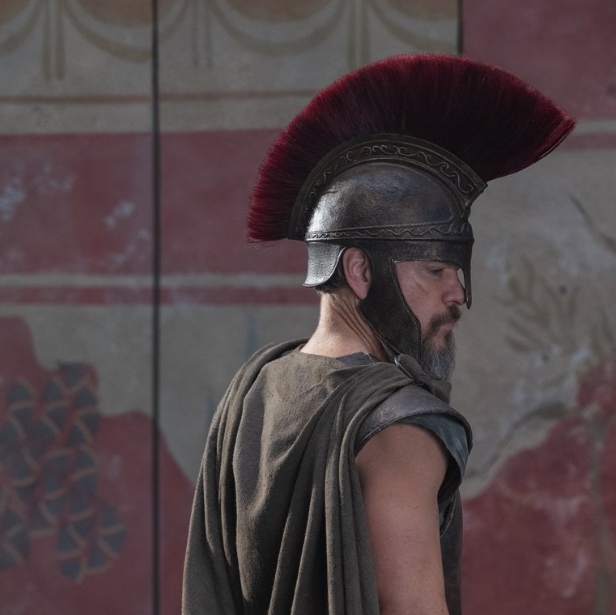
Among viewers, 71% rated the film positively, with satisfaction reported by 45% and enthusiasm by 18%. The survey also found that 79% believe the production promotes Greece internationally and 75% think it will help boost tourism.
The film has generated particular interest because of the scale of its production in the country. Nolan’s $250 million epic began shooting in Greece in March 2025, with locations including Pylos, Voidokilia Bay, Methoni Castle and Acrocorinth. The Greek state provided 6.5 million euros in public funding, while the production’s use of major Greek locations turned the country into a prominent part of the film’s global publicity.
The survey also points to a generational impact as some 72% of viewers said the film brought younger generations closer to ancient Greek literature, while 36% said Homer became a subject of family discussion and 31% compared the film with the original texts.
The artistic choices, however, remain a more complicated matter. Specifically, visual effects received the strongest rating, at 86%, followed by the performances of Matt Damon and Anne Hathaway at 85% and Nolan’s direction at 81%. The adaptation of Homer’s epic received the lowest rating, at 48%, suggesting that enthusiasm for the production does not necessarily translate into approval of its interpretation of the ancient text.
Conversely, the casting has been particularly contentious, given that Lupita Nyong’o’s portrayal of Helen of Troy has divided public opinion both in Greece and around the world. For the former, 46% of respondents in the poll expressed positive or neutral views; 46% negative. Among respondents who had seen the film, however, acceptance rose to 62%.
The casting controversy had begun well before the movie’s release, with criticism focusing on the absence of Greek actors in major roles and on perceived historical inaccuracies in costumes and production design.
The debate intensified in 2026, with critics, including Elon Musk, attacking Nolan’s casting choices and accusing the production of sidelining Greek cultural heritage. Nolan defended his approach, arguing that judging the film before audiences had seen the finished work was premature and that a filmmaker’s responsibility is to remain faithful to the source while offering a personal interpretation.
Despite the controversy, 57% of Greeks surveyed said they were receptive to freer adaptations of ancient history and mythology. Views remain more evenly divided, however, over whether artistic freedom should take precedence over fidelity to the original text.