 Μake us preferred on Google
Spain’s two main parties are running almost level ahead of the November 29 snap election, according to a new poll, as conservative leader Alberto Núñez Feijóo and Socialist Prime Minister Pedro Sánchez get ready for a one-on-one televised debate on Thursday night.
The survey, carried out for POLITICO by PF Global, puts Feijóo’s People’s Party (PP) in first place with 29.5% of the vote and Sánchez’s Socialists close behind at 27.2%. With a margin of error of 2.6 points, the gap is too small to call. The pollster interviewed 2,454 people between November 15 and 17.
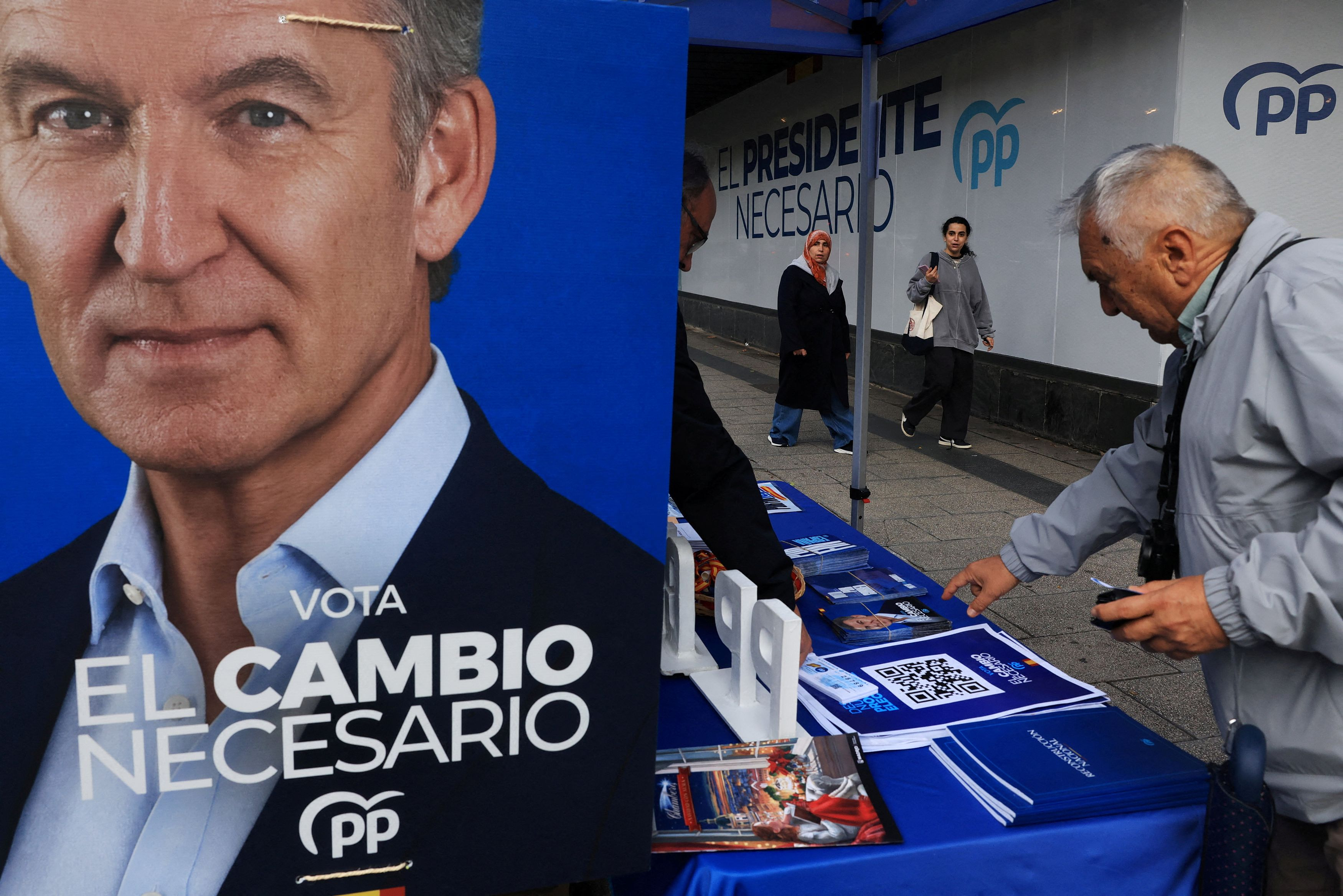
A man picks up an election campaign brochure of Spain’s opposition People’s Party (PP) leader and prime ministerial candidate Alberto Nunez Feijoo outside the party headquarters in Madrid, Spain, November 18, 2026. REUTERS/Susana Vera/File Photo
Vox Holds The Key
The far-right Vox party is a clear third at 19.6%, and its result gives a fuller sense of where the next government is likely to come from. Together, the PP and Vox would win almost half of the vote, leaving Feijóo the frontrunner to become prime minister.
Other recent polls point the same way. A daily poll by 40db for El Pais showed the Socialists rising to 30.3% from 29.9%, exceeding the 30% mark for the first time in that poll since the 2023 election, but it still found that the PP, on 31.5%, and Vox, on 18%, would together win more than 190 seats in the 350-seat lower house, a majority.
An NC Report poll for La Razón projected 201 to 205 seats for the PP and Vox combined, and 102 to 104 for the Socialists. The state-run CIS poll remained a major outlier, projecting 134 to 143 seats for the Socialists against 155 to 171 for the PP and Vox combined, suggesting Sánchez could retain power through a broad left-wing coalition.
The POLITICO poll also tracks how voters have moved since the last election in 2023. One in five people who voted for the PP back then now say they will choose Vox, while one in 10 former Socialist voters say they are switching to the PP.
A Fractured Left
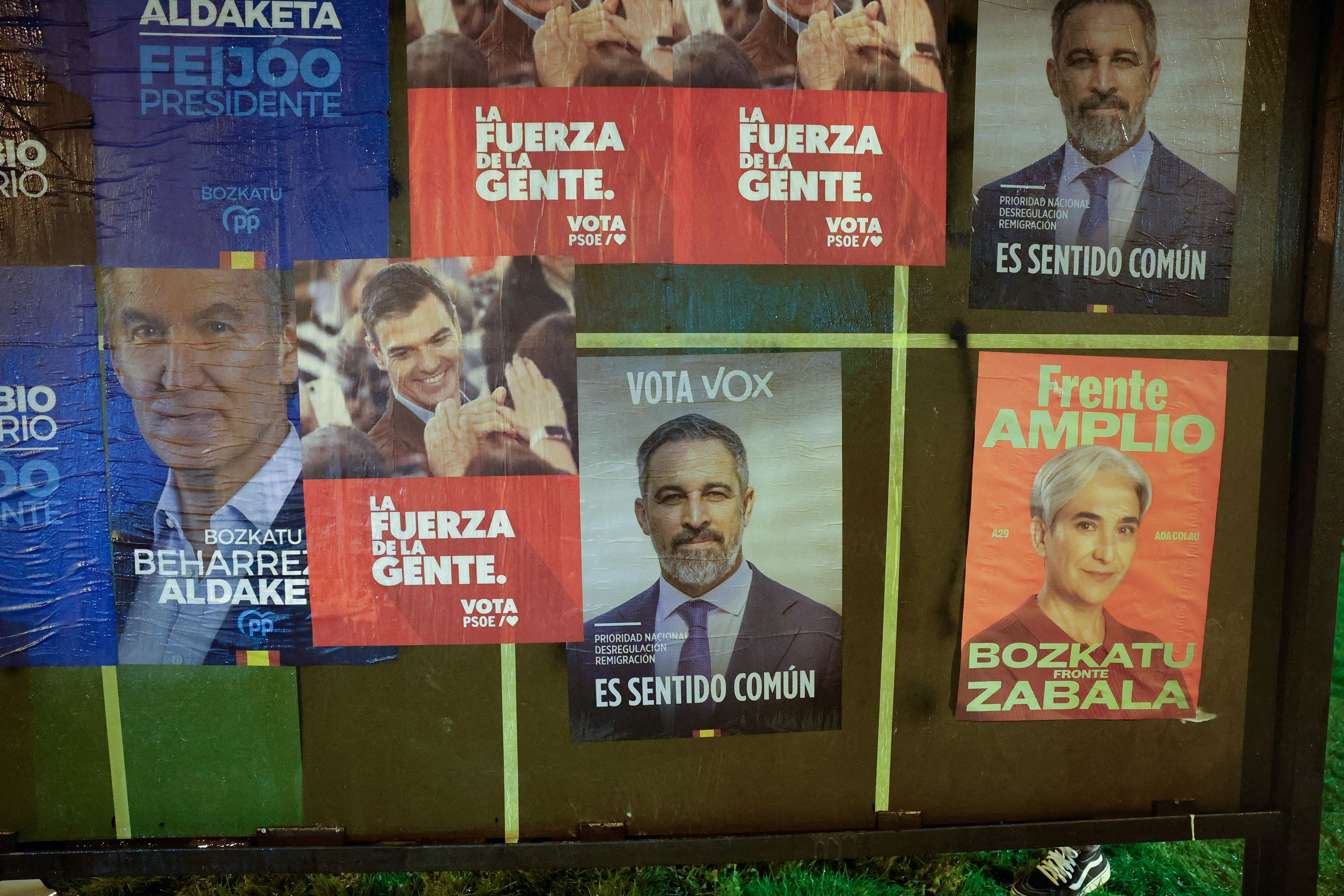
A major problem for the Socialists is the weakness of their partners on the left. Sumar, the junior member of Sánchez’s coalition government for the past three years, has relaunched itself as Frente Amplio, or Broad Front, in a bid to revive its support. The rebrand has not paid off. Podemos declined to join the new alliance, and the poll has Frente Amplio at just 5.9% and Podemos at 2.2%. Combined, that is well below the 12.3% Sumar won in 2023.
The left could still come together in a different way, by consolidating behind the Socialists. According to the survey, 29% of Frente Amplio and Podemos supporters are prepared to vote for Sánchez to keep Vox out of government. But that tactical shift also shrinks the left’s total presence in parliament, making it harder for Sánchez to assemble the partners he would need to stay in power. About 30% of Socialist voters say their main reason for backing him is to block Vox leader Santiago Abascal.
A Spending Push By Decree
As it fights to close the gap, Sánchez’s government has approved more than €1.5 billion in new welfare measures over the past month, Reuters reported, with more planned before election day. According to Reuters’ tally of costs published on the government’s website, the package includes about €820 million for vulnerable families, €221 million for victims of disasters such as floods and last month’s deadly train crash, and around €426 million in housing subsidies. Housing is voters’ top concern, and Sánchez has promised to tackle it head-on if he wins a majority.

Investigators work at the site of the collision where two high-speed trains crashed between the towns of Mora and Orgaz, in Urda, near Toledo, Spain, October 30, 2026. REUTERS/Susana Vera
Because the government has lacked the votes to pass a new budget since 2023, it has increasingly relied on emergency decrees, which Congress can block but cannot reverse retroactively. Since taking office in June 2018, Sánchez’s cabinets have issued more such decrees than any prime minister since Spain’s transition to democracy, according to the analysis outlet Electomania. With parliament dissolved since October 5, the latest measures need only the approval of a 69-member standing committee, where the balance of seats is slightly more favorable to the ruling coalition than in the full Congress.
Political analyst Eduardo Bayon said the spending could help mobilize voters who might otherwise stay home, by reinforcing the Socialists’ image as the party that protects the vulnerable. Sánchez defended the measures in a television interview, arguing that his government had shown economic growth and redistribution can go hand in hand.
Economists are less convinced. Higher tax revenue and EU funds have so far allowed the government to pay for the measures without adding to public debt in the short term. But Diego Martínez López of the think tank Fedea warned that multiyear commitments made to win votes now could create problems for the next government, effectively putting off the bill. Spain’s fiscal watchdog, AIReF, and other economists have criticized the lack of transparency of spending by decree, which is much harder to track than regular budget updates. AIReF has also warned that, although Spain’s debt-to-GDP ratio has fallen in recent years, higher spending threatens the spending limits agreed with the EU and Spain’s own domestic caps.
Some of the measures have been paid for from Spain’s contingency fund, a reserve of €3.96 billion meant for unforeseen emergencies. AIReF found that 71% of last year’s contingency spending went on predictable, recurring costs, such as peacekeeping missions and ordinary welfare payments, that should be covered by the regular budget. Feijóo has promised a full audit of the public finances if he wins, saying repeatedly that he does not trust the government’s figures. Spain’s finance ministry did not respond to Reuters’ request for comment.
A Deeply Personal Campaign
The POLITICO poll shows how much the race has turned into a contest over individual leaders. Just as left-wing voters are mobilizing against Vox and Abascal, voters on the right are rallying against Sánchez. Around 30% of all respondents said removing the prime minister was their top goal, a figure that rises to 59% among PP and Vox supporters.
Doubts About The Count
The survey also found widespread distrust of the vote count, especially on the right. Some 65% of Vox voters and 34% of PP voters said they did not trust it, compared with only 15% of Socialist voters. Suspicion runs even higher when it comes to postal voting.
Right-leaning voters also broadly oppose the so-called grandchildren’s law, which lets descendants of Spanish exiles and emigrants obtain citizenship and therefore the right to vote. The law is opposed by 63% of Vox supporters and 56% of PP supporters.