 Μake us preferred on Google
Meteorologists are monitoring an unusually early disruption of the Arctic polar vortex, a development that could influence winter weather across Europe by increasing the chances of Arctic air moving south.
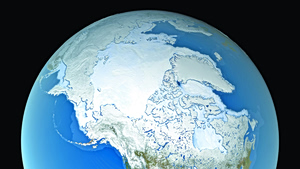
The polar vortex is a vast area of low pressure and extremely cold winds that circulates around Earth’s poles. Located in the stratosphere, at an altitude of approximately 10 to 50 kilometers (6 to 31 miles), it acts as a barrier that generally keeps frigid air contained within polar regions.
When the vortex remains strong and compact, cold air stays concentrated around the North Pole. This typically contributes to milder winter conditions in Europe and North America.
However, when the vortex weakens, shifts position or splits apart, that barrier can break down. The resulting changes can allow waves of polar air to move farther south, potentially triggering severe cold spells and snowfall. Such disruptions are often associated with sudden stratospheric warming.
An unusually early disruption
Recent meteorological data from the National Observatory of Athens and international organizations indicate that the polar vortex is weakening and becoming disrupted unusually early in the season.
Meteorologists are describing the development as one of the earliest disruptions recorded in recent decades. This raises the likelihood of cold air masses moving toward Europe, although it does not determine exactly where or when they will arrive.
What could this mean for Greece?
The weakening of the polar vortex does not automatically mean Greece will experience a severe winter or widespread snowfall.
The movement of cold air over the coming weeks will depend largely on the position of high- and low-pressure systems across Europe and the Mediterranean, as well as their interaction with other global climate phenomena, including El Niño.
If the right atmospheric conditions develop, with high-pressure systems strengthening over Northern Europe, cold air masses could move toward the Balkans and potentially reach Greece.
Recent snowfall and low temperatures recorded in Greece are consistent with the kinds of weather effects associated with polar vortex disruptions. However, they do not establish that the country will necessarily face further snow or freezing conditions.
Meteorologists are continuing to monitor the vortex’s behavior to improve forecasts and help residents prepare for possible changes in weather patterns.
A disruption can therefore increase the chances of cold air moving toward lower latitudes, but it does not guarantee that Greece will experience snowfall or frost.