The Greece-Cyprus electricity interconnection project is entering a new phase, with France assuming a central role in the development of the Great Sea Interconnector (GSI) through a major investment agreement announced by the Greek government.
The agreement, scheduled to be signed at 4:30 p.m. local time at the Maximos Mansion—the office of Greek Prime Minister Kyriakos Mitsotakis—will make French infrastructure investment fund Meridiam the majority shareholder of Great Sea Interconnector (GSI), the company established to develop the Greece-Cyprus electricity interconnection.
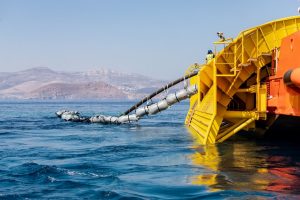
In addition, a trilateral agreement will be signed between Greece’s Independent Power Transmission Operator (IPTO), GSI, and French cable manufacturer Nexans covering seabed survey work required for the project’s implementation.
According to the report, the developments give France a leading role in the nationally significant project, helping move it beyond previous geopolitical challenges.
A 14-Year Project Linking Greece, Cyprus, and Israel
The history of the electricity interconnection dates back 14 years. Initially conceived as a link between Greece and Cyprus, the project was later expanded to include Israel.
The planned network will span 1,208 kilometers (751 miles) of submarine and underground power cables. Of that total, 898 kilometers (558 miles) will connect Crete and Cyprus.
The interconnector will have a transmission capacity of 1,000 megawatts (MW), operate at 500 kilovolts (kV), and reach maximum cable-laying depths of up to 3,000 meters (9,843 feet). The project’s estimated cost stands at €1.9 billion.
Strategic and Economic Importance
According to the report, the project carries significant geopolitical, energy, and economic importance.
For Cyprus, the interconnection will end the island’s energy isolation, giving practical effect to its integration into the European Union’s electricity network.
The report also states that Greece and Cyprus will strengthen their geopolitical position in a region facing challenges from Turkey and other sources of instability in the Eastern Mediterranean, while Israel will gain an alternative source of electricity supply.
The project is also expected to deliver substantial economic and social benefits for Cyprus, whose electricity generation currently relies exclusively on diesel-powered plants.
According to the estimates cited, the project is expected to generate a total net social benefit of €6 billion, compared with an estimated construction cost of €1.9 billion. For a typical household consuming 5,000 kilowatt-hours (kWh) of electricity annually, it is projected to reduce electricity bills by more than €400 per year from the first year of operation.