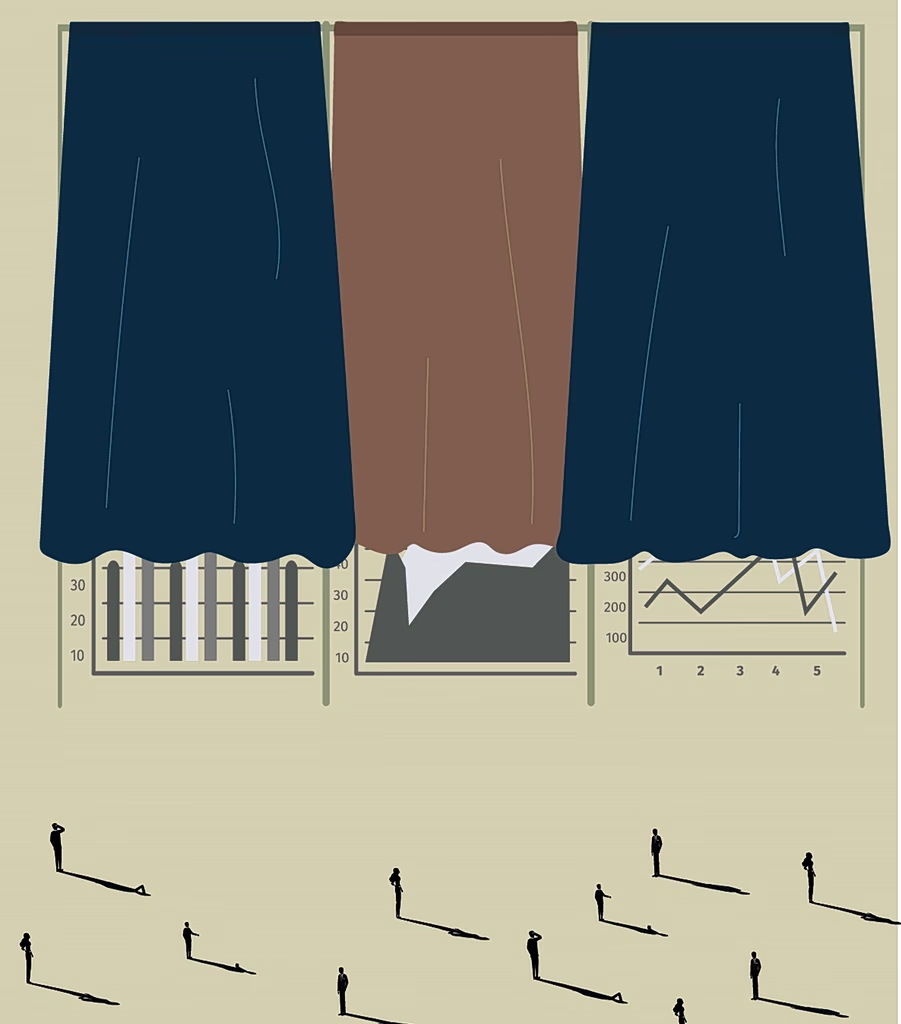
The unpredictability of the voter before the ballot box can only be compared to the fear of the goalkeeper facing a penalty kick.
Let us say, paraphrasing one of the most famous lines born on football pitches, that for seven years now “elections have been a game played by around thirty parties, and in the end Mitsotakis wins.” Except that not all victories are the same. Certainly not in football, where a team—as will happen in this World Cup beginning in a few days—can go home having won its final match.
The ball, or at least what is more poetically defined as the “magic of football,” is full of adjectives and descriptions. A victory can be crushing, sweeping, insignificant, difficult or easy, fair or unfair. It can be a “comeback victory” or an “upset victory.” Victory has a form, a shape, and a dimension.
And, as with all games that are not played only between two sides, it is by no means certain that “the winner takes it all.” Tennis with its net is one thing. Football with its goalposts and nets is another. And elections with their ballot box are something else entirely.
Especially these elections, even if neither triumphs nor surprises are expected. Or rather, precisely because of that.
Almost everyone assumes that Mitsotakis will win (almost, because one must be accurate: in the polling question regarding the perception of who will win, there is a highly optimistic 0.9% who believe that in the end SYRIZA—or whatever remains of it along with its scraps—will win, a 0.2% who are betting everything on Stefanos Kasselakis’ Democrats, and a 0.8% who believe that the Spartans party will experience a new epic in some electoral Thermopylae).
But among all the others—the almost everyone—no one knows what form, what shape, and what dimension Kyriakos Mitsotakis’ victory will have.
Electoral behavior is individual and, as such, unpredictable. Each person standing before the ballot box, inside the private space of the voting booth, is simply themselves. The vote is the product of a personal process of reasoning, from which emotion and one’s individual way of perceiving things are never absent.
You encounter, for example, someone who tells you: “In the previous elections I voted for Velopoulos, but now I will vote for Tsipras, whom I have never voted for before.”
Another, a New Left voter in the European elections, explains to you: “Since there is no strong socialist party and I don’t see anything else, I will probably vote for Mitsotakis.”
And then there is the right-wing voter who, believing that Mitsotakis has altered the much-discussed “soul of the political faction,” searches for and recognizes the ideological purity he is missing in the Communist Party of Greece.
Or the centrist voter who, during the last seven years, moved from Simitis’ PASOK to Mitsotakis’ New Democracy, but now hesitates because the story of the wiretapping scandal does not sit well with him.
All of this does not mean that “the best argument against democracy is a five-minute conversation with the average voter,” as Winston Churchill supposedly said, with the humor nature had gifted him and with the privilege history offered him of embodying the liberal world during wartime.
It means that the electoral performance of the winner can be unexpected in any direction. It may confirm Mitsotakis’ dominance, even though he does not achieve an outright majority. Or it may prove to be “Pyrrhic.”
Speaking in World Cup terms, the Hellenic Republic is sufficiently protected so that the election result is not determined by some “Hand of God.” The match, therefore, “will be decided in the details,” as our sports colleagues say.
It may take one or two extra times—and, who knows, perhaps even penalties.
Who will win in the end?
Since “the match is still in progress,” it would be worth taking a closer look at the (very) fine print of the opinion polls. That is where the “picture of the match” is hidden, beyond the obvious.