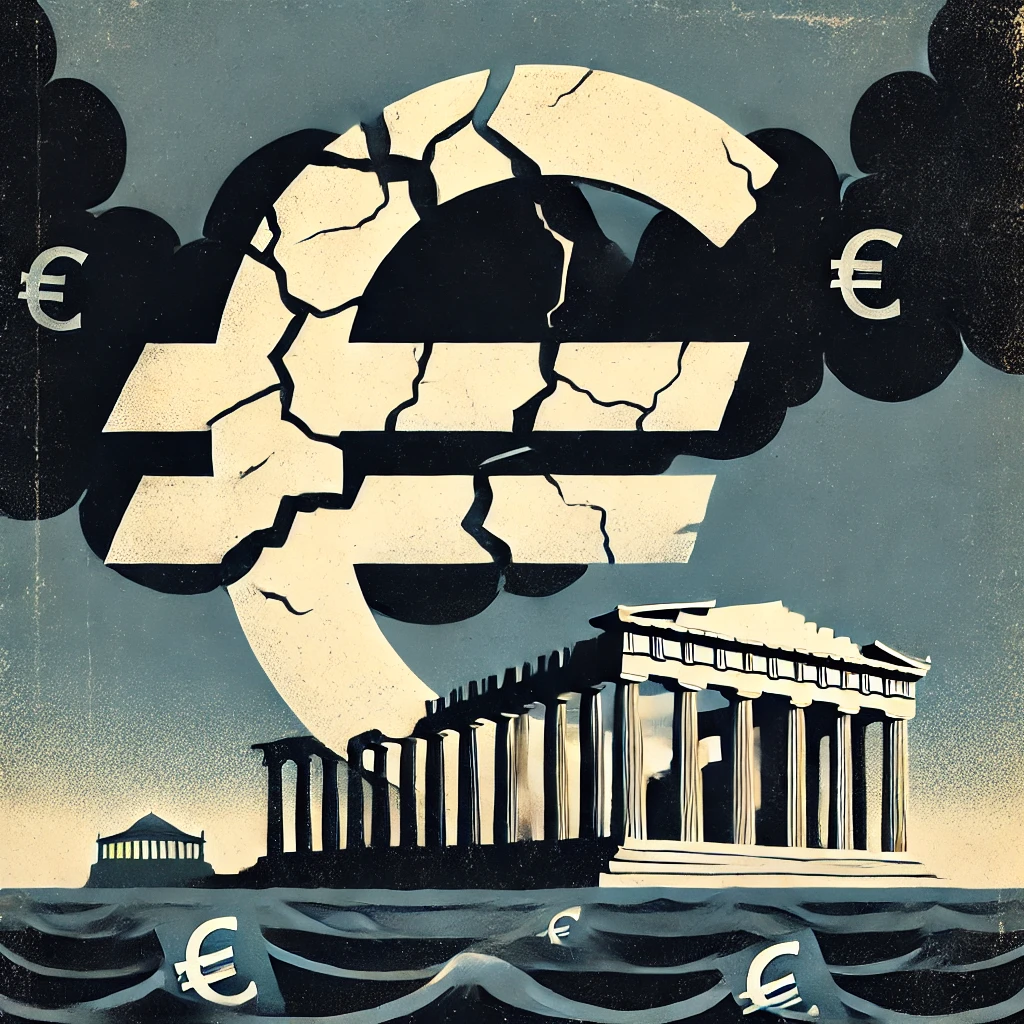
In early December 2008, a snippet of information was published in the small print of the Greek dailies which, with the benefit of hindsight, looks prophetic. Namely, that the European Commission had approached the European Central Bank in confidence with a question: what would happen “should a Eurozone member state face difficulties refinancing their debt”. The Bank’s response was that “nothing can be done”. That the treaties forbid it. The message reached Athens, too. “Don’t look to us for anything; you’ll have to ask the IMF”!
The information was conveyed to the Hellenic Parliament a few days later, during the budget debate, by former Prime Minister Costas Simitis. Needless to say, the government of the day dismissed the warning with disparaging comments. “The Greek economy is shielded by the reforms of recent years”, Kostas Karamanlis assured him. And the Opposition preferred not to enter into ominous discussions that would only upset the voters.
The clouds, of course, were beginning to gather. In December 2008, Greek spreads had climbed from 20 basis points, where they had been at the end of 2003, to 210. Come the New Year, S&P announced the first downgrade of Greece’s credit rating. The “Greek risk” (together with the Italian risk) became the primary topic of discussion from London to Frankfurt. Until, in mid-February 2009, the German Finance Minister at the time, the Social Democrat Peer Steinbrück, issued an unexpected statement. Whatever the European treaties say, he said, if a euro country faces a debt problem, the eurozone will find a way to help. The very next day, Greek 10-year bond spreads fell sharply. Greece had bought itself some reaction time.
But it didn’t react. Its borrowing accelerated and any measures were postponed for later, because there were European elections coming up in June and the ruling party simply “had” to win. It lost. Within a year, in May 2010, the Troika had already landed on our shores. What followed was so close to the bone, we probably don’t need anyone to remind us of the details.
But the time has come to look back at the great adventure of bankruptcy and what led up to it. Partly because it’s the anniversary of the referendum today, and partly in the light of Angela Merkel’s confessions in Athens, the discourse has shifted back to the past. It’s just that, if we are going to remember “our own troubles”, let’s recall them properly.
There are at least two gaps in Mrs. Merkel’s narrative, for instance. First, when she says she only became aware of the Greek problem in 2010. And was taken by surprise. That’s hard to swallow, when we know Greece has been a hot topic in Berlin and Frankfurt from late 2008 on. Indeed, she even confessed to the Financial Times in April 2009 that Greece had been her greatest anxiety at the time.
The second is her insistence that she couldn’t have done anything better for the Greek crisis in 2010, even if the Americans had put her under incredible pressure, since the treaties (and the German Constitutional Court) would not allow her to disburse money for Greece. It’s as if she hadn’t heard her own finance minister, Steinbrook, a few months earlier, when he said something very like what Mario Draghi would say three years later, in 2012: “whatever it takes”—with similar results.
But two crucial—and, as it would turn out, fateful—changes had taken place in the meantime. The first in Germany. Mrs. Merkel had formed a new coalition after the September 2009 elections, with Wolfgang Schaeuble installed in the finance ministry. And the second in Greece. Which beat the other countries of the European South to the post and was the first to go bankrupt.
As has been said many times, if Ireland had been the first across the line, if it had been Taoiseach Brian Cowen rather than Prime Minister George Papandreou who had been the first to ask for help to deal with the impossibility of borrowing from the markets, everything would have been different. Ireland was a more fiscally virtuous country than Germany. Its fall could not be attributed to the “laziness” and “wastefulness” of the Irish. Europe would have been obliged from the start to address the crisis not as a “sin” committed by one country, but as a systemic problem of the Euro. But while Ireland had, with broad support, been applying austerity measures since 2008 to pre-empt the disaster, Greece was still running at full pelt toward the precipice. And became the ideal culprit.
It had accumulated more debt in five years than in its entire history as a free state. It had shown surpassingly irresponsible fiscal management, was ensnared in an archaic clientelistic political system, and had an over-bloated and under-productive public sector.
All of which gave Steinbrück’s successor, Wolfgang Schaeuble, the opportunity to impose the view that Europe showing solidarity for Greece would create a “moral hazard”. That the debt crisis was a national, Greek sin and that sinners should be made an example of before they could seek help and salvation.
Europe paid for that decision, but Greece paid a still steeper price. What Europe learned from the ordeal is an open question. But the key issue for us is what Greece learned from it, and how much it has changed. Well, the stench emanating from the agricultural funding scandal at the OPEKEPE seems to be crying out: a lot may have changed, but not the most crucial thing of all: Politics’ basic instinct continues to lead it to perpetually reproduce client networks which (it believes) secure it an archaic legitimacy through lawlessness.
Source: Ta Nea